Brisbane & South East Queensland
What a data cabling technician actually does when the van pulls up
Booking a data cabling technician is the easy part. Knowing what happens next usually isn't — who turns up, what they need from you, and how long they'll be under your roof or in your ceiling. This page walks through an actual visit, start to finish, so the day itself holds no surprises.
Work carried out by an ACMA registered cabler no. 42489 Installed to AS/CA S009:2020 One technician, every visit
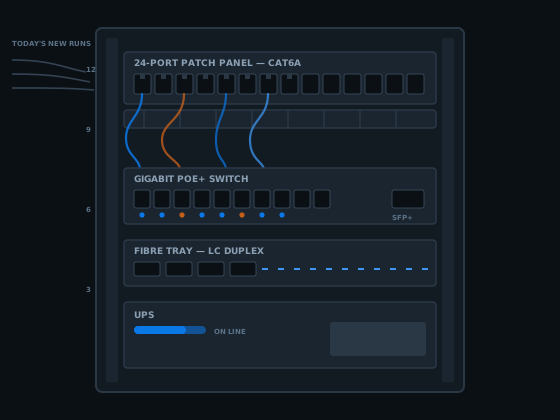
Most of what a data cabling technician does on site follows the same order regardless of the job: confirm the scope, check access, run and terminate the cable, test every link, and hand over paperwork instead of a promise. Two data points in a house and twenty in an office fit-out go through the identical sequence — only the number of trips and the size of the crew change.
Most people booking a data cabling technician have never had one on site before, so the same three questions come up every time: who's actually turning up, what do they need from me, and how long am I giving up a room for. This page answers all three in order. For the legal side of who may lawfully hold the registration, that's covered in full on the registered cabler Brisbane page — this one sticks to what actually happens on the day.
Who actually turns up: what a data cabling technician is
A data cabling technician working on anything that connects to a telecommunications network has to be a registered cabling provider, or be directly supervised at all times by one who takes full responsibility for the work. That's section 21 of the Telecommunications (Cabling Provider) Rules 2025, and it applies to a two-point house job exactly the same as a forty-point fit-out.
For most residential and small commercial jobs, one data cabling technician does the whole visit: the person who quoted the job, drove the van, and will be the one signing the compliance statement at the end. It isn't a call centre dispatching whoever's free — it's the same registration number on the quote and on the paperwork afterwards.
No electrical licence needed
Queensland doesn't require an electrical licence for this work — section 55(3) of the Electrical Safety Act 2002 (Qld) says so directly. The authority to be there comes from the federal cabling registration, not a sparky's ticket.
When there's a second person
On bigger jobs an offsider sometimes works alongside the registered technician. Under section 21(d) that person must be directly supervised at all times — present on site, not on the end of a phone.
Ask for the registration number if it isn't already on the quote. It's a fair question, and a data cabling technician who holds one will hand it over without blinking — checking it takes five minutes and is worth knowing how to do before you actually need it.
What a data cabling technician carries in the van
The stock in the van decides how much of the job gets finished in one visit. A data cabling technician who turns up without the right wall plate finish, patch panel spares or a working certifier is planning to come back — which is why the van gets checked against the quote before it leaves the depot, not worked out on your driveway.
Cable and connectors
Cat6 and Cat6A on reels, keystone jacks, wall plates in standard finishes, and enough patch leads to finish a rack without a second trip for one lead.
Termination and test gear
Punch-down tools, crimpers, a cable certifier for the permanent link testing every job needs, and a toner for tracing an existing run that isn't labelled.
Access and safety gear
Ladder, head torch, fish rods for a blocked wall cavity, dust sheets for the floor under a manhole, and the PPE a commercial site induction will ask about.
Arrival and the walk-through
The first part of any visit is a walk, not a drill. A data cabling technician arriving at a house or office starts by confirming the scope against the quote — how many points, roughly where, and whether anything's changed since the phone call or the site photos. Ten minutes here saves an afternoon of guessing later.
On a house, that walk covers where each outlet lands, whether the access is the roof, the subfloor or both, and what's in the way — stored boxes in the manhole, a wardrobe under the spot a point needs to come out. On a commercial site it's the same walk with a site contact instead of a homeowner, plus a look at where the comms room or patch panel actually is.
This is also when anything that's changed gets sorted — an extra point, a moved desk, a different wall than the one discussed on the phone. Small changes on the day are normal. Big ones, like doubling the point count, usually mean a revised quote before any cable comes off the reel.
The thing that actually decides the day
Roof cavity, subfloor and riser access
What a data cabling technician can do in a single visit comes down to access more than anything else, and Brisbane's housing stock varies a lot. A post-war brick veneer with a roof cavity is usually the easiest job in the book — cable drops down inside the wall cavity and comes out at a standard wall plate with no cutting beyond the plate itself.

Queenslanders on stumps flip that around: the roof might be harder to move through, but the subfloor gives a crawl-space route to almost anywhere in the house. Newer slab-on-ground estates are the trickier end — roof access only, sometimes a trussed roof with barely room to move, and no subfloor to fall back on if the roof route is blocked.
Commercial buildings add their own layer: a suspended ceiling with a plenum above it, a riser cupboard running between floors, or a high-rise with body corporate rules about booking the lift and working after hours. None of it stops the job — it changes how long it takes and whether one visit or several gets the points landed.
What to have ready before a data cabling technician arrives
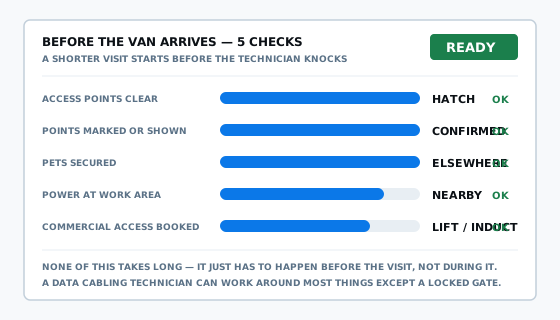
Most of what slows a visit down isn't the cabling — it's finding the manhole under a stack of boxes, or discovering the dog has strong opinions about strangers in the roof. None of the following takes long, and all of it turns a longer visit into a shorter one.
Clear the access points
A path to the manhole, the subfloor hatch or the riser cupboard, with nothing stacked underneath it. If a ladder needs to stand there, it needs floor space too.
Mark or describe each point
Know roughly where each outlet should land — a note, a photo with an X, or just being home to point at the wall works fine.
Secure pets
A friendly dog in a roof cavity is still a dog in a roof cavity. Somewhere else for the visit keeps everyone, technician included, relaxed.
Power at the work area
A nearby power point speeds up testing and any tool charging on site. Not essential, but it removes one small delay.
Book access on commercial sites
Lift bookings, loading dock times and induction paperwork sorted before the day, not organised from the lobby when the van turns up.
Someone to open up
A key, a code, or a person on site at the agreed time. A locked gate with nobody home is the most common reason a visit runs long.
How long a data cabling technician's visit actually takes
There's no single answer, and anyone who gives you one before seeing the job is guessing. What actually moves the number is access and point count, not the cabling itself — pulling a run through an open roof cavity takes minutes; pulling the same run through a blocked one takes considerably longer.
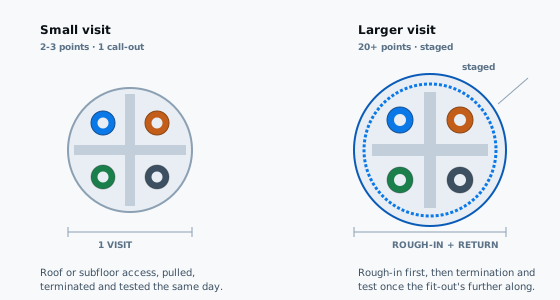
A straightforward job — two or three points in a house with clear roof access — is usually done in a single visit, cable pulled, terminated, tested and labelled before the van packs up. A larger office fit-out with twenty or more points is a different shape of job: rough-in on one visit, then termination and testing once the partitions and ceiling are in, staged around the other trades rather than squeezed into one day.
Small residential job
A handful of points, roof or subfloor access, testing included. Usually one technician, one visit.
Larger commercial fit-out
Rough-in, then a return visit for termination and test once other trades are through. Staged around the building program, not the calendar.
Occupied offices: how a data cabling technician works around your day
Cabling an office that's still trading is a logistics problem as much as a technical one. The work gets staged so the old cabling stays live until the new links are tested and proven, cutover happens outside trading hours, and nobody arrives on a Monday to a desk that's stopped working.
What that means for you: a data cabling technician working on an occupied floor will usually confirm which areas are off-limits during business hours, whether after-hours or weekend access is needed, and what the site's own induction or sign-in process requires. A full IT network installation across a floor is planned around those constraints from the quote stage, not discovered on the day.
Noise, dust and what to expect while the work's on
Most of a cabling visit is quiet — pulling cable, terminating jacks, checking a tester. The noisy parts are short and specific: a hole cut for a new wall plate, or a drill going through a stud or masonry wall. Dust sheets go down first, and any hole gets cut to the size of the plate, not bigger.
You don't need to hover, but it helps to be reachable. A data cabling technician mid-job sometimes hits something the walk-through didn't show — a blocked cavity, insulation packed tighter than expected, a cable run that has to detour around ductwork. A quick decision from you keeps the job moving instead of guessing on your behalf.
Testing and handover before the van leaves
Every permanent link gets tested against the standard it was installed to before the job is called finished — that's not an optional extra, it's how you know a cable that lights up will actually perform under load. A link that only gets a visual check is a link nobody has actually proven.
Handover includes the test results and the written compliance statement required under section 25 of the Cabling Provider Rules, supplied whether or not the invoice has been paid yet. It should carry the technician's name, contact details, registration proof, and a plain statement that the work is complete and complies with the Wiring Rules.
After the visit: what you're left with
Walk away with more than a working port. Every outlet and patch panel position gets labelled to match at both ends, so the next person who opens the rack — including a different data cabling technician years later — can work out what they're looking at without guessing.
Keep the compliance statement and test results somewhere you can find them. They're the evidence the fixed cabling in your building was installed lawfully, and they're what an insurer, a landlord or a future fault-finding visit will ask for first. If a point needs adding later, or the Wi-Fi coverage still isn't right, cabling a ceiling point for a wireless access point is usually a short follow-up rather than a whole new job.
If you want to check any of this independently, the ACMA's own page on cabler registration covers the same ground from the regulator's side.
Data cabling technician questions people actually ask
What does a data cabling technician actually do during a home visit?
A data cabling technician confirms the point locations against the quote, checks roof or subfloor access, pulls and terminates the cable, tests every finished link against the standard, and hands over the results along with the compliance statement — all in the one visit for most residential jobs.
Do I need to be home when a data cabling technician arrives?
For a residential job, yes, or at least reachable — someone needs to open up, confirm point locations, and make the call on anything unexpected found during the visit, like a blocked cavity. On a commercial site a site contact usually covers this instead.
What should I have ready before a data cabling technician arrives?
Clear access to the roof manhole, subfloor hatch or riser cupboard, a rough idea of where each point should land, pets secured somewhere else, and someone available to let the technician in at the agreed time. Commercial sites should also have lift bookings and induction paperwork sorted in advance.
How long does a data cabling technician spend on a two-point job?
With clear roof or subfloor access, a two-point residential job is usually finished in a single visit — cable pulled, terminated, tested and labelled before the van leaves. Blocked access, long runs or masonry walls all add time, which is why access matters more than the point count.
What identification should a data cabling technician show on arrival?
Ask for proof of cabling registration — a card or certificate showing the individual's name, registration number and class. A data cabling technician working lawfully carries this and won't be offended by the question; it takes a few minutes to check the number against the registrar's record.
Does a data cabling technician work alone or bring a team?
Most residential and small commercial jobs are one technician, start to finish — the same person who quoted the job and who signs the compliance statement afterwards. On larger fit-outs a second person sometimes works under direct supervision, which the cabling rules require at all times.
What access does a data cabling technician need in a Queenslander?
Mostly the subfloor. Queenslanders on stumps usually give a crawl-space route to almost anywhere in the house, even where the roof cavity is tight or broken up by later additions. Clearing anything stacked against the subfloor hatch before the visit makes the biggest difference to how quickly it goes.
Can a data cabling technician work around an occupied office during business hours?
Yes — most commercial cabling is staged that way. Cable gets pulled and terminated in sections, cutover happens outside trading hours, and the existing cabling stays live until the new links are tested and proven, so the office keeps running while the work is done around it.
What does a data cabling technician carry in the van?
Cable on reels in the categories being installed, wall plates and patch leads, termination tools, a certifier for testing every permanent link, and access gear like a ladder, fish rods and dust sheets. What's stocked is checked against the quote before the van leaves the depot.
What happens if a data cabling technician can't get roof access on the day?
It gets flagged on the spot rather than worked around quietly. Sometimes a subfloor or surface-run alternative solves it there and then; sometimes the job needs a second visit once whatever's blocking access — stored goods, insulation, a locked manhole — is sorted out.
Book a data cabling technician for your job
Tell me what the property is, roughly how many points, and whatever you know about roof or subfloor access. That's usually enough to scope the visit before the van leaves the depot.
Or call 07 3521 8082. Voicemail means I am up a ceiling somewhere; leave a message and I will call back.
Work carried out by an ACMA registered cabler no. 42489 All work to AS/CA S009:2020