Logan — between Brisbane and the Gold Coast
Data cabling Logan, from Beenleigh's older streets to Yarrabilba's newest
Logan sits on the motorway between two cities, and the building stock proves it: post-war brick through Springwood, Logan Central and Slacks Creek, slab-on-ground estates still being built at Yarrabilba and Flagstone, and a logistics precinct at Crestmead big enough to run its own postcode. Data cabling Logan work answers to all three, done by a registered cabler and tested before handover.
ACMA registered cabler no. 42489 Installed to AS/CA S009:2020 Compliance statement every job
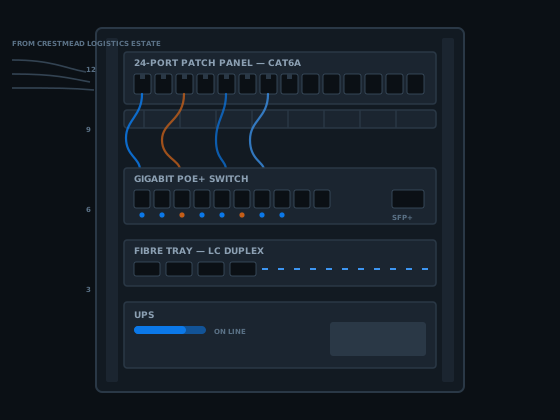
Logan is the fastest growing council area in Queensland — up 3.9 percent in the 2023-24 financial year alone — and it got there by being two places at once. Beenleigh, Springwood, Logan Central and Slacks Creek have carried Brisbane and Gold Coast commuters since the 1960s. Further south and west, Yarrabilba and Greater Flagstone are still filling paddocks with new streets, on a combined build-out state planning puts past 200,000 people by 2066. Data cabling Logan work sits across both halves of that split, and the job changes depending on which half you're standing in.
None of that growth moves without the freight side, and Logan carries plenty of it — the Crestmead Logistics Estate alone is a nine-stage, 157-hectare project built around the Logan and Gateway Motorways. This page covers what makes data cabling Logan work its own trade: the housing split, the industrial precinct, the nbn technology on each side of it, and what a proper install and test regime actually looks like. For the wider region, the data cabling Brisbane hub page covers the whole patch this business works.
What data cabling Logan jobs actually involve
Strip away the postcode and data cabling Logan work is the same trade practised anywhere: fixed cable, wall plates, patch panels and a comms point everything else plugs into. A data cabling installation in Brisbane proper follows the same rules — this page is about the parts of the job that are specifically Logan's own, and there's more of those than the postcode suggests.

The 100 metre channel limit that governs every run — 90 metres of fixed cable plus up to 10 metres of patch leads at each end — doesn't change from suburb to suburb. What changes is how the cable gets to the outlet in the first place, and in Logan that answer depends on whether the building is forty years old or four months old. Most jobs also still want a phone line run alongside the data points; that side of the work is covered separately on the telephone cabling installation page.
Logan's suburbs: established streets and growth estates
Logan's estimated resident population passed 403,500 in mid-2025 and is on track to clear 500,000 by 2036, but the growth isn't spread evenly. Beenleigh, at the junction where the Beenleigh and Gold Coast rail lines meet, has carried commuters south of Brisbane since the 1880s, and its surrounding streets, along with Logan Central, Woodridge and Kingston, filled in fast from the 1960s onward — Logan Central itself wasn't even gazetted as its own suburb until 1985, carved out of land that used to belong to Woodridge and Kingston.
Census figures put roughly 85 percent of Logan's occupied dwellings down as separate houses, against 11.8 percent townhouses and semis and under 3 percent flats — a heavily detached housing stock, which is a different starting point for a data cabling Logan job than inner Brisbane's mix of high-rise and unit blocks.
Springwood tells a similar story to Beenleigh — a 1960s-onward suburb of brick and fibro homes that's since built up around Springwood Mall, currently mid-way through a $16 million expansion. Slacks Creek sits between the two, much the same era and housing type. All three are the suburbs where a data cabling Logan job usually means a roof cavity, a short run, and cable that never has to touch a wall cavity from the outside.
South and west of that established belt, the story flips. The Greater Flagstone Priority Development Area covers 7,188 hectares west of Jimboomba and is planned for 51,500 dwellings and up to 138,000 people over a thirty to forty year build-out — it's already home to around 10,000 residents, adding roughly 500 new houses a year. Yarrabilba, a smaller but faster-moving PDA between Plunkett Conservation Park and Waterford-Tamborine Road, is planned for 20,000 dwellings and up to 50,000 people.
Both are slab-on-ground estate housing with no subfloor and no established roof cavity to fall back on until the trusses go up, and both are backed by a $1.2 billion infrastructure deal between the state government, Logan City Council and the estates' developers — which is why a data cabling Logan quote for a Yarrabilba build always starts with a question about which stage it sits in.
The bit most Logan quotes skip past
Logan's logistics corridor: Crestmead, Berrinba and the M1
Logan sits directly on the Brisbane-Gold Coast freight corridor, and the Logan Motorway is the reason why — a 30 kilometre toll road carrying an average 203,000 vehicles a day, linking the Ipswich Motorway in the west to the Pacific Motorway (the M1) at Loganholme in the east, with a spur to the Gateway Motorway in between. Warehousing and logistics operators have built around that junction accordingly.
The largest of them is the Crestmead Logistics Estate — a nine-stage, 157-hectare development at the corner of Green and Clarke Roads, aiming for around 650,000 square metres of warehousing, logistics and manufacturing space and more than 6,000 full-time jobs once complete. Singapore's Mapletree Logistics Trust is behind the estate's first stage alone, a 200,000 square metre, $440 million logistics park. Close by, Crestmead Business Park adds smaller office-and-warehouse tenancies, and the Southwest 1 industrial estate at Berrinba runs the same brief on a smaller footprint, both linked to the Logan Motorway, Gateway Motorway and Mt Lindesay Highway.
Every one of those sites is a different data cabling Logan brief to a Beenleigh office or a Springwood home. Warehouse floor plates are big enough that the 100 metre copper limit gets hit before you're halfway across the building, PoE cameras and access control run alongside the data network as standard, and Cat6A tends to be the sensible default rather than an upgrade anyone has to argue for.
nbn across Logan: established suburbs versus new estates
Established Logan suburbs mostly came online through the original national broadband rollout on fibre-to-the-node, the same technology used across most of established Brisbane, with a federal upgrade program now offering eligible fibre-to-the-node premises an on-demand move to full fibre. That part of the story isn't unique to Logan — it's standard rollout history repeating across South East Queensland's older suburbs generally.
The growth corridor is where it gets locally specific. A 2016 federal policy change ended nbn's exclusive right to run fixed-line infrastructure into brand new estates, and developers gained the option of contracting a private network operator instead — nbn keeps a fallback role as the infrastructure provider of last resort, but it no longer has automatic first claim on a new development. That means two stages of the same Yarrabilba or Greater Flagstone estate can end up on different networks, with different equipment sitting at the boundary point.
Before assuming what's in the garage of a new Logan build, it's worth checking rather than guessing — the same registration and standard apply to a data cabling Logan job either way, whether the boundary point is nbn's or a private operator's.
Commercial data cabling Logan businesses need
Commercial data cabling Logan work splits roughly the same way the suburbs do — established town centre offices on one side, warehousing and industrial fitouts on the other, each wanting a different design from day one.
Beenleigh and Springwood offices
A data cabling Logan job in either town centre gets cabled the same way a commercial data cabling job in the Brisbane CBD would be — staged pulls, after-hours cutover, and the old links kept live until the new ones test clean.
Crestmead and Berrinba warehouses
Long throws across a single floor plate, high racking that changes access, and a fibre link to a satellite cabinet rather than one heroic copper run once the building gets past 100 metres end to end.
New estate town centres
Yarrabilba and Flagstone are both building out their own commercial precincts alongside the housing — greenfield fitouts, no legacy cabling to work around, but also no existing comms room to reuse.
Cameras, access control and Wi-Fi
PoE cabling for cameras, door controllers and access points is common to every one of the above — it's cabling work wearing a security hat, and it's usually the part left off the first draft of the quote.
Why registration matters for data cabling Logan work
The rule governing data cabling Logan work is federal, not something Logan City Council has any say over. Fixed cabling that connects to a telecommunications network must be installed by a registered cabling provider, or by someone directly supervised at all times by one, under section 21 of the Telecommunications (Cabling Provider) Rules 2025. That applies identically whether the job is a Beenleigh shopfront or a Crestmead warehouse, and it's separate from any electrical licence — the Electrical Safety Act 2002 (Qld) says at section 55(3) that an electrical licence isn't required for telecommunications cabling work.
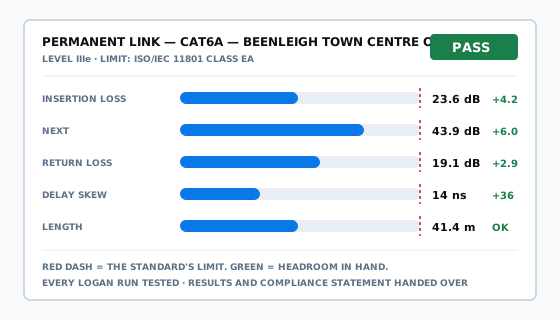
Work across Logan runs under the same ACMA cabler registration as every other job this business handles — registration no. 42489, open class, which covers structured, fibre and coaxial cabling without a separate endorsement for each. The same registered data cabler who works Brisbane covers Logan, and every job gets the written compliance statement required under section 25, supplied whether or not the invoice is paid yet.
Every permanent link on a data cabling Logan job gets tested against the standard it was installed to before handover, not just plugged in and checked for a link light — the difference between a proper install and cable pulled as a sideline between other trades.
Cat6 or Cat6A for a data cabling Logan install
The split in Logan's building stock makes this call easier than usual for most data cabling Logan jobs. A brick or fibro home in Springwood, Slacks Creek or Logan Central with a run under 30 metres does the job on Cat6 — gigabit to the full 100 metres, and the labour is identical to Cat6A either way. A new build at Yarrabilba or Flagstone going in with PoE cameras and a possible future 10 gigabit switch upgrade is better served starting with Cat6A, because re-pulling cable through a finished slab home is a much bigger job than doing it once, properly.
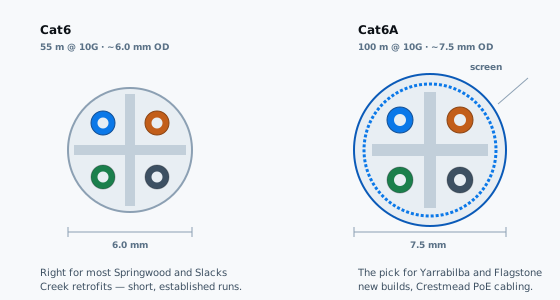
| Cat6 | Cat6A | |
|---|---|---|
| 1 Gbps | 100 m | 100 m |
| 10 Gbps | ~55 m | 100 m |
| Screening | Usually unscreened | Screened against alien crosstalk |
| Outside diameter | ~6.0 mm | ~7.5 mm |
| Suits | Established suburbs, short runs | New estates, PoE, Crestmead & Berrinba sites |
What data cabling Logan quotes actually cost
Access moves a data cabling Logan quote more than the cable spec does. A Springwood or Slacks Creek home with clear roof cavity access is a quick job, because the cable never has to fight the building to get where it's going. A Yarrabilba slab build where the ceiling's already up around the trusses, or a Crestmead warehouse with racking already installed, takes longer for the same outlet count.
Structured cabling is generally priced per outlet — cable, both terminations, wall plate, patch panel port, testing and labelling — with the per-point rate falling as the count rises. Fault finding and small additions on a data cabling Logan job are priced hourly instead; published rates for comparable work sit around $185 per hour for standard hours across the region, with a premium for after-hours or emergency callouts. The full breakdown of how those numbers get built, and what to check on any quote, sits on the data cabling cost page.
Home network cabling in Logan houses
Most residential enquiries in Logan start life as a Wi-Fi complaint, and they usually trace back to the same cause as anywhere else — one router in a corner of the house trying to cover a floor plan it was never going to reach. A cabled ceiling point roughly central to the house, feeding a proper access point, fixes more coverage problems than any router upgrade, and the detail on planning that for a whole house sits on the home network cabling page.
In an established Springwood or Beenleigh home, that ceiling point is almost always a short drop from the roof space with no wall damage at all. In a Yarrabilba or Flagstone build it comes from the roof cavity too, just a newer one. Either way, a home data cabling Logan enquiry usually settles on the same three runs: the study, the TV wall, and that central ceiling point, planned before the ceiling closes rather than after.
Logan and the corridor around it
Logan sits right in the middle of the run down the M1, so data cabling Logan work naturally borders two other patches this business covers. North, closer to Brisbane, is data cabling South Brisbane territory, and east across to the bay is data cabling Redlands — both quoted the same way, access first, cable category second. South down the M1 is data cabling Gold Coast, which shares a lot of Logan's own growth-corridor story, along with the dedicated data points Gold Coast page for smaller jobs.
West across the range, data cabling Springfield covers a growth corridor that looks a lot like Yarrabilba and Flagstone — the same slab-on-ground estate housing, the same roof-only access. Residential work generally stays closer to home; commercial work travels further if the job is worth the drive — ask, rather than assume it's out of range.
Data cabling Logan questions we get asked
What's different about data cabling in an established Logan suburb like Springwood compared to a new estate at Yarrabilba?
A post-war brick or timber home in Springwood or Slacks Creek almost always has roof cavity access, so cable drops down inside a wall from above with no fuss. A new Yarrabilba build is slab-on-ground, same as most estate housing going up right now, so every run has to come from the roof space and gets planned around the truss layout before the ceiling goes on.
Does Logan River or Albert River flooding affect data cabling in suburbs like Beenleigh or Eagleby?
In low-lying pockets near the rivers, yes. The February 2022 flood was one of the worst in Logan's history, with alerts issued across sixteen suburbs and doorknocks in Beenleigh and Eagleby. Homes in those pockets are usually raised or re-stumped as a result, and any cable run underneath needs to sit above that flood line, not just above the original one.
Is nbn or a private network running fibre through new Logan growth estates like Greater Flagstone?
It depends on the stage. A 2016 federal policy opened the new estates market to private network operators, so nbn is no longer guaranteed to be the only carrier laying cable through a new development. Some Greater Flagstone and Yarrabilba stages are on nbn's fibre-to-the-premises footprint, others on a private operator — worth checking before assuming what's sitting in the garage.
What data cabling does a warehouse at the Crestmead Logistics Estate actually need?
Big floor plates and long throws to the far wall push past the 100 metre copper limit fast, so a fibre run to a satellite cabinet is the usual fix rather than one long copper pull. Add PoE cameras, access control and warehouse management scanners on the network and Cat6A becomes the standard spec, not an extra.
Can data cabling go into an occupied office in Beenleigh Town Centre without stopping trade?
Yes. Cable gets pulled and terminated in stages, cutover happens after hours or on a weekend, and the old links stay live until the new ones test clean. Most Beenleigh Town Centre and Springwood office cabling runs this way, so nobody arrives to a dead desk on the Monday.
How many data points does a new home at Yarrabilba or Flagstone need?
Most new builds through the Yarrabilba and Greater Flagstone corridor get cabled for a study or home office, the main living area for a smart TV, and a ceiling point roughly central to the floor plan for a wireless access point. Three to five outlets covers most four bedroom estate homes in that area comfortably.
Is Cat6 enough for an established brick home in Slacks Creek or Logan Central, or does it need Cat6A?
For most 1970s and 1980s brick homes in Slacks Creek or Logan Central, Cat6 is the right call — the runs are short, gigabit is plenty, and the labour cost is the same either way. Cat6A earns its place when the run is long, the site is commercial, or PoE cameras are going in.
Who do I call for a data cabling fault in a Springwood or Shailer Park office?
A registered cabler, not the IT helpdesk. A port stuck at 100 megabit instead of gigabit, drops that come and go after a fitout, or a run nicked by another trade are physical layer problems, and the only way to find them is testing the actual link against the standard rather than guessing at a software fix.
Does Logan's mostly detached housing stock make data cabling easier than inner Brisbane?
Generally, yes. Around 85 percent of Logan's occupied dwellings are separate houses rather than units or townhouses, which means most jobs deal with a roof cavity and internal wall cavities instead of a body corporate, a shared riser and access rules written by someone else. It doesn't remove every complication, but it removes a common one.
Get a data cabling Logan quote
Tell me what the building is — established brick home, new estate slab, town centre office or a warehouse — and roughly how many points you need. Most data cabling Logan jobs can be scoped from a few photos and a phone call. If it's a fault rather than an install, say what it's doing; that usually narrows it down before anyone drives out.
Or just call 07 3521 8082. If it goes to voicemail I am up a ceiling somewhere; leave a message and I will call back.
ACMA registered cabler no. 42489 All work to AS/CA S009:2020