Government & institutional work — Queensland
Government data cabling contractors: what public sector cabling work actually requires
Procurement, panel arrangements, security clearances and after-hours access to occupied public buildings — the parts of a council, school or agency cabling job that a residential quote never touches, explained straight, without pretending to hold anything that isn't held.
ACMA registered cabler no. 42489 Installed to AS/CA S009:2020 Compliance statement every job
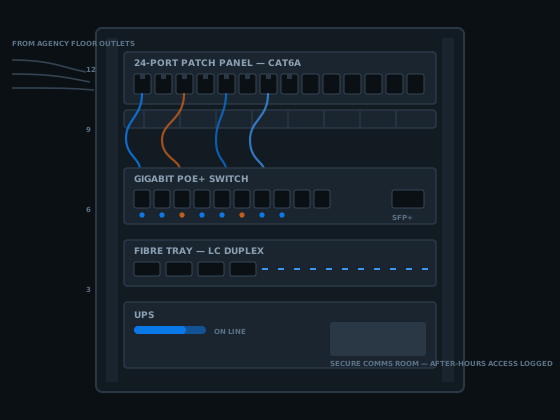
A council office, a state school, a library or a health facility buys cabling work differently to a private tenancy — not because the cable or the standard changes, but because the building sits inside a procurement process, has occupants who cannot simply be worked around, and sometimes asks questions a residential job never raises. This page is about what government data cabling contractors actually deal with on that side of the job, told plainly rather than dressed up.
It is written for anyone comparing quotes for a public building, and for any of the government data cabling contractors doing the quoting. It leans on the same rules covered on the page about a registered cabler in Brisbane, and sits alongside what a data cabling technician actually does on site once the job is underway.
How government data cabling contractors actually get engaged
The instinct is to assume every dollar of government spending runs through a formal tender. Most cabling work does not. Full prequalification for building and trade contractors applies once a project's value passes one million dollars — a handful of extra data points, a comms room refresh, or a fault-finding callout in a council building sits well under that, and gets bought the same way a private business buys it: a scope, a written quote, and a purchase order.
What changes is the paperwork sitting around that quote. A public sector buyer is spending money they answer for, so government data cabling contractors get asked for things a homeowner never thinks to ask: an ABN that matches the invoice, a current insurance certificate, and increasingly a registration number rather than a vague "fully qualified" line — the same due diligence any public purchasing officer runs on any contractor.
Panel arrangements and standing offers, explained plainly
A standing offer arrangement — also called a supplier panel — is a pre-approved list an agency can buy from without re-running a full process every time. It speeds up recurring purchases, and it is part of why the phrase "government data cabling contractors" gets used loosely to mean anyone on such a list, when it more accurately describes anyone doing the work lawfully, panel or not.
What a panel actually streamlines
Repeat purchasing. An agency buying across dozens of sites a year avoids re-tendering each job — it calls off the panel instead, on agreed terms.
What it does not replace
Cabler registration, which sits with the individual under federal rules regardless of any panel sitting above it.
Being on a panel and being registered to do the work answer two separate questions — one is whether a business can be engaged without a fresh tender, the other is whether the person on site is lawfully entitled to do the cabling. Most government data cabling contractors never touch a panel at all for a given job, because it sits under the value where a direct quote is the normal route regardless.
The bit that gets confused most often
Security clearances and site checks — what actually applies
"Security clearance" is the question government data cabling contractors get asked most often, and it covers two genuinely different things. Formal personnel security clearances — Baseline, Negative Vetting 1 and Negative Vetting 2 — are sponsored through the Australian Government Security Vetting Agency for people who need ongoing access to classified information: Protected, Secret or Top Secret. A business cannot buy one for itself; a department has to sponsor the application, and the work behind it is overwhelmingly defence and high-security federal in nature.
Formal clearances (AGSVA)
Baseline, NV1, NV2. Sponsored by an agency, tied to classified information access. Not the norm for a council office, school or library cabling job.
What most institutional sites actually run
Photo ID checked at reception, a visitor register or sign-in app, a national police check on file, and a site induction before anyone touches a ceiling tile.
For most of the work government data cabling contractors take on — a council building, a state school, a suburban library — the checks that apply are the everyday ones, not the classified ones. Confusing the two leads buyers to ask for something that was never relevant.
After-hours access to occupied public buildings
A courthouse, a hospital wing or a library cannot simply close for a day so cabling can go in — the same problem occupied commercial premises create, except the public cannot be redirected to a different branch as easily as staff can be moved to another floor. Government data cabling contractors end up doing a large share of institutional work in the same window commercial cutovers already use: evenings, weekends, and school or facility closure periods where they exist.
Getting onto site outside normal hours runs through the building's facilities team, not the cabler's own arrangements — a visitor sign-in, sometimes a temporary access card, and a comms room key handed over for the shift are typical. On a school site the window is often the holidays themselves, which is when a large share of the work government data cabling contractors do inside schools actually happens.
It is the same staged, out-of-hours approach used on an occupied commercial fitout, just coordinated through a facilities manager instead of an office manager.
The one thing that never changes
Registration and the standard don't shift for government data cabling contractors
Everything covered so far sits on top of the same base requirement that applies to a house in Ipswich or a warehouse fitout: cabling that connects to a telecommunications network must be installed by a registered cabling provider, or by someone directly supervised at all times by one, under the Telecommunications (Cabling Provider) Rules 2025. A public building does not raise or lower that bar — it is a federal requirement that applies identically to a council chamber and a suburban house.
The same goes for the standard the work is installed to. AS/CA S009:2020, the Wiring Rules, governs a government fitout exactly as it governs a home network upgrade, and it is a free download from the Australian Telecommunications Alliance. Government data cabling contractors do not get a separate, lighter or heavier version of the rules to work to — there is one standard, and it applies regardless of who signed the purchase order.
Worth checking on any quote from government data cabling contractors: a registration number, which class it is, and whether the compliance statement under section 25 of the Cabling Provider Rules is included as standard, not an optional extra.
Different institutional sites, different day-to-day rules
"Government and institutional" covers a wide range of buildings, and the practical constraints change more between site types than the cabling itself does. What follows is the pattern most government data cabling contractors run into across the common categories.

Schools and childcare-adjacent sites
Work done while children are present, in a space they occupy, needs a blue card. Work done after hours or during the holidays — most institutional cabling in schools — generally does not, because no children are on site for it to apply to.
Councils, libraries and community centres
Public opening hours, staffed reception, and often the least restrictive access of the group — closer in practice to a commercial office fitout than to a school or health site.
Health precincts
Occupied around the clock in parts of the building, so cabling gets scoped ward by ward or wing by wing, with clinical areas treated with more care than an admin corridor.
Courts and justice facilities
Higher day-to-day security than most sites in this group — sign-in, escorted movement in some areas — but still no different registration requirement underneath it.
The through-line: cabling rules stay constant for government data cabling contractors across all four, and what shifts is access, timing and who signs off before the ladder goes up.
WHS, SWMS and older buildings: the asbestos register question
A meaningful share of Queensland's public building stock — schools, council offices, older health buildings — predates 1990, and any workplace built before that year is legally required to keep an asbestos register on site. That register is not a formality for government data cabling contractors. Roof cavities, risers and old service ducts are exactly where a contractor pulling cable ends up working, and checking the register before opening one is standard practice on an older public building.
Disturbing asbestos is one of the specifically defined categories of high risk construction work under Queensland's WHS Regulation, which means a safe work method statement has to exist before that category of work starts, not be written up afterwards. In practice this rarely stops a cabling job — most runs avoid affected material entirely once the register has been checked — but it is a step government data cabling contractors build into an older site that a 2005-built display home never raises.
None of this applies to a newer slab-on-ground school or a recently built council annex — the obligation is tied to the building's age, not the category of site.
What a quote from government data cabling contractors should include
Public money invites more scrutiny than a private renovation. The list below is close to what any careful buyer should ask for anyway — it just matters more once someone has to account for it.
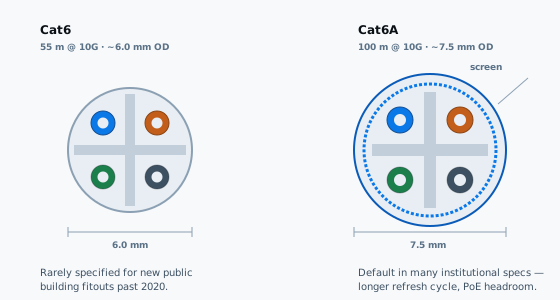
Cable category is worth naming on its own line. Plenty of institutional specifications default to Cat6A rather than Cat6, because a public building tends to sit unrenovated far longer than a private tenancy does, and the screened cable holds 10 gigabit across the full channel where standard Cat6 starts falling short past roughly 55 metres. Not every agency mandates it, but government data cabling contractors naming the category either way beat a quote that just says "data cable" and leaves the buyer guessing.
| Line | What it should say |
|---|---|
| Cable | Named by category — Cat6 or Cat6A, not "data cable" |
| Registration | Number and class, not a business name alone |
| Insurance | Current public liability certificate, sighted not just claimed |
| SWMS | Supplied if the site triggers high risk construction work |
| Access | Whether after-hours or holiday-period access is assumed |
| Testing | Every link tested, results and compliance statement supplied |
None of it is exotic paperwork — it separates government data cabling contractors worth engaging from a quote that looks fine until something goes wrong. What those lines cost, per point or hourly, is covered on the page about data cabling costs in Brisbane.
Testing and the handover statement on public sector work
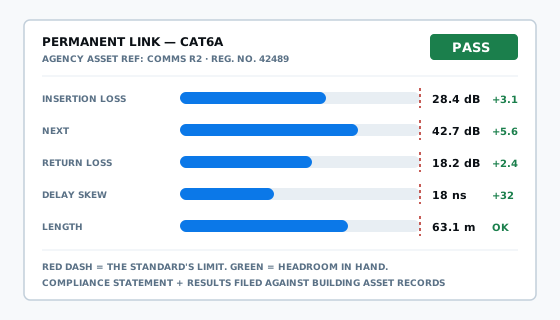
Every permanent link government data cabling contractors install gets tested against the standard it was built to — insertion loss, near-end crosstalk, return loss, delay skew and length, on all four pairs. That does not change because the client is an agency rather than a homeowner, but the paper trail matters more, because it is the record a facilities manager or asset team will file and go looking for years later.
The written compliance statement required under section 25 of the Cabling Provider Rules is owed regardless of who is paying or how long the invoice takes to clear. For government data cabling contractors, that statement plus the test results are usually filed against the building's asset records rather than kept by an individual — worth confirming who receives the paperwork before the job wraps up, so it lands with the right person the first time.
Where government data cabling contractors work: Brisbane, councils and regional agencies
None of the process above is specific to one council or department — it applies the same way to a Brisbane City Council facility as it does to a regional shire office, a state school in Ipswich or a health service on the Gold Coast. What changes with distance is travel, not the rules the job runs under.
For the cabling itself rather than the institutional layer around it, the same considerations that apply to a wireless network installation in a commercial office apply inside a public building too — ceiling access points, PoE budget and where the access points actually need to sit are the same engineering questions government data cabling contractors answer whether the building is owned by a private landlord or a government department.
Government data cabling contractors: questions we get asked
Do government data cabling contractors need a licence beyond ACMA registration?
No separate government cabling licence exists. The requirement is the same one that applies to every job: registration under the Telecommunications (Cabling Provider) Rules 2025, in a class that covers the work. Queensland does not add an electrical licence on top, on a council job any more than a residential one — the registration is what a public sector buyer should actually ask to see.
Does a small cabling job for a Queensland Government agency have to go to formal tender?
Usually not. Formal prequalification for building and trade contractors applies once a project's value passes one million dollars — a comms room upgrade or a batch of extra points sits well under that, bought as a direct or quoted purchase rather than a full tender. Agencies set their own thresholds for exactly when a quote is enough.
What is a standing offer arrangement and does it decide who can quote on government cabling?
A standing offer arrangement, or supplier panel, is a pre-approved list an agency can buy from without a fresh process each time. It speeds up recurring purchases but does not replace cabler registration, which sits with the individual regardless of any panel — plenty of government data cabling contractors' work is still bought as a direct quote outside one.
Do I need a security clearance for data cabling work inside a Queensland Government building?
Almost never, for typical council, school or agency office work. Formal clearances — Baseline, NV1 and NV2, sponsored through AGSVA — exist for ongoing access to classified information and sit mostly with defence and federal work. Most government data cabling contractors run instead on site inductions, ID checks and visitor registers, a different and far more common bar to clear.
Do government data cabling contractors need a blue card to work in a Queensland school?
Only in specific circumstances. A blue card is required for work inside a school while children are present and the contact goes beyond incidental. Work done after hours, weekends or school holidays when no children are on site is exempt, and a separate exemption covers work totalling no more than seven days a year, which does not extend to business owners.
How does after-hours access actually work for cabling in an occupied public building?
It runs through the building's facilities team rather than the cabler alone. A visitor register, sometimes a temporary access card, and a comms room key handed over for the shift are typical. Courts, health precincts and libraries run on public opening hours, so cabling gets timed around them the way commercial cutovers are staged around a business day.
Why do older Queensland public buildings need an asbestos check before cabling work starts?
Any Queensland workplace built before 1990 must have an asbestos register kept on site, and a large share of the state's older schools, council buildings and health facilities fall into that bracket. Disturbing asbestos is a defined category of high risk construction work under the WHS Regulation, so a safe work method statement has to exist before a roof cavity or riser gets opened, not after.
What should a government or institutional buyer ask for in a data cabling quote?
The registration number and class, an ABN matching the invoice, a current public liability certificate, and a safe work method statement if the site triggers high risk construction work. On top of that, testing stated explicitly and the compliance statement confirmed as part of handover, not assumed. A quote missing any of these is worth a follow-up question.
Is Cat6A compulsory for government and institutional cabling jobs?
There is no blanket rule making it compulsory, though plenty of institutional specifications default to it, because a public building tends to be recabled far less often than a private tenancy changes hands. Cat6A holds 10 gigabit to the full 100 metre channel and copes better with PoE cameras and access points, usually the reasoning when a specification exists.
Can a one-person cabling business take on government or institutional work in Brisbane?
Yes, for anything under the prequalification threshold, which covers most institutional cabling jobs — extra data points at a school, a library upgrade, a council office fault. Registration sits with the individual, not the size of the business behind them, and a one-person operation with a current registration is not disqualified from quoting simply for being small.
Get a quote for a council, school or agency cabling job
Tell me what the building is, roughly how many points, and any access arrangements the site already has in place — after-hours entry, a facilities contact, or a holiday-period window. Like most government data cabling contractors' quotes, this one can be scoped from that and a walk-through.
Or call 07 3521 8082. If it goes to voicemail I am up a ceiling somewhere; leave a message and I will call back.
ACMA registered cabler no. 42489 All work to AS/CA S009:2020