Brisbane & South East Queensland
Fiber network installation between buildings and across a site
A fiber network installation between two buildings starts with a trench, not a cable reel. Warehouse to office, Building A to Building B, the shed across the yard — this is the civil work behind the link, the pits and ducts that carry it, and why the fibre itself is the easy part.
Depth of cover 450 mm under a road Single-mode only, between buildings Compliance statement every job
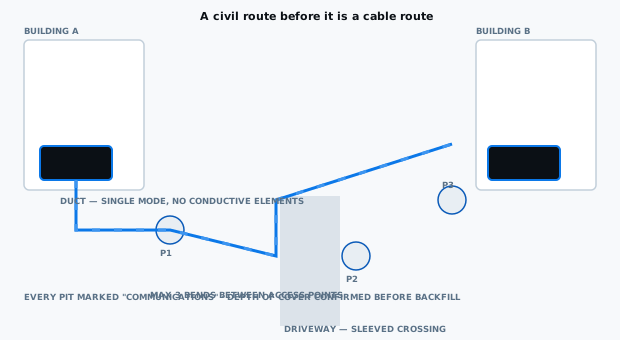
Most fibre pages talk about the glass. This one is about the ground it goes through. A fiber network installation between separate buildings — whether you call it that or a fibre optic network installation, both spellings land on the same job — is decided as much by where a trench can go as by any cable spec sheet.
The single-building story, patch panels and risers inside one structure, is covered on the fibre optic cable installation page. This one picks up where that leaves off: the link crossing open ground between two structures, who has to approve it, how deep it has to sit, and why single-mode is the only sensible choice once you are trenching anyway.
What a fiber network installation between buildings actually is
Inside a building, fibre solves a distance problem: a run too long for copper's 100 metre channel. Between buildings it solves a different one — two structures with their own earthing, their own switch rooms, and nothing electrically safe to connect them with. A fiber network installation between buildings is that link: glass with no metal in it, run from one building's comms room to the other's, usually underground.
It is not a bigger version of the cabling inside either building. The design starts outdoors: where the route can go, what it has to cross, how deep it has to sit, and who signs off on it before a shovel goes in. The fibre itself — single-mode, spliced or pre-terminated — is close to the last decision made, not the first. Warehouse-to-office backbone, campus fibre, inter-building link, site-wide fibre network installation — different names, same brief.
The part that surprises people
A fiber network installation between buildings is a civil job first
Ask for a quote on cabling inside an office and you get a cabler's number. Ask for a fiber network installation between two buildings and the honest answer involves a trench, a boring contractor, or both — before anyone talks about fibre count or connectors. The civil work sets the schedule, the cost, and often whether the job is even straightforward.
The sequence runs roughly: confirm the route is clear of other services, get the permissions that route needs, excavate or bore it, lay and bed the conduit, backfill and reinstate the surface, then — only then — pull, splice, terminate and test the fibre. Swap that order around and you end up trenching twice.
The cabling half of a fiber network installation between buildings is done by a registered cabler and takes a day or two. The civil half — survey, approvals, digging, reinstating — is what makes the calendar slip, and it is worth pricing as its own piece of work rather than an afterthought bolted onto the cabling.
Permission, easements and Dial Before You Dig
Cabling inside your own building needs nobody's sign-off but yours. The moment a fiber network installation crosses ground between buildings, that changes. AS/CA S009:2020, clause 17.2, is direct about it: a cabling provider installing cabling between separate premises needs the permission of the relevant local authority, or of the owner of any third-party property the route crosses.
The same clause is equally direct about what a cabler cannot do: use a Carrier's or anyone else's conduits, pits or access holes without express permission, even if the route passes right beside one. Every building-to-building fiber network installation gets its own pathway.
Before any earth-breaking work — trenching, boring, even hand-digging a pit — S009 says to contact Dial Before You Dig, the free national referral service, on 1100 or at 1100.com.au. It identifies what other underground services sit near the route — gas, power, water, other telecommunications — so the trench does not find them the hard way.
Worth checking before you get a quote: whether the route crosses a boundary, an easement, or a shared driveway. A fiber network installation that only touches your own land is a simpler approval path, and cheaper to confirm at the planning stage than mid-trench.
Pit and pipe — how the underground path actually gets built
"Pit and pipe" is the shorthand for the two things that make an underground fiber network installation serviceable rather than a cable buried and forgotten: conduit to protect and guide the fibre, and pits at intervals to haul cable through, joint it, and get back into the route later without re-excavating the whole run.
Conduit
Rigid UPVC or polyethylene, minimum 23 mm inside diameter, sized for the cable count being pulled, with a draw rope left in for the next job.
Pits and access holes
Legibly marked "Comms" or "Communications", positioned clear of driveways unless built to take the load, and fitted with a siltation trap so silt does not migrate into the conduit.
Building entry
Where conduit enters either building it has to be sealed to stop fluid, gas, insects and vermin following the pathway indoors — one of the first things missing on a rushed job.
Cable run directly in the ground without conduit is the exception, and S009 still requires it sleeved in conduit for at least 300 mm before entering a pit, to protect the sheath. Pulling a spare conduit alongside the working one, while the trench is open, is the cheapest insurance a fiber network installation ever buys.
Optical fibre is one of six specialised cabling categories under section 22 of the Telecommunications (Cabling Provider) Rules 2025, alongside aerial, broadband, coaxial, structured and underground. Whoever splices and terminates the glass end needs that category completed and notified to the registrar — the civil half of a fiber network installation does not carry that requirement, but the cabling half always does.
Depth of cover and marking the route
How deep the duct sits is not a judgement call. S009 clause 18.6 sets a minimum depth of cover of 450 mm under a public footway or roadway, and 300 mm everywhere else, measured from the finished ground surface to the top of the cable or conduit. Where solid rock, shale or another service makes that impossible, the standard allows the duct to sit shallower under a concrete cover, or to run above ground secured to a fence or wall instead.
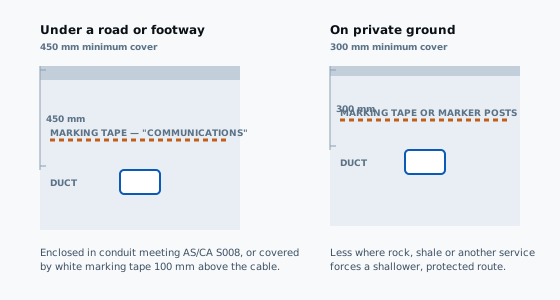
Marking matters as much as depth. Conduit for a fiber network installation is meant to be coloured white, or white with a stripe, and marked "COMMUNICATIONS", so the next person to open that trench knows what they are looking at before they touch it. Where the cable is not enclosed in conduit under a public footway or road, white marking tape at least 100 mm above the cable does the same job, and marker posts at intervals are an accepted alternative on long, straight private runs.
Designing the pathway
Conduit, bends and access points — the geometry of a fiber network installation
Cable has to be pulled through conduit by hand or by winch, and geometry decides whether that is straightforward or a return visit with more equipment. S009 caps a run at no more than three 90-degree bends, or the equivalent, between one access point and the next.
A gentle curve formed in the ground does not count toward that limit, provided its radius is generous — at least 130 times the conduit's inside diameter — which is why a well-designed fiber network installation sweeps around a corner rather than turning it. A tighter turn than that needs an extra pit, not a sharper bend.
Access points can be a pit, an access hole, an above-ground enclosure, or the point where conduit terminates at a building, and how far apart they sit is set by the conduit's diameter — the bigger the duct, the longer the pull allowed. That is arithmetic to settle before the trench is marked out, not after cable is stuck halfway through a bend.
Riser entry — where the outside link becomes an inside one
The pit-and-duct route ends at a wall, and a fiber network installation changes character right there. Everything before that point is outdoor cabling, built to the underground rules. Everything after it is indoor cabling, and the transition itself carries its own requirements.
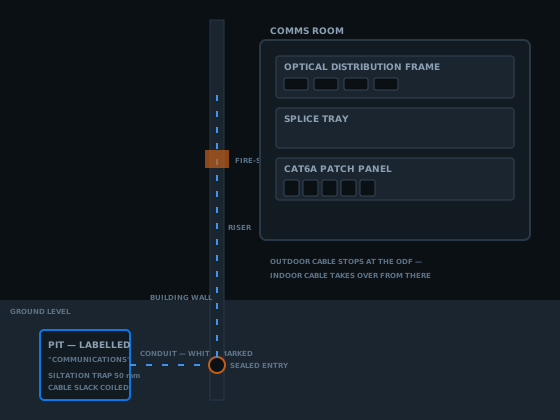
The entry point
Conduit entering a building has to be sealed against fluid, gas, insects and vermin, and any penetration through a fire-rated wall or floor has to be fire-stopped to match the rating of the element it passes through.
The riser and the frame
From the entry point the cable rises to an optical distribution frame, where it is spliced or connectorised and handed off to the indoor patch panel. That frame is the boundary — the outdoor build stops there, and ordinary indoor cabling takes over.
For what happens beyond that frame — rack layout, patch panels, labelling — the comms room and rack build page covers the indoor half. A fiber network installation is only half finished once the glass is in the ground; the entry and the riser are where a rushed job usually shows.
Aerial and sheltered-structure alternatives to trenching
Underground is the default, not the only option. S009 lists wireless technology and electrically non-conductive cabling — optical fibre — as two unconditional ways to link separate buildings, and recognises a third: cabling in a service tunnel, covered walkway or above-ground trunking between buildings, treated as indoor cabling as long as it still meets the same interconnection and UV rules.
Where neither a covered structure nor a dig is realistic — existing poles, no digging permitted, a short span with clear eave-to-eave access — aerial fibre lashed to a messenger wire is a legitimate alternative, built with UV-resistant cable and the same single-mode fibre as underground. Underground still wins most Brisbane site-to-site jobs, because a buried fiber network installation is out of reach of storms, reversing trucks and tree limbs for its whole working life.
The one call worth getting right
Why a fiber network installation between buildings is single-mode, always
Inside one building, multimode fibre has a real place — cheaper optics over a floor-to-floor riser well under its range. Between buildings the arithmetic changes, and the honest advice for a building-to-building or site-wide fiber network installation is single-mode, no exceptions.
Two reasons, both about the trench rather than the glass. Distance: building-to-building spans on a Brisbane site regularly sit past where multimode stays the cheaper option once transceiver cost and future bandwidth are weighed together. And more decisive — once the trench is backfilled and the driveway repaved, redoing the fibre because it will not reach far enough is a second full civil job, not a cable swap.
The maths is one-sided. A single-mode transceiver costs more than a multimode one, but that difference is small change next to reopening the same trench. Spending a little more on optics to avoid ever re-trenching a fiber network installation is not a close call.
Core count follows the same logic — pulling a 12-core cable when four are needed today costs little extra while the duct is open, and leaves room for a second building or a redundant path later without a second dig.
What a fiber network installation between buildings costs
Nobody quotes this kind of job from a floor plan alone, because the number is dominated by what the ground between the buildings looks like, not by the fibre. What follows is what the money actually buys, so a quote reads as more than a total.
The civil component
Trenching or boring the route, supplying and laying conduit, building or buying pits, reinstating turf, pavers or a driveway surface, and traffic management if the route crosses a trafficked area. On most site-to-site jobs this is the larger part of the invoice.
The cabling component
Fibre supply, splicing or pre-terminated assemblies, the optical distribution frames at each end, and testing every core with results and the compliance statement handed over at completion. Smaller than the civil side, and the part most quotes describe in the least detail.
For hourly work on an existing fiber network installation — a fault, a re-splice, extending a route — published Brisbane rates for comparable cabling work sit around $185 per hour for standard hours. A new building-to-building link is priced as a fixed sum once the route has been walked, because the civil scope cannot be guessed from a satellite photo. If the need is floor-to-floor rather than structure-to-structure, the wider fibre optic cabling installation solutions covers that job and what it costs by comparison.
Where fiber network installation work happens around Brisbane
Multi-building sites are common wherever industrial and commercial property was built up over decades — the industrial estates through Rocklea, Salisbury, Wacol and Yatala, business parks at Eagle Farm and Murarrie, and school, club and aged-care sites with a second structure across a car park. Any of those is a candidate for a fiber network installation rather than a single-building fibre job.
Brisbane metro is home ground, with the same work turning up across Ipswich, Logan, Redlands, North Lakes, Springfield, the Gold Coast, the Sunshine Coast and Toowoomba. The registration for optical fibre as a specialised category is checked the same way wherever the job is — ask whoever quotes it, and the registered cabler page explains what to ask for.
Fiber network installation questions I get asked
How deep does the conduit need to be buried for a fiber network installation between two buildings?
S009 sets a minimum depth of cover of 450 millimetres under a public footway or roadway, and 300 millimetres everywhere else, measured to the top of the cable or conduit. Where rock, shale or another service blocks that depth, a shallower run under a concrete cover, or conduit secured above ground against a fence, is allowed instead.
Do I need council approval or Dial Before You Dig for a fiber network installation across my own property?
Yes to Dial Before You Dig, even on private land — a free service on 1100 or at 1100.com.au that identifies underground services before any earth-breaking starts. S009 also requires permission from the relevant local authority, or from the owner of any third-party property the cabling crosses, before work begins between separate buildings.
What is a pit and pipe network in a fiber network installation?
It is the underground infrastructure the fibre travels through — conduit for the cable, and pits or access holes at intervals where it can be hauled, jointed and inspected. Each pit is labelled as a communications pit and built with a siltation trap so silt cannot migrate into the conduit.
Can copper cable be run between buildings instead of fiber for a network installation?
S009 allows it only under conditions, and most equipment will not accept it anyway. Twisted pair between buildings needs the ports at both ends rated for outdoor cabling, and most Ethernet and IP ports are built for indoor use only. Optical fibre with no conductive elements carries no such restriction, which is why it is the default.
Is single-mode or multimode fibre used for a fiber network installation between buildings?
Single-mode. Building-to-building distances on a Brisbane site regularly pass what multimode covers economically, and the trench is the expensive, once-only part of the job — the extra cost of a single-mode transceiver is small by comparison. Specifying single-mode removes any need to re-open the ground because the link needs to reach further.
How many bends can the conduit have in a fiber network installation before it needs another pit?
No more than three 90-degree bends, or the equivalent, between two access points under S009. A sweeping curve in the ground does not count toward that limit provided its radius is at least 130 times the conduit's inside diameter. A tighter run than that needs an extra pit, not a sharper bend.
Can a fiber network installation between buildings go overhead instead of underground?
Sometimes, where poles or building eaves already exist on the route and trenching would mean crossing a driveway or car park. Aerial fibre still needs UV-resistant cable, a messenger wire or self-supporting construction rated for the span, plus the same single-mode fibre. Underground is chosen more often — it survives storms, vehicles and vegetation better over the life of the link.
What happens where the duct for a fiber network installation crosses a driveway or another underground service?
The separation at a crossing follows the other utility's own requirements, and S009 sets its own minimum where that service is low or high voltage power. In practice the driveway gets sleeved before it is concreted or paved, or the duct is bored under it, so nobody has to dig it up again later.
Who installs a fiber network installation between buildings — a civil contractor or a registered cabler?
Both, doing different halves of the job. Trenching, boring and pit installation is civil work and needs no cabling registration. Everything from that point — conduit compliance, pulling the cable, splicing, terminating and testing — is cabling work, and by federal law must be done by, or under the direct supervision of, a registered cabling provider.
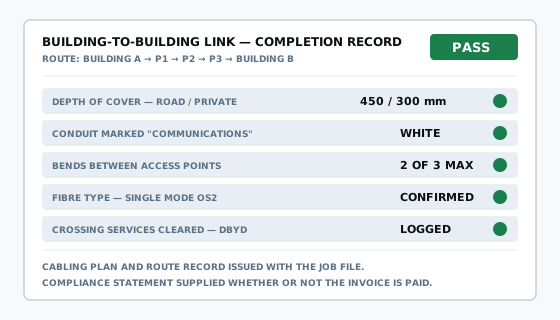
What does the completion record for a fiber network installation between buildings need to show?
S009 expects details of cabling between separate premises recorded on cabling plans and cable distribution records — route, pit locations, depth of cover, conduit type and cores used. Section 25 of the Cabling Provider Rules also requires a written compliance statement after the work, regardless of whether the invoice has been paid.
Get a fiber network installation quote
Tell me the two buildings, roughly how far apart they are, and what sits between them — lawn, driveway, car park or something already ducted. That is enough to work out whether the job needs a trench, a bore, or something else, and to give you a straight answer on what a fiber network installation between your buildings actually involves.
Or just call 07 3521 8082. If it goes to voicemail I am up a ceiling somewhere; leave a message and I will call back.
All work to AS/CA S009:2020 Test results handed over