Brisbane & South East Queensland
What a data cabling installer in Brisbane actually does on the day
Quotes for data cabling all look the same on paper — a day rate, a list of points, a promise it will be fast. What separates a good data cabling installer from someone with a fish tape and a punch-down tool is what happens between rough-in and handover: how the cable gets run, terminated, labelled and proven before anyone plugs anything in. This page is that process, explained the way I would explain it standing next to you on site.
Work done by an ACMA registered cabler no. 42489 Open class, all categories Compliance statement issued every job
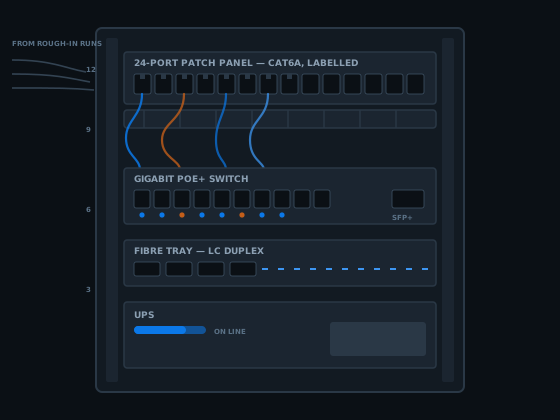
Most people hiring for network cabling never see the job happen — they see a quote, then an invoice, with the actual day disappearing in between. That gap is where cheap work hides. A data cabling installer worth the money follows the same order every time: scope the job, pull cable before anything closes up, terminate and label it properly, test every link against the standard, then hand over paperwork that proves it. Skip any one of those and the fault shows up later, usually on someone else's roof.
None of this is optional under the rules either. Whoever is in your ceiling cavity or running cable through a riser needs to be a registered cabler — the classes, the endorsements and what each may lawfully touch are covered on the registered cabler Brisbane page. This one stays on the ground: what a data cabling installer actually does, in what order, and what you should be seeing at each stage if the job is being run properly.
What a data cabling installer needs settled before day one
The decisions made before anyone touches a drill matter more than the pulling itself. A data cabling installer worth hiring walks the site, or at minimum works from decent photos, before pricing anything. What is the building, where can the comms room live, how many points, and — the one people forget — where does the cable actually terminate. That last answer decides which registration class covers the job, because a restricted cabler cannot lawfully land anything at a patch panel or a main distribution frame.
The quote that comes back should name the cable category, state whether testing is included, and say what making good covers. Ask any of the data cabling installers Brisbane fit-out managers actually rebook, and they will tell you the same thing: a quote that is vague about those three items is a quote that grows once the ceiling is open. Cable itself is a small part of the number — access is what moves it, and a proper scope visit is what catches that before the invoice does.
What gets scoped
Building type and age, roof or subfloor access, point count, where the comms room or cabinet sits, and whether the site is occupied while the work happens.
What the quote should show
Cable category by name, testing and certification stated as included or extra, and making good covered rather than assumed.
Rough-in: the first thing a data cabling installer does on site
Rough-in happens before ceilings close, walls are sheeted or carpet goes down. Cable gets pulled from every outlet, ceiling point or camera back to a central comms room as a home run — nothing daisy-chains, and each cable is independent so damage to one run never takes out another. That star pattern is not a preference; it is how structured cabling is meant to work, and it is what makes fault finding fast years later.

Cable gets left long and coiled at both ends during rough-in, not cut to length. Layouts shift right up until a fit-out is finished — a desk moves, a wall plate gets repositioned — and cable with spare length absorbs that for free. A data cabling installer who cuts too early turns a small layout change into a re-pull, which is a bad trade for saving ten minutes on the day.
The 90 metre fixed cable plus 10 metre patch limit — 100 metres total per channel — decides where the comms room has to sit, and it is worked out at rough-in stage, not discovered afterwards. On an occupied site this all happens around the people working there rather than through them, which means coordinating with the electrician and the ceiling fixer so nobody is queued up waiting on someone else's trade.
The step that decides whether it lasts
Termination and labelling — where the job holds together or doesn't
Termination is punching each conductor down onto a keystone jack or a patch panel port in the correct pinout, dressing the pairs so they stay twisted right up to the point of contact, and keeping the bend radius within limits. Untwist a pair too far back from the termination and the cable can still carry a link light — it just will not pass a proper test, which is why this step and the testing step are really one job split in two. It is the point where a data cabling installer's work either holds for the life of the building or turns into a fault call eighteen months later.
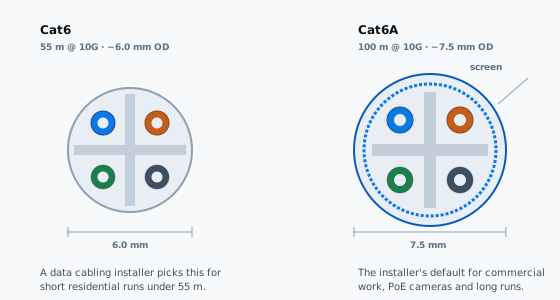
| Cat6 | Cat6A | |
|---|---|---|
| 10 Gbps distance | ~55 m | 100 m |
| Screening | Usually none | Foil screen, alien crosstalk |
| Typical use | Budget residential runs | Commercial, PoE cameras, long runs |
Labelling is not a courtesy — it is required under the Wiring Rules, and a data cabling installer who skips it is leaving a fault-finding problem for whoever visits next. Every outlet and every patch panel port gets a matching label at both ends, recorded against a plan or spreadsheet, so the next person to open the rack can work out what they are looking at without pulling a tone generator through the ceiling first.
Where the termination lands also matters legally. A restricted cabler may terminate a socket or a network termination device, but not a main distribution frame or a patch panel — which rules out most commercial fit-outs entirely. Open class covers all of it, which is the class almost every commercial data cabling job in Brisbane actually needs.
Testing: how a data cabling installer proves the job, not just claims it
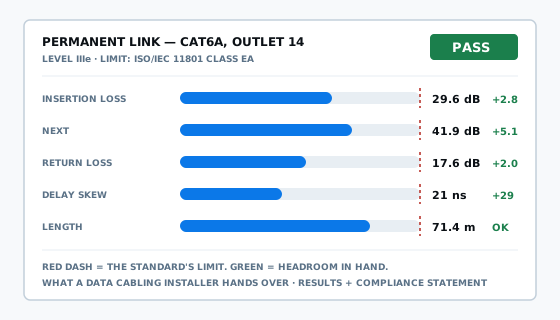
A link light proves continuity. It does not prove performance, and plenty of terminations negotiate a gigabit on a short run and fail completely once the run gets long or the building fills up with electrical noise nearby. The only way to know for sure is to certify the link against the standard it was installed to, using a proper cable tester rather than a cheap continuity checker.
What gets measured
Insertion loss, near-end crosstalk, return loss, delay skew and length, on all four pairs, at both ends, against the limit for the category installed.
Headroom, not a bare pass
A result that scrapes in with a fraction of a decibel to spare will fail in a few years as a termination ages. Margin in hand is the sign the work was done properly.
Why it takes time
Testing an office full of points properly can take an afternoon on its own. Skipping it saves the installer time and hands the risk straight to you.
Handover: what a data cabling installer hands you at the end
The job is not finished when the last patch lead is plugged in. Under section 25 of the Cabling Provider Rules, a written compliance statement has to be given to you as soon as practicable after the work — and it must be supplied regardless of whether you have paid the invoice yet. That statement carries the installer's name, contact details and proof of registration, identifies the work done, and states that it complies fully with AS/CA S009:2020, the Wiring Rules.
Alongside the statement you should get the test results for every permanent link and a labelling record showing which port maps to which outlet. A registered data cabling installer keeps a copy of the compliance statement for at least a year and has to produce it to the ACMA on request, so there is no good reason for it to be missing from your paperwork either.
Ask before the job starts, not after: whether the compliance statement is automatic or something you have to chase, and whether the test results come as raw numbers or a proper pass report you could hand to an insurer or a landlord. The answer tells you a lot about whether the data cabling installer treats paperwork as part of the job or as an afterthought.
A home job looks nothing like an occupied office fit-out
The five stages stay the same, but a data cabling installer runs them completely differently depending on the site. Knowing which situation you are in helps you read a quote properly and set reasonable expectations about how long the job actually takes.
A house with roof access
Usually one installer, often finished in a day for a handful of points. Cable drops through the roof cavity into wall cavities, the only opening is the one the wall plate covers, and there is nobody else on site to work around.
An occupied commercial fit-out
Staged by floor or zone, cutover scheduled after hours, old cabling left live until the new links are tested and proven. Real coordination with cleaners, security and other trades, not just a bigger version of the house job.
Either way, a data cabling installer plans the sequence around the site rather than the other way round. Slab-on-ground homes with no roof access are the honest exception — surface duct or a partial ceiling opening usually has to be discussed before the job starts, and it is worth raising at quote stage rather than finding out on the day. A home network cabling job and a fully staged office rollout are the same trade, run at very different paces.
Who should actually be on site
There is exactly one lawful way for someone without a registration to touch the cabling: a section 21(d) direct supervision arrangement. The supervisor has to hold a registration covering that kind of work, meet the specific competency requirements for it, and accept full responsibility for what gets done — and "directly supervised" means present on site, not contactable by phone from another job.
That requirement is set out in the Telecommunications (Cabling Provider) Rules 2025, and it applies to a single point in a house the same as a forty-point fit-out. It is worth asking any data cabling installer plainly who will be pulling and terminating your job, and whether that person holds the registration themselves or is working under one.
The role is different from a cabling technician's, which covers the hands-on skills rather than who is legally responsible for the job — that distinction, and where an apprentice fits in, is covered on the page about what a data cabling technician does. On the ground the two roles often overlap, especially on a small operation.
Choosing between data cabling installers in Brisbane
Once you know the five stages, comparing quotes gets a lot easier — you are checking whether each one is actually planning to do all five, not just the parts that show.
Registration and class
Ask for the number and whether it is open or restricted. Anything landing at a patch panel needs open class.
Cable named, not vague
"Data cable" on a quote line is not a specification. Cat6 or Cat6A, stated plainly, is.
Testing included
Ask whether certification is in the price or an add-on, and what results you actually receive.
Compliance statement
Confirm it is issued automatically at handover, not something you have to request weeks later.
Labelling covered
Should be in the base price, not a line item that appears once the quote is accepted.
Who's actually on site
The registered data cabling installer themselves, or someone under their direct supervision. Ask, and listen to how the question lands.
A council job or a school fit-out adds tender paperwork and evidentiary requirements on top of the federal cabling rules — the detail lives on the page for government data cabling contractors, but the actual work on the ground follows the same five stages as any other install. What changes is the paper trail expected around it, not the cabling itself.
If price is the only thing separating two quotes, go back to the checklist above before deciding — the number behind a data cabling cost is usually explained by which of those five items got left out, and testing and certification is the one that gets cut most often because it is invisible until something fails.
Data cabling installer questions Brisbane clients actually ask
What does a data cabling installer actually do on the day, step by step?
Five stages in order: scope the job and confirm the quote, pull cable to every point before ceilings or walls close up, terminate it onto outlets and a patch panel, test every link against the standard it was installed to, then hand over the results and the paperwork. That order is what separates a data cabling installer from someone just pulling cable. Skipping the order, not just a step, is usually where a job goes wrong.
How long is a data cabling installer on site for a typical Brisbane office fit-out?
It depends entirely on point count and access, not floor size. A straightforward 20-point fit-out with an open ceiling might run two to three days for rough-in, termination and testing combined. A heritage building with masonry walls and no roof cavity can take the same crew twice as long for half the points.
Does a data cabling installer need to be a registered cabler to work in my house?
Yes, with no exception for residential jobs. Section 21 of the Telecommunications (Cabling Provider) Rules 2025 requires anyone connecting cabling to a telecommunications network to be a registered cabling provider, or directly supervised at all times by one. It applies to a single data point in a spare room the same as an office fit-out.
What should a data cabling installer hand over when the job is finished?
Test results for every permanent link, and the written compliance statement required under section 25 of the Cabling Provider Rules — the installer's name, contact details, proof of registration, what work was done, and confirmation it complies with the Wiring Rules. It is owed regardless of whether the invoice has been paid.
Why do data cabling installers leave cable long during rough-in instead of cutting it to length?
Because the exact termination point often shifts before a fit-out is finished — a desk moves, a wall plate gets repositioned, a patch panel port gets reassigned. Cable left long at both ends during rough-in absorbs that change for free. Cut it short too early and a small layout change turns into a re-pull.
Can a data cabling installer work around staff in an occupied Brisbane office?
Yes, and most commercial rough-in and termination happens exactly that way. Work is staged floor by floor or zone by zone, cutover to new links is scheduled outside trading hours, and the old cabling stays live until the new runs have been tested and proven. A data cabling installer running it properly treats the trading day as fixed and works everything else around it.
What happens if a data cabling installer skips the testing step?
The job looks finished because the link light comes on, but a link light only proves basic continuity, not performance. A termination with excess untwist or a bend radius that's too tight can carry a gigabit on day one and drop out or fail at 10 gigabit later — and without a test result, there's no record of what was actually installed.
How do I compare quotes from different data cabling installers in Brisbane?
Ask the same four questions of each one: which cable category is specified, is testing and certification included in the price, is a written compliance statement issued at handover, and what is their registration number and class. A quote that answers all four clearly is usually the one worth taking, even if it isn't the cheapest on the page.
Get a data cabling installer quote
Tell me what the building is, roughly how many points, and whether it is occupied while the work happens. That is usually enough to scope a fixed quote — cable named, testing included, compliance statement issued at the end.
Or call 07 3521 8082. If it goes to voicemail I am up a ceiling somewhere; leave a message and I will call back.
Work done by an ACMA registered cabler no. 42489 All work to AS/CA S009:2020