Greater Springfield, south-west of Brisbane
Data cabling Springfield: built into a master-planned city, not bolted on afterwards
Greater Springfield is Australia's largest master-planned community — a purpose-built city planned from open paddocks in 1991, not a heritage town stretched to fit modern data. Data cabling Springfield work spans a town centre older than most Australian shopping strips get to be, a hospital precinct that only finished opening this year, and new estates still going up in Spring Mountain — same registered cabler, same standard, different starting point every time.
ACMA registered cabler no. 42489 Installed to AS/CA S009:2020 Compliance statement every job
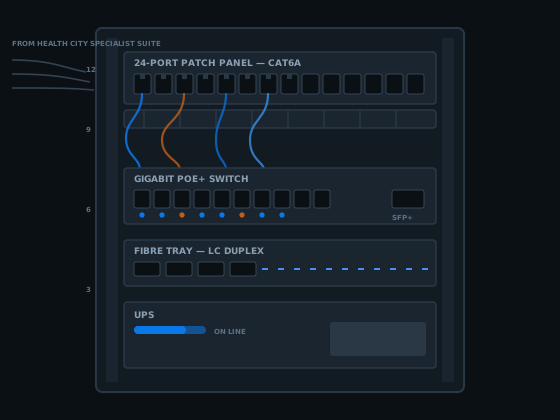
Most of South East Queensland grew the way growth normally happens — a subdivision here, an infill block there, a mix of eras stitched into one suburb over decades. Greater Springfield didn't. The whole 2,860 hectare footprint was bought as one parcel in 1991 by Maha Sinnathamby and Bob Sharpless, planned as a single city from the start, and built out estate by estate against that plan ever since. That makes data cabling Springfield work sit alongside the wider data cabling Brisbane page in one sense — same rules, same registration — but genuinely different in how the buildings themselves were put together.
What still varies inside that masterplan is the era. A Springfield Lakes home from the early 2000s and a Spring Mountain home going up this year were both built under the same city plan, just two decades of construction practice apart — and that gap, not the suburb name, is what most data cabling Springfield quotes actually price for. The rest of this page covers that split, plus what makes Springfield's own commercial and health precinct unlike anywhere else this business works.
What data cabling Springfield jobs cover
Strip away the masterplan branding and data cabling Springfield work is the same trade it is everywhere: fixed cable, wall plates, patch panels and a comms point everything else plugs into. What changes here is the starting condition. A job in an original Springfield Lakes street is a retrofit into a twenty-year-old house, same as a retrofit anywhere. A job in a Spring Mountain display-home release, or a fitout in one of the specialist suites going up around the new Springfield Central hospital, is closer to a new-build commercial job — cabling designed in before the walls close, not squeezed in after.

The 100 metre channel limit doesn't care which era the building belongs to — 90 metres of fixed cable plus up to 10 metres of patch leads at each end, same as any other data cabling Springfield job or any job in Brisbane proper. What actually decides whether a run is straightforward is access: a roof cavity with clear rafters, a comms cupboard already stubbed with conduit, or neither.
Australia's largest master-planned community, one build order at a time
Greater Springfield is routinely described as Australia's largest master-planned community and among the ten largest in the world — a 2,860 hectare city bought as farmland in 1991 by developer Maha Sinnathamby and his business partner Bob Sharpless, and built out since under a single masterplan rather than a patchwork of separate developer applications. The 2021 census put the population at roughly 47,000, with growth projected to reach around 105,000 residents by 2030. Six named suburbs make up the footprint as it stands today: Springfield, Springfield Lakes, Springfield Central, Brookwater, Augustine Heights and Spring Mountain, each released at a different point in that thirty-year build-out.
That single-developer model is exactly why data cabling Springfield jobs read differently to jobs in an old Brisbane suburb that grew block by block. The road reserves, the underground services, and increasingly the building stock itself were planned against one masterplan document rather than inherited piecemeal — a genuinely different starting point for anyone pulling cable, and the reason this page exists separately from the rest of the region.
Housing eras: Springfield Lakes to Spring Mountain
Springfield Lakes was officially named in 2000, with its first residents arriving in the years either side of that and its state primary school opening in 2007 — this is the established core of Greater Springfield, brick veneer and roof-cavity homes now old enough that a data cabling Springfield job here is a genuine retrofit: cable dropped through the roof space into a wall cavity, same as any twenty-year-old Brisbane house. Spring Mountain, by contrast, is still releasing new stages under the Springfield Rise banner — The Boulevard, Creekwood, Forest Ridge and several more — and is close to the last significant undeveloped land left inside the masterplan.
New-build homes across current Springfield releases increasingly come with a basic conduit or data riser stubbed in during construction, because project builders in growth corridors like this one now spec for it as standard rather than an afterthought — though the exact provision varies by builder, so it's worth confirming what's actually in the wall before assuming a clear path exists. An older Springfield Lakes home has none of that, and the cable has to find its own way through an existing roof cavity instead.
The precinct that changes the job
Data cabling Springfield's Health City precinct
Springfield Central carries a health and education precinct with no real equivalent anywhere else this business services. Mater Private Hospital Springfield opened in 2015 as an 80-bed, $85 million facility with four operating theatres, and it now sits beside the new Mater Public Hospital Springfield — a nine-storey, 186-bed hospital that opened in phases through April and May 2026, built with $638 million of Queensland Government funding. It carries an emergency department, an intensive care unit, six operating theatres and Greater Springfield's first maternity unit: 16 patient rooms, 16 neonatal cots and six birth suites, expected to deliver around 1,700 babies a year. Close to 1,000 staff work across the combined site.
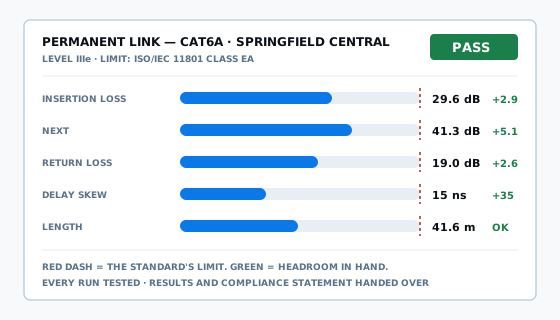
None of that hospital construction is a data cabling Springfield job I'd claim credit for, but it reshapes what gets asked for around it. Specialist suites and private practices are leasing space through Springfield's Health City precinct specifically to sit near the hospital and the University of Southern Queensland's Springfield campus, which opened in February 2006 and added a $45 million four-storey teaching building in 2015. Every one of those suites needs its own data cabling Springfield fitout — a reception point, consult-room outlets, phones, and often a camera or access-control run — independent of whatever the hospital itself is doing.
NBN across Springfield's estates — check the street, not the suburb
Network technology in Greater Springfield splits along much the same line as the housing stock. Established pockets of Springfield Lakes and Springfield Central were connected through nbn's original rollout on fibre to the node, using copper already in the ground from when those streets were first built. The newest stages releasing in Spring Mountain are going in as fibre to the premises instead, laid at construction under nbn's new-developments program rather than retrofitted later. Neighbouring stages of the same estate can land on different technology depending on when each was actually built, so it's worth checking the specific address before assuming — the same caution that applies to any data cabling Springfield quote that touches the NBN boundary.
Commercial data cabling Springfield businesses actually need
Orion Springfield Central is the town centre end of the data cabling Springfield job — a shopping and office precinct that opened its first stage in March 2007 and has grown to around 200 retailers anchored by Woolworths, Coles, Big W, Target and Event Cinemas, built around a main street and town square rather than a conventional mall layout. Every tenancy fitout and refit in a centre like that needs the same things: point-of-sale and EFTPOS runs, back-of-house network cabling, security camera drops, and a network that survives the fit-out cycle a retail lease goes through every few years — comparable in every respect to a commercial data cabling job anywhere else in Brisbane.
The other side of Springfield's commercial spine is Parkside, a roughly 600,000 square metre business park that includes the Polaris Data Centre — a carrier-neutral facility spanning five levels with more than 9 megawatts of IT capacity and its own dark-fibre ring back to the Brisbane CBD. The office suites and business tenancies around a landmark like that are the actual data cabling Springfield jobs on offer here, not the data centre itself, which runs to its own specialist contracts. A Parkside office fitout gets staged and terminated the same way as any ethernet cabling installation solutions job on an occupied floor — cutover after hours, old links live until the new ones test clean.
Why registration matters for a Springfield job too
The rule that governs data cabling Springfield work is federal, the same as everywhere else this business operates. Fixed cabling that connects to a telecommunications network must be installed by a registered cabling provider, or by someone directly supervised at all times by one, under section 21 of the Telecommunications (Cabling Provider) Rules 2025. It doesn't matter whether the site is a brand-new Spring Mountain display home or an established Springfield Lakes house — the requirement is identical, and it sits separately from any electrical licence under Queensland's Electrical Safety Act 2002, section 55(3).
Every data cabling Springfield job runs under the same ACMA cabler registration as work carried out anywhere else on this site — registration no. 42489, open class, which covers structured, fibre and coaxial cabling without a separate endorsement for each category. The same registered data cabler who covers Brisbane covers Springfield, and every job gets the written compliance statement required under section 25 — supplied whether or not the invoice has been paid yet, and worth keeping alongside whatever paperwork came with a new house or a hospital-precinct lease.
Cat6 or Cat6A for a data cabling Springfield install
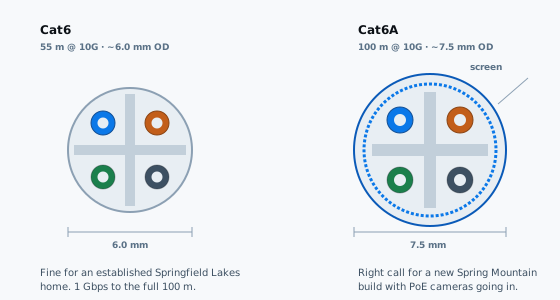
The housing-era split makes this an easier call than usual. A Springfield Lakes or Augustine Heights home with runs under 30 metres does the job fine on Cat6 — gigabit to the full 100 metres, and the labour cost is identical to Cat6A either way. A new Spring Mountain build going in with a PoE camera, an access point ceiling drop and the possibility of 10 gigabit switching down the track is better served starting with Cat6A, because re-pulling cable through a finished new home is a much bigger job than doing it once, properly, while the walls are still open.
| Cat6 | Cat6A | |
|---|---|---|
| 1 Gbps | 100 m | 100 m |
| 10 Gbps | ~55 m | 100 m |
| Screening | Usually unscreened | Screened against alien crosstalk |
| Outside diameter | ~6.0 mm | ~7.5 mm |
| Suits | Older Springfield Lakes & Augustine Heights homes | New Spring Mountain builds, PoE, Health City suites |
What data cabling Springfield quotes actually cost
Access moves a data cabling Springfield quote more than the cable does, same as anywhere. An established Springfield Lakes home with a clear roof cavity is a straightforward job. A two-storey Brookwater home with limited roof access, or a specialist suite fitout going into a shell that hasn't had its ceiling grid installed yet, takes longer for the same outlet count. Structured cabling is generally priced per outlet — cable, both terminations, wall plate, patch panel port, testing and labelling — with the per-point rate dropping as the count rises. Fault finding and small additions are priced hourly instead, and the full breakdown of how those numbers actually get built sits on the data cabling cost page.
Home network cabling in Springfield houses
A lot of residential data cabling Springfield enquiries start as a Wi-Fi complaint, whichever era the house belongs to. One router in the corner of a double-storey Brookwater home, or a Spring Mountain build with a study at the far end of the floor plan, both struggle the same way — a single cabled ceiling point roughly central to the house, feeding a proper access point, fixes more coverage problems than any router upgrade. In an established Springfield Lakes home that point comes down through the existing roof cavity; in a new build it can go in before the ceiling closes.
Either way, the detail on planning it room by room, including installing data points that will actually get used, sits on the home network cabling page.
Springfield and the suburbs around it
Data cabling Springfield work doesn't stop at the masterplan boundary. West along the same growth corridor, data cabling Ipswich covers the older heritage core and the neighbouring Ripley Valley estates, sharing a lot of the same new-estate housing stock as Spring Mountain without the health precinct. South, data cabling Logan covers its own growth corridor on the other side of the Logan River. Both get quoted the same way a Springfield job does — access first, cable category second, testing always included.
Toward Brisbane proper, the same registered cabler covers any data cabling installation in Brisbane work, and a data cabling Springfield commercial job travels further than a residential one if the site is worth the drive — a Springfield business park fitout is no different to one in the CBD once the van is loaded. Ask, rather than assume it's out of range.
Data cabling Springfield questions we get asked
How is data cabling different in an early-2000s Springfield Lakes home compared to a new Spring Mountain build?
A data cabling Springfield job in an early-2000s Springfield Lakes home is a straightforward retrofit — cable drops through the roof cavity into a wall cavity, same as any established Brisbane house. A new Spring Mountain build often has a basic conduit or data riser already stubbed in during construction, so the cable has a purpose-built path instead of finding its own way through an existing roof space.
What data cabling does a specialist suite in Springfield's Health City precinct need?
A typical specialist suite needs a reception point for booking and payment systems, data outlets in each consult room for records and imaging, phone lines, and often a camera or access-control run given the building sits inside a hospital precinct. Each private practice fits out its own tenancy separately from whatever the hospital itself is doing.
Is nbn fibre to the premises available in the newest Spring Mountain estates?
Genuinely new releases in Spring Mountain are generally connected as fibre to the premises under nbn's new-developments program, built in at construction rather than retrofitted. Older stages of the same estate can sit on different technology, so any data cabling Springfield quote should check the specific address rather than assume the whole suburb matches.
Do new Springfield homes already have conduit for data cabling installed?
Many project homes built in recent Springfield releases include a basic conduit or riser for future data cabling, because builders in growth corridors increasingly spec for it as standard. It is not universal across every builder or every stage, so it is worth confirming what is actually in the wall before a quote assumes a clear path exists.
What data cabling does a tenancy at Orion Springfield Central need?
A retail tenancy needs point-of-sale and EFTPOS runs, a back-of-house network switch, and usually a security camera drop, wired to survive the fit-out cycle a lease goes through every few years. An office tenancy in the surrounding precinct needs the same basics without the point-of-sale hardware.
Can data cabling be installed in an occupied office at Springfield's Parkside business park without stopping trade?
Yes. A data cabling Springfield job in an occupied office is pulled and terminated in stages, cutover happens after hours or on a weekend, and the existing links stay live until the new ones have been tested and proven — the same approach used on any occupied commercial floor, Parkside included.
Is Cat6 enough for a Brookwater or Augustine Heights home, or does it need Cat6A?
For most Brookwater or Augustine Heights homes with runs under 30 metres, Cat6 is the right call — gigabit to the full 100 metres, and the labour cost is identical either way. Cat6A earns its place when PoE cameras, an access point ceiling drop, or future 10 gigabit switching are part of the plan.
How many data points does a new Spring Mountain home typically need?
Most new Spring Mountain builds get cabled for a study or home office, the main living area for a smart TV and streaming box, and a ceiling point roughly central to the floor plan for a wireless access point. Three to five outlets covers most four-bedroom new builds comfortably.
Who do I call for a data cabling fault in a Springfield Central office or specialist suite?
A registered cabler, not the IT helpdesk. A data cabling Springfield fault — ports negotiating at 100 megabit instead of gigabit, intermittent drops after a fitout, or a run cut during other trades' work — is a physical layer problem, and tracing it means testing the actual link against the standard rather than guessing at software fixes.
Get a data cabling Springfield quote
Tell me what the building is — an established Springfield Lakes house, a new Spring Mountain build, or a specialist suite or office fitout in Springfield Central — and roughly how many points you need. Most data cabling Springfield quotes can be scoped from a few photos. If it's a fault rather than an install, say what it's doing; that usually narrows it down before anyone drives out.
Or just call 07 3521 8082. If it goes to voicemail I am up a ceiling somewhere; leave a message and I will call back.
ACMA registered cabler no. 42489 All work to AS/CA S009:2020