Brisbane & South East Queensland
Commercial data cabling testing: a link light is not a pass
Commercial data cabling testing is the step that turns a bundle of terminated cable into something you can prove. Every permanent link swept against the standard it was built to, every measured value handed over, and the written compliance statement that has to come with it.
ACMA registered cabler no. 42489 Swept to 500 MHz for Cat6A Results on every link
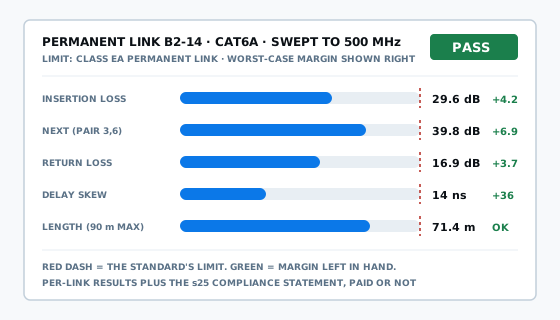
There is one moment in a cabling job where the work either holds up or quietly does not, and it happens after everyone has packed up. Commercial data cabling testing is that moment. It is the only part of the process that produces evidence rather than opinion, and it is the first line a cheap quote deletes.
I want to be blunt about why this page exists. Most buyers cannot read a test report, so most reports never get read, so plenty never get produced. This page is the reading guide. By the end of it you will know what commercial data cabling testing measures, what each number is actually telling you, and which piece of paper the law says you are owed.
Why commercial data cabling testing starts with distrusting the link light
Plug a laptop in, the port lights up, everyone relaxes. That light means a switch and a network card agreed on something, which is a far smaller claim than commercial data cabling testing makes. It does not mean the cable meets any standard, and it does not even mean all four pairs are connected.
100BASE-TX uses two pairs. Pairs three and four can be broken, crossed, or terminated on the wrong pins entirely and the link will still come up at 100 megabit and pass traffic all day. Someone will notice eighteen months later when a gigabit switch goes in and half the floor negotiates down.
Gigabit needs all four pairs. So does 10GBASE-T, which transmits on all four at once and relies on the receiver stitching the streams back together. Four-pair PoE at 802.3bt pushes current down every conductor. The margin for a lazy termination has been shrinking for twenty years, which is exactly why commercial data cabling testing has stopped being optional on anything that matters.
The short version: a link light proves connectivity. A certification result proves performance against a published limit. They are not the same claim, and only one of them survives an argument with an insurer, a landlord or an incoming IT provider.
Three different jobs, three different prices
Commercial data cabling testing: verification, qualification and certification are not synonyms
The word "tested" gets used for all three, which is how quotes end up looking identical when they are not. Here is the actual hierarchy, cheapest to most rigorous.
Verification
Continuity and wire map. Does each pair land on the right pins at both ends, with decent contact. A hundred-dollar tester does this. Fine for finding a dead outlet, useless as evidence, and blind to a split pair.
Qualification
Everything verification does, plus a judgement on whether the link will carry a nominated application — voice, 100 megabit, gigabit. Useful for troubleshooting an existing site. It does not test against the cabling standard.
Certification
A full frequency sweep of every parameter against the limits for the category installed, with a recorded pass or fail and the measured margin. This is what commercial data cabling testing means when the word is used properly.
Certification is the only tier that produces a defensible document. It sweeps the link across its whole band — 100 MHz for Cat5e, 250 MHz for Cat6, 500 MHz for Cat6A — and records the worst-case result at every frequency step, not a single reading.
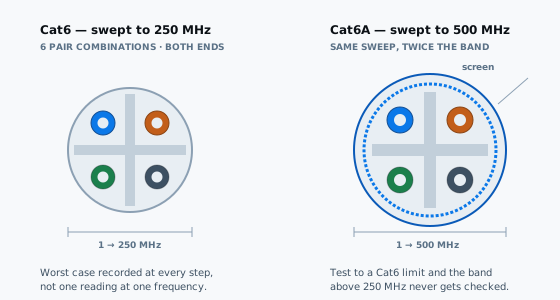
Both categories carry gigabit to 100 metres. The reason Cat6A gets swept to twice the frequency is that 10GBASE-T occupies twice the band, and a link that looks perfect at 250 MHz can fall apart above it. Testing to the wrong limit is a quiet way of producing a report that means nothing.
Permanent link or channel — what commercial data cabling testing measures against
This is the single most useful thing a buyer can learn to check, and it takes ten seconds. All commercial data cabling testing is measured against one of two definitions, and they are not interchangeable.

Permanent link — 90 m
The fixed cabling only: the patch panel port, the run through the building, and the outlet. The tester's own calibrated reference cords are excluded from the result. This is the part the installer built and the part the installer is answerable for.
Channel — 100 m
End to end, including your patch leads at both ends. Up to 10 metres of cords on top of the 90 metre fixed run. The limits are looser because more connections are allowed for, and the leads are yours to swap tomorrow.
Ask for permanent link results on new work. A channel result is not wrong, but it measures a combination that includes components the cabler did not supply, and its wider tolerances can carry a fixed run that would not pass on its own. Commercial data cabling testing that only ever reports channel figures is worth a question.
There is a third case worth knowing: a run that terminates directly on a plug at the far end for a camera or an access point, with no outlet. That is a modified permanent link, it has its own limit, and it should be labelled as one on the report rather than quietly tested as something else.
What commercial data cabling testing actually measures
A certification report is not one test. Commercial data cabling testing runs nine or ten measurements per link, most of them on every pair combination, in both directions. Here is the list and what each one is for.
| Parameter | What it measures | Why it matters |
|---|---|---|
| Wire map | Pin-to-pin continuity, shorts, opens, reversals, split pairs | Catches the crossed pair that a link light hides |
| Length | Electrical length per pair, using the cable's velocity figure | Flags runs over 90 m before anything else fails |
| Propagation delay | Time for a signal to travel the link | Bounded so equipment timing assumptions hold |
| Delay skew | Difference between the fastest and slowest pair | 10GBASE-T uses all four pairs at once; skew breaks it |
| Insertion loss | Signal lost along the link, in dB | Distance, heat and bad terminations all show here |
| NEXT / PS NEXT | Crosstalk at the end nearest the tester | The classic termination-quality parameter |
| ACR-F / PS ACR-F | Far-end crosstalk relative to loss | Bites hardest on long runs |
| Return loss | Signal reflected back by impedance changes | Finds crushing, kinks and tight bends |
The "PS" versions are power-sum results: the combined effect of the other three pairs on the pair being measured, rather than one pair at a time. They matter because real traffic does not politely use one pair while the others sit idle.
For Cat6A there is a further layer — alien crosstalk between neighbouring cables in the same bundle, which is what the screen exists to suppress. It is measured rarely in the field because it is slow and awkward, and honest commercial data cabling testing says so rather than implying it was covered.
What a commercial data cabling testing failure is telling you
This is the part worth reading twice, because each parameter fails for a different physical reason. A report that says FAIL is not a mystery — it names the fault if you know the translation.
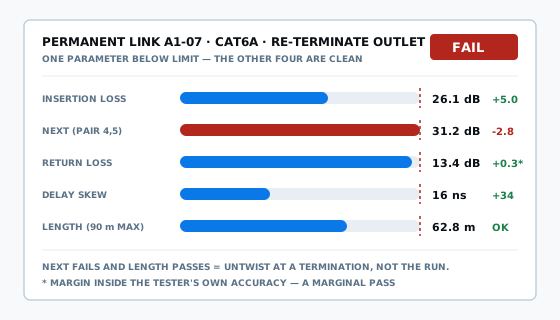
NEXT fails
Untwist at a termination, nearly every time. The twist is what cancels crosstalk; strip back too far or fan the pairs out to make a punch-down look neat and the cancellation stops working. Re-terminate that end and it goes away.
Insertion loss fails
The run is too long, the cable is not what the label claims, or a termination is adding resistance. Copper-clad aluminium sold as copper shows up here first. So does a cable baking in a Brisbane roof cavity in February.
Return loss fails
Something changed the impedance. A cable tie done up with pliers, a kink from a pull around a purlin, a bend tighter than the cable allows, or 23 AWG cable jammed into a jack built for 24 AWG. Damage during the pull, not a design problem.
Delay skew fails
Pairs with different insulation travelling at different speeds — usually a cheap or mixed-construction cable. Two-pair applications never notice. 10 gigabit does, because it cannot reassemble streams that arrive too far apart.
Length fails
Either the run genuinely exceeds 90 metres, or the tester's velocity setting does not match the cable. The first one is a design fault that should have been caught when the comms room location was chosen, not on test day.
Wire map fails
Crossed pairs, an open conductor, or a split pair — where both conductors of a "pair" come from different real pairs. Split pairs are nasty: continuity looks perfect and NEXT collapses. Only a proper sweep catches them.
The reason I go through this in detail is that a fault on a report is cheap to fix on the day the ceiling is still open and expensive once the fitout is finished. Commercial data cabling testing done at handover, rather than after the tenant moves in, is the difference between a re-termination and a room full of furniture that has to be moved.
It also changes how you read a quote. If the same person pulls the cable, terminates it and tests it, the incentive to find problems is weaker than if commercial data cabling testing results are handed to you as raw files rather than a one-page summary that says everything passed.
Headroom: why commercial data cabling testing should never stop at a bare PASS
Every certification result carries a margin — how far the worst measurement sat from the limit, in decibels. That margin is the number I care about, and it is the one that summaries of commercial data cabling testing quietly drop.
A link with several decibels in hand was built with room to move. A link that passed by three tenths of a decibel is technically compliant and practically fragile. Terminations relax over years. Patch leads get swapped for whatever is in the drawer. A roof cavity in a Brisbane summer runs hot, and insertion loss rises with temperature.
The asterisk
When a measured value sits closer to the limit than the tester's own published accuracy, the result gets marked with an asterisk. ANSI/TIA-1152 sets that convention. A marked pass counts as compliant under the standards — but it means the tester cannot honestly separate that link from the limit.
What I do about it
On new work, a marginal pass gets re-terminated and re-tested rather than accepted. It costs twenty minutes on the day. Explaining a flaky link two years later, on a site where nobody remembers who touched what, costs considerably more than that.
None of this is in the standard, to be clear. The standard cares about pass or fail and nothing else. Headroom is a judgement about how long the install will last, which is precisely why commercial data cabling testing results should reach you with the margins intact instead of a summary page with a green tick on it.
One question that sorts most quotes: ask to see a sample report from a previous job with the per-link margins showing. Anyone doing commercial data cabling testing properly can produce one in about a minute. It is a fair question and it is not rude to ask it.
The compliance statement commercial data cabling testing does not replace
Test results are technical evidence. The compliance statement is a legal document, and it is a separate thing. Both arrive at the end of a job, and treating commercial data cabling testing as a substitute for the statement is the most common misunderstanding I run into.
Fixed cabling that connects to a telecommunications network can only be installed by a registered cabling provider, or by someone directly supervised at all times by one. That comes from section 21 of the Telecommunications (Cabling Provider) Rules 2025, which commenced on 31 March 2025. Registration is issued to individuals, never to companies.
Section 25 then requires a written statement of compliance to be given to the customer after the work. Subsection (3) is the one worth memorising: the statement must be supplied regardless of whether payment has been made. It is not leverage and it is not an upsell.
What the statement says
That the cabling was installed in accordance with the mandatory standard, AS/CA S009:2020 — the Wiring Rules — along with who did the work and under which registration. The standard itself is a free download from the Australian Telecommunications Alliance.
What it does not say
Anything about performance. A compliance statement does not tell you a link carries 10 gigabit or that the margins were healthy. That is what the test report is for, and it is why commercial data cabling testing and the statement are two deliverables rather than one.
Worth checking who is signing it. There are three registration classes — open, restricted and lift — and a restricted registration specifically does not authorise work terminating at a main distribution frame or a patch panel, which covers essentially all commercial structured cabling. You can look up how the classes work on the ACMA cabler registration pages. Work on this site is carried out by an ACMA registered cabler, registration no. 42489, open class.
What a proper commercial data cabling testing handover looks like
Four things should land in your inbox when commercial data cabling testing is finished. If you get fewer than four, ask why before the last invoice gets paid.
Per-link results with margins
One record per link, showing the limit applied, the measured worst case and the margin for every parameter. Labelled to match the patch panel and the outlet, so the report is usable a year later by someone who was not there.
The test set-up recorded
The limit selected, the cable type, and the date. A report that does not say which limit it was measured against is not evidence of anything — Cat6A cable tested to a Cat6 limit will pass comfortably and mean nothing.
The compliance statement
Written, signed, with the registration number on it, supplied whether or not you have paid. Keep it with the building records — landlords, insurers and the next IT provider all eventually ask.
Labelling that matches
Both ends labelled, and the labels matching the report. Labelling is a requirement under the Wiring Rules, not a nicety, and a report you cannot tie to a physical port is only half useful.
All of that sits alongside the physical side of the job — how the rack is built, how the patching is dressed, where the panels sit. There is a full walk-through of that in the comms room and rack installation guide, and it matters here because a rack you cannot trace is a rack where the test records stop being useful the first time someone moves a lead.
What commercial data cabling testing costs, and when re-testing is worth it
On new installs, commercial data cabling testing should already sit inside the per-point price. It is part of the work, not a line item you opt into. If a quote lists it separately, that is a signal about what the base price actually covers.
Standalone commercial data cabling testing on existing cabling is charged hourly. Published Brisbane rates for comparable work sit around the $185 per hour mark for standard hours, and how many links get done in an hour depends almost entirely on access — a tidy comms room with labelled panels moves fast, an unlabelled one does not. The wider breakdown of data cabling costs in Brisbane goes through how the per-point and hourly models compare.
Worth re-testing
Before a switch upgrade to 10 gigabit. Before a lease handover or a make-good dispute. After a fitout where other trades were working above the ceiling. When a site has intermittent faults nobody can pin down.
Not worth it
A handful of links in a small office that already work at the speed you need, with no upgrade planned. Testing for the sake of a folder is money that would be better spent on the two runs you know are marginal.
Re-testing an existing site almost always turns up something. The usual pattern is that most links are fine, a few are marginal, and one or two will not carry what the new equipment needs. Knowing which is which before the switch arrives is the whole value of commercial data cabling testing on an existing building.
The background on how any of this cabling gets designed and installed in the first place is on the network cabling Brisbane overview, which covers the topology, the cable categories and the registration side in one place.
Commercial data cabling testing questions I get asked
Does a link light prove a commercial data cabling testing pass?
No. A switch will negotiate 100BASE-TX on two pairs alone, so a run with a broken or crossed pair on four, five, seven or eight still shows a link light and still moves traffic. Gigabit and 10 gigabit need all four pairs behaving, and so does four-pair PoE. The light tells you something is connected, not that the link meets the standard.
What is the difference between verification, qualification and certification testing?
Verification checks continuity and wire map with a cheap tester — pins land where they should. Qualification goes further and tells you whether the link will carry a nominated application such as gigabit Ethernet. Certification is the only one that sweeps the link across its full frequency range and issues a pass or fail against the cabling standard. They cost different money because they answer different questions.
Should commercial data cabling testing report permanent link or channel results?
Permanent link, for anything newly installed. The permanent link is the fixed cabling the installer is responsible for — patch panel port, the run, and the outlet, up to 90 metres, with the tester's own calibrated reference cords excluded from the result. Channel results include your patch leads, which you can swap tomorrow, and the channel limits are looser. Ask for permanent link.
What does a NEXT failure on a certification report actually mean?
Almost always too much untwist at a termination. Near-end crosstalk is signal leaking between pairs at the end nearest the tester, and the twist is what cancels it. Strip too much jacket, or fan the pairs out to make the punch-down tidy, and the leak goes up. The fix is re-terminating that end properly rather than anything to do with the cable in the wall.
Why did my cabling fail return loss but pass everything else?
Return loss is reflected signal caused by impedance changes along the link. It picks up damage the other parameters shrug off: a cable tie done up hard, a kink from a pull around a sharp edge, a bend tighter than the cable's radius, or a 23 AWG cable forced into a jack designed for 24 AWG. It is the parameter that catches rough handling during the pull.
What does a PASS with an asterisk mean on a cable test result?
It means the measured value sits closer to the limit than the tester's own published measurement accuracy, so the result is inside the uncertainty band. ANSI/TIA-1152 says to mark those with an asterisk. Standards treat a marked pass as compliant, and it is a legitimate result — but on new work it is worth asking why that link is the one hugging the line.
How much headroom should commercial data cabling testing show on a new Cat6A link?
There is no number in the standard — the standard only cares about pass or fail. In practice a freshly installed link with several decibels of worst-case margin has been built with room to age, and one scraping in with a few tenths has not. Terminations relax, heat in a roof space raises insertion loss, and patch leads get swapped. Margin is what absorbs all of that.
Do I get a compliance statement even if I have not paid the cabling invoice?
Yes. Section 25(3) of the Telecommunications (Cabling Provider) Rules 2025 requires the written statement of compliance to be given to the customer regardless of whether payment has been made. It is not a bargaining chip and it is not an optional extra. If a cabler tells you the paperwork comes after the invoice clears, they are describing a rule that does not exist.
Is a compliance statement the same thing as a certification test report?
No, and confusing the two is common. The compliance statement is a legal document under the Cabling Provider Rules saying the work meets the mandatory standard. The test report is technical evidence — measured values, limits and margins for every link. You want both. One satisfies the rules, the other tells you whether the cabling will actually carry what you plan to put on it.
Can commercial data cabling testing be done on cabling installed years ago?
It can be tested and you get a report, which is genuinely useful before a switch upgrade or a lease handover. What you cannot get retrospectively is a compliance statement from someone who did not do the work — that belongs to the cabler who installed it. Re-testing an existing site usually finds a handful of links that will not carry what the new equipment needs.
Get a commercial data cabling testing quote
Tell me how many links, what category the cable is meant to be, and whether the panels are labelled. Those three answers set the time on site for most commercial data cabling testing jobs. If it is a fault rather than a whole site, say what the symptom is.
Or just call 07 3521 8082. If it goes to voicemail I am up a ceiling somewhere; leave a message and I will call back.
ACMA registered cabler no. 42489 All work to AS/CA S009:2020