Brisbane & South East Queensland
Network cabling Brisbane trusts to be right the first time
Network cabling Brisbane businesses and homes actually rely on — Cat6A, fibre and comms rooms, designed to the standard, installed by an ACMA registered cabler, and handed over with test results instead of a promise.
ACMA registered cabler no. 42489 Installed to AS/CA S009:2020 Compliance statement every job
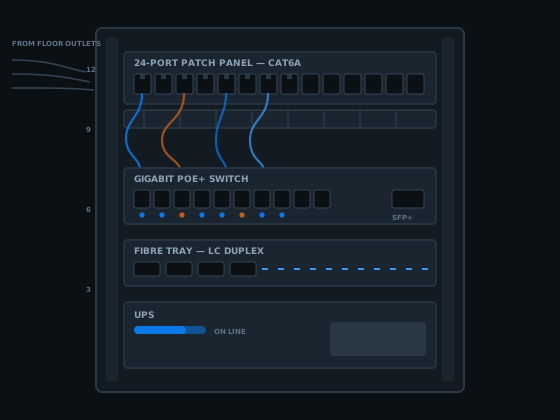
Most of what goes wrong with a building's network was decided on the day the cable went in. Network cabling Brisbane wide gets quoted by a lot of people who do it as a sideline between switchboards and air conditioning — this is the trade itself, done by someone registered to do it, tested on completion, and documented well enough that the next person to open the rack can work out what they are looking at.
Network cabling Brisbane buyers usually compare on price alone, because the quotes all look the same on paper. They are not. The difference sits in the cable specified, whether the links get tested and certified, and whether the person pulling the cable is a registered cabler at all. If you want the numbers behind a quote, start with what network cabling Brisbane work costs.
What network cabling Brisbane jobs actually cover
The cable is the part nobody sees and everybody depends on. Every network cabling Brisbane job is built as a star: each outlet runs back to a central point, nothing daisy-chains, and every run is independent so one damaged cable takes out one desk instead of a floor.

Horizontal cabling
The runs from the comms room out to each wall plate or ceiling point. Copper, and bound by the 100 metre channel limit — 90 metres of fixed cable plus up to 10 metres of patch leads at both ends.
Backbone and risers
Fibre between comms rooms, or between floors. This is what you use when copper runs out of distance, and it is the part that decides whether the building can be upgraded later without a rebuild.
Comms rooms and racks
Patch panels, switches, cable management, labelling and the earth. A tidy rack is not vanity — it is the difference between a ten minute fault find and a half day one.
Outlets and data points
Wall plates, floor boxes, ceiling points for wireless access points, and dedicated runs for cameras, printers and door controllers.
Testing and certification
Every permanent link tested against the standard, results handed over, and the written compliance statement the rules require.
Fault finding and repairs
Ports that negotiate at 100 megabit instead of a gigabit, intermittent drops, a run someone cut during a fitout. Usually a termination, occasionally a rodent.
The bit most quotes leave out
Network cabling Brisbane work is licensed — federally, not by the state
This surprises people, including a fair number of tradespeople. Fixed cabling that connects to a telecommunications network can only be installed by a registered cabling provider, or by someone directly supervised at all times by one who accepts full responsibility for the work. That comes from section 21 of the Telecommunications (Cabling Provider) Rules 2025, which commenced on 31 March 2025.
Queensland does not add an electrical licence on top. The Electrical Safety Act 2002 (Qld) says at section 55(3) that an electrical work licence is not required for the purpose of installing or repairing telecommunications cabling. So "fully licensed electrician" tells you nothing about whether someone may lawfully run your data cabling. The registration is the thing to ask for.
The three registration classes
There are exactly three: open, restricted and lift. Open covers cabling that terminates at a socket, a network termination device or a main distribution frame. Restricted specifically does not authorise work terminating at an MDF or at a patch panel — which is essentially all commercial structured cabling.
Endorsements sit on top
Structured, optical fibre, coaxial, aerial and underground cabling are separate specialised categories. Holding one requires both completing the units of competency and notifying the registrar. An open registration covers all of them; a restricted registration covers only aerial, broadband and underground.
What to ask anyone quoting network cabling Brisbane work: their cabler registration number, which class it is, and whether they hold the endorsement for the specific work you need. Then ask whether the compliance statement comes with the job. Under section 25 it has to be supplied as soon as practicable after the work — and expressly regardless of whether you have paid yet.
The standard all of it is built to is AS/CA S009:2020, the Wiring Rules, which is a free download from the Australian Telecommunications Alliance. It is worth ten minutes of anyone's time who is about to spend real money on cabling.
Commercial network cabling Brisbane: offices, warehouses and fitouts
Commercial network cabling Brisbane work is where the design decisions bite. The 100 metre channel limit sets where the comms rooms go. The number of access points sets how many ceiling runs you need. Whether you are running cameras at 802.3bt decides whether Cat6 is still adequate or whether the whole job should be Cat6A.
Office fitouts
Cabled floor by floor as the partitions go in, with outlets landing where the desks actually end up rather than where the first draft of the plan put them. Coordinated around the other trades so the ceiling does not have to come down twice.
Occupied premises
Staged cutover, out of hours where it needs to be, old links left live until the new ones have been tested and proven. Nobody arrives Monday to a desk that does not work.
Warehouses and industrial
Long runs, high ceilings, and the distance problem arriving early. Usually solved with fibre to a satellite comms cabinet rather than heroic copper.
Cameras, access control and Wi-Fi
PoE cabling is the crossover with a security background — cameras, door controllers and access points are just powered data points, and they are the ones most often forgotten until after the cabling is done.
Home network cabling Brisbane — houses and small offices
Wi-Fi problems in Brisbane houses are usually not Wi-Fi problems. They are one router in the corner of a brick-and-tile house trying to cover a floorplan it was never going to cover. A cabled ceiling point in the middle of the house, with an access point on the end of it, fixes more coverage complaints than any router upgrade — which is why most residential network cabling Brisbane enquiries start as a Wi-Fi complaint.
The runs worth cabling are the ones that will not move: the study, the TV wall, a ceiling point or two for access points, and the NBN termination point if it landed somewhere inconvenient. Cable is cheap on the day the ceiling is open and expensive once it is closed.
Most Brisbane homes with a roof cavity can be cabled with no wall damage at all — the cable drops inside the cavity and the only opening is the one the wall plate covers. Slab homes with no roof access are the exception, and that gets worked out before the job starts, not halfway through.
Cat6 or Cat6A — which network cabling Brisbane buildings actually need
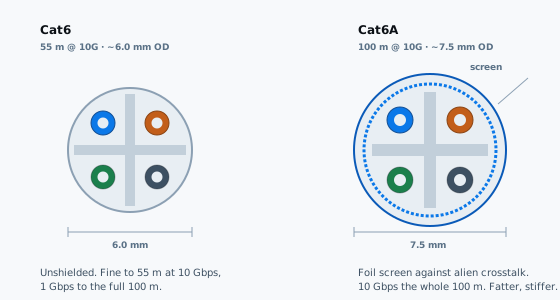
This is the most common network cabling Brisbane question, and the honest answer is that the cable is a small part of the job cost. The labour to pull it is the same either way. The cable is the one component you cannot change later without doing the whole thing again.
| Cat6 | Cat6A | |
|---|---|---|
| 1 Gbps | 100 m | 100 m |
| 10 Gbps | ~55 m | 100 m |
| Screening | Usually unscreened | Screened against alien crosstalk |
| Outside diameter | ~6.0 mm | ~7.5 mm |
| Pathway impact | More cables per conduit | Fewer — plan tray and conduit for it |
| Sensible for | Short runs, budget residential | Commercial, PoE cameras, anything long-lived |
Rule of thumb: if the building is commercial, if the runs are long, or if you are putting PoE cameras and access points on it, install Cat6A. For a three bedroom house where the longest run is 30 metres, Cat6 is not a compromise — it is the right cable.
Testing and certification — what separates network cabling Brisbane work from cable pulling
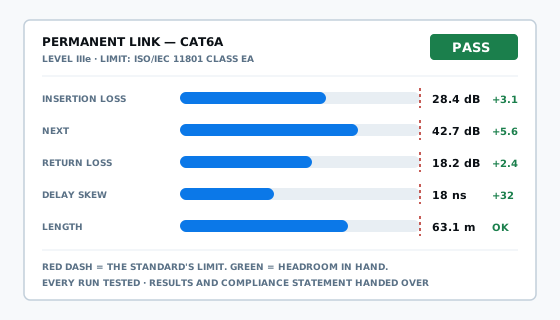
A cable that carries a link light is not a cable that passes. Plenty of terminations will negotiate a gigabit on a short run and fail completely once the run is long or the building fills up with electrical noise. The only way to know is to test the link against the standard it was built to — and it is the step network cabling Brisbane quotes most often leave out.
What gets measured
Insertion loss, near-end crosstalk, return loss, delay skew and length — on all four pairs, at both ends, against the limit for the category installed.
Headroom, not just pass
A link that scrapes in with 0.2 dB to spare will fail in three years when a termination ages. Headroom is what tells you the install was done properly.
The paperwork
Test results plus the written compliance statement required by section 25 of the Cabling Provider Rules. Keep it — it is what an insurer or a landlord will ask for.
What network cabling Brisbane rates actually look like
Almost nobody in this trade publishes numbers, which makes network cabling Brisbane quotes hard to compare. Here is how the pricing actually works, so you can read one.
Priced per point
Most structured cabling is quoted per outlet installed — cable, termination at both ends, wall plate, patch panel port, testing and labelling. The per-point rate falls as the count rises, because the setup and access cost is shared across more outlets.
Priced hourly
Fault finding, small additions and callouts are hourly. Published Brisbane rates for comparable work sit around the $185 per hour mark for standard hours, with after-hours and emergency work carrying a premium.
What moves the number most is access, not cable. A single outlet into a room with a roof cavity above it is straightforward. The same outlet in a two storey rendered building with no cavity access is a different job entirely. That is why nobody serious quotes network cabling Brisbane work over the phone without either seeing it or asking a lot of questions first.
Three things to check on any cabling quote: is testing and certification included or extra; is the cable specified by category and brand or just called "data cable"; and does the price include making good and labelling. Those three are where cheap quotes get cheap.
Where we take network cabling Brisbane wide
Brisbane metro is home ground for network cabling Brisbane work — north and south side, the CBD and the inner industrial belt. Beyond that: Ipswich, Logan, Redlands, North Lakes, Springfield, the Gold Coast, the Sunshine Coast and Toowoomba.
Residential work stays closer in, because a two hour round trip for a single data point does not make sense for anyone. Commercial work travels further — if the job is worth the drive, it is worth asking. Out west, data cabling in Ipswich is its own job again: the old timber stock sits on stumps with subfloor access, while the Ripley Valley estates are slab-on-ground with roof access only.
How a network cabling Brisbane job runs, start to finish
No surprises is the whole point. Every network cabling Brisbane install follows the same five steps, whether it is two data points in a house or eighty in a fitout.
Scope
What the building is, where the points go, and where the comms room can live. This is the step that decides whether the job is simple, so it is worth doing properly.
Fixed quote
Per point, with the cable category named, testing included and making good stated. Network cabling Brisbane quotes that hide those three are the ones that grow.
Rough-in
Cable pulled and left long at both ends, before ceilings close or partitions go up. On occupied sites this happens around you, not through you.
Terminate and label
Outlets, patch panel, and every point labelled at both ends to match. Labelling is not optional under the rules and it is the part that saves you money later.
Test and hand over
Every link tested, results supplied, compliance statement issued. That is where a network cabling Brisbane job properly ends.
It stays supported
Add a point later, move a desk, chase a fault — the labelling and test records mean the next visit starts with information instead of guesswork.
Network cabling Brisbane questions we get asked
What is network cabling?
Network cabling is the fixed cable, outlets, patch panels and comms room hardware that carry data around a building. It is the permanent layer under your Wi-Fi, phones, cameras and computers — installed once, and expected to outlast several generations of the equipment plugged into it.
Do I need a licensed cabler for network cabling in Brisbane?
Yes. Any cabling that connects to a telecommunications network must be performed by a cabling provider registered under the Telecommunications (Cabling Provider) Rules 2025, or by someone directly supervised at all times by one. It is a federal requirement, not a Queensland one, and it applies to homes as well as commercial sites.
What Australian Standards apply to network cabling installation?
AS/CA S009:2020, the Installation Requirements for Customer Cabling, known as the Wiring Rules. Compliance with it is mandatory under section 23 of the Cabling Provider Rules. Performance standards such as the AS/NZS 11801 series describe how the cabling should perform, but S009 is the one that carries legal force.
Can network cabling be installed in an existing home?
Usually yes. Most Brisbane homes have a roof cavity or subfloor that gives a path down internal wall cavities, so cable can be run to new outlets without opening up walls. Slab-on-ground homes with no roof access are harder, and those are the jobs where surface duct or a partial ceiling access point gets discussed before any work starts.
What is the difference between Cat6 and Cat6A cabling?
Both carry gigabit to 100 metres. The difference is 10 gigabit: Cat6 manages it to about 55 metres, while Cat6A holds 10 gigabit across the full 100 metre channel because it is built to much tighter alien-crosstalk limits, most often as a screened cable. Cat6A is thicker and stiffer, which affects how many cables fit a conduit or tray.
How many data points do I need?
In an office, plan two outlets per desk and a dedicated run for each wireless access point, printer and camera. In a home, cable the spots that will not move: the study, the TV wall, and a ceiling point in the middle of the house for an access point. Cable is cheap on the day and expensive to add later.
Will I need to repair my walls after cabling?
In most homes, no. Cables drop inside the wall cavity from the roof space and come out at a standard wall plate, so the only opening is the one the plate covers. Where a cavity is blocked or a wall is masonry, that gets identified and discussed before the job starts rather than discovered halfway through.
Can you cable an occupied office without disruption?
Yes, and most commercial cabling is done that way. Cable is pulled and terminated in stages, cutover happens outside trading hours, and the old cabling stays live until the new links have been tested and proven. After-hours and weekend work is normal on occupied sites.
What certification do you provide?
Every permanent link is tested against the standard it was installed to, and you get the results plus the written statement of compliance required by section 25 of the Cabling Provider Rules. That statement is your evidence the cabling was done lawfully, and it must be supplied whether or not the invoice has been paid.
What areas do you service for network cabling in Brisbane?
Brisbane metro, plus Ipswich, Logan, Redlands, North Lakes, Springfield, the Gold Coast, the Sunshine Coast and Toowoomba. Commercial work travels further than residential work — if the job is worth the drive, ask.
Get a network cabling Brisbane quote
Tell me what the building is and roughly how many points you need. Most network cabling Brisbane jobs can be scoped from a few photos and a phone call. If it is a fault rather than an install, say what it is doing — that usually narrows it before anyone turns up.
Or just call 07 3521 8082. If it goes to voicemail I am up a ceiling somewhere; leave a message and I will call back.
ACMA registered cabler no. 42489 All work to AS/CA S009:2020