Ipswich & the western corridor
Data cabling Ipswich homes and businesses actually rely on
Data cabling Ipswich jobs run from timber Queenslanders on stumps in Woodend and Coalfalls through to slab-on-ground builds still going up in Ripley Valley — different access, same standard, same registered cabler doing the work either way.
ACMA registered cabler no. 42489 Installed to AS/CA S009:2020 Compliance statement every job
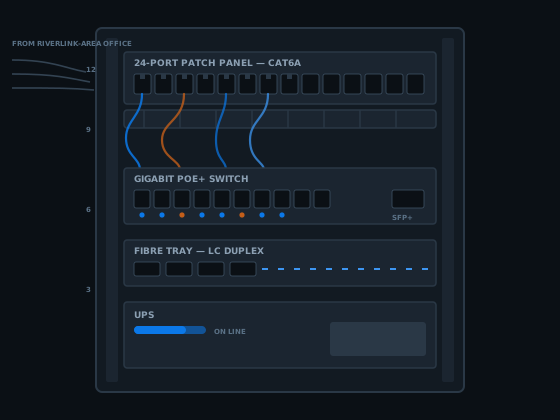
Ipswich is not one housing stock, it is two collapsed into one local government area — a heritage city with more than 7,000 heritage-listed sites sitting next to one of the fastest growing corridors in South East Queensland. Data cabling Ipswich work has to answer to both, which is why a job in Sadliers Crossing and a job in Ripley are rarely quoted the same way.
Most data cabling Ipswich enquiries start with a Wi-Fi complaint or a fitout deadline, and end with a decision about where the cable actually runs — subfloor, roof cavity, or a fibre link to a second comms point because the building is bigger than 100 metres end to end. Get that decision right on day one and the rest of the job is straightforward.
What data cabling Ipswich jobs involve
Underneath the branding, data cabling Ipswich work is the same trade as anywhere else: fixed cable, wall plates, patch panels and a comms point that everything else plugs into. It sits alongside the wider data cabling Brisbane page, which covers the whole region — this page is about the parts of the job that are specifically Ipswich's own.

What makes Ipswich its own market is the spread between old and new. The 100 metre channel limit that governs every run — 90 metres of fixed cable plus up to 10 metres of patch leads at each end — does not change from job to job. What changes from suburb to suburb is how the cable gets to the outlet in the first place, and that is what most data cabling Ipswich quotes actually price for.
Ipswich suburbs: stumps to slabs
Ipswich's inner suburbs — Woodend, Coalfalls, Sadliers Crossing, Eastern Heights and Newtown — hold an unusually dense run of timber Queenslanders from the city's boom years in the 1860s through to the early 1900s. Most sit on stumps with open subfloor access, which is the single biggest advantage a cabler gets in this trade: cable runs underneath the house, comes up inside a wall cavity, and the only visible work is the wall plate itself.
The growth corridor tells the opposite story. The Ripley Valley Priority Development Area alone is planned for close to 48,750 dwellings and around 131,000 people over a twenty to thirty year build-out, with roughly 7,200 homes and two trading town centres already in the ground as of 2026. Add Yamanto, Deebing Heights, Augustine Heights, Redbank Plains and South Ripley and that is a lot of slab-on-ground brick veneer with no subfloor at all — every run has to come from the roof cavity, and a single-storey slab home with a hip roof usually cables without fuss.
Flooding is the other thing that shapes a data cabling Ipswich job. The Bremer River catchment has produced major floods in 1974, 2011 and 2022 — the January 2011 event peaked at 19.40 metres on the Ipswich gauge, February 2022 at 16.72 metres — and low-lying pockets near the Bremer and its feeder creeks have been re-stumped or raised as a result. On a subfloor job in one of those areas, the clearance and the flood line worth building above are both worth asking about before quoting, not after.
The bit people assume wrong
NBN and private fibre networks across Ipswich
Established Ipswich suburbs mostly came online through the original national rollout on fibre-to-the-node, the same as most of established Brisbane, with a federal upgrade program now offering eligible fibre-to-the-node premises a free move to full fibre. That part of the picture is not unique to Ipswich — it is standard rollout history repeating across most of South East Queensland's older suburbs.
The growth corridor is where it gets genuinely local. A 2016 policy change means NBN Co is no longer required to run fibre to every new estate, and developers are free to contract a private network operator instead — the same commercial players who run private fibre networks in new estates right across the country. That means two stages of the same Ipswich estate can land on different networks, with different equipment at the boundary point.
Before assuming what network termination device is sitting in the garage of a new Ripley or Yamanto build, it is worth checking rather than guessing. The same registration and standard apply either way for data cabling Ipswich work, whether the job is a data cabling installation in Brisbane proper or out here past the range.
Commercial data cabling Ipswich businesses need
Ipswich's commercial spine runs from the CBD across the footbridge to Riverlink — the city's main retail and services precinct on the Bremer River, roughly 52,000 square metres of shops, offices and specialty tenancies — out to Swanbank and the Ebenezer corridor further southwest. Each end of that spine needs a different approach to commercial data cabling Ipswich work.
CBD and Riverlink offices
Tenancy fitouts and refits in occupied buildings, cabled in stages with cutover after hours so the business does not lose a trading day. Comparable in every way to a commercial data cabling job in Brisbane proper, just twenty minutes further west.
Swanbank and Ebenezer industrial
Swanbank's industrial precinct covers around 18.8 square kilometres of energy, waste and logistics sites, and the proposed Ebenezer Regional Industrial Area southwest of the city is targeting more than 3,500 jobs as the Inland Rail terminal comes online. Long runs and high ceilings push the distance problem early — fibre to a satellite cabinet solves it.
RAAF Base Amberley sits about 8 kilometres southwest of the Ipswich CBD, and the businesses that service it and the surrounding light industrial estates are cabled to the same standard as anywhere else — nothing about proximity to the base changes the registration or testing requirement, only the volume of PoE cameras and access control most of those sites want cabled in alongside the data runs.
Why registration matters here too
The rule that governs data cabling Ipswich work is federal, not local. Fixed cabling that connects to a telecommunications network must be installed by a registered cabling provider, or by someone directly supervised at all times by one, under section 21 of the Telecommunications (Cabling Provider) Rules 2025. It applies the same way whether the job is two blocks from Ipswich City Council or in the Brisbane CBD, and it is separate from any electrical licence — Queensland's Electrical Safety Act 2002 says at section 55(3) that an electrical licence is not required for telecommunications cabling work.
Work here is carried out under the same ACMA cabler registration as every other job this business does — registration no. 42489, open class, the broadest of the three registration classes. Where a job involves a specialised category such as structured or optical fibre cabling, section 22 requires the cabler to hold the completed units for it, notified to the registrar. The same registered data cabler who works Brisbane covers Ipswich, and every job gets the written compliance statement required under section 25, supplied whether or not the invoice is paid yet.
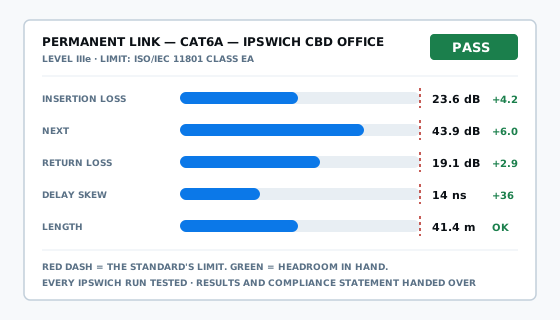
Every data cabling Ipswich job gets tested against the standard it was installed to before handover, not just plugged in and checked for a link light. That is what separates a proper data cabling Ipswich installation from someone who pulled cable as a sideline between other trades — the paperwork proves the work, rather than asking you to take it on faith.
Cat6 or Cat6A for a data cabling Ipswich install
The split in Ipswich's housing stock makes this an easier call than usual for most data cabling Ipswich jobs. A weatherboard or brick home in Woodend, Coalfalls or Raceview with a run under 30 metres does the job on Cat6 — gigabit to the full 100 metres, and the labour is identical to Cat6A either way. A new build in Ripley Valley or Redbank Plains going in with PoE cameras, an access point ceiling drop and possible future 10 gigabit switching is better served starting with Cat6A, because re-pulling cable through a finished slab home is a much bigger job than doing it once, properly.
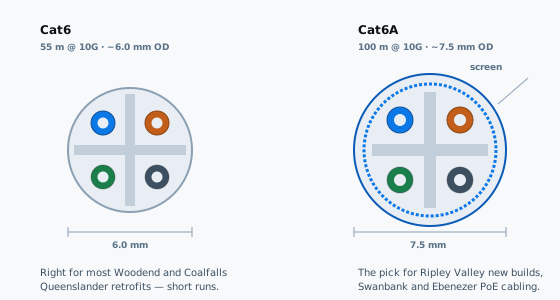
| Cat6 | Cat6A | |
|---|---|---|
| 1 Gbps | 100 m | 100 m |
| 10 Gbps | ~55 m | 100 m |
| Screening | Usually unscreened | Screened against alien crosstalk |
| Outside diameter | ~6.0 mm | ~7.5 mm |
| Suits | Older Ipswich homes, short runs | New estates, PoE, Swanbank & Ebenezer sites |
What data cabling Ipswich quotes actually cost
Access is what moves a data cabling Ipswich quote, more than the cable itself. A Queenslander with clear subfloor access is one of the quicker jobs going, because the cable never has to touch the ceiling at all. A two-storey rendered home with no subfloor and a sealed roof space, or a Ripley slab build where the ceiling has already gone up around the trusses, takes longer for the exact same outlet count.
Structured cabling is generally priced per outlet — cable, both terminations, wall plate, patch panel port, testing and labelling — with the per-point rate dropping as the count rises. Fault finding and small additions are priced hourly instead; published Brisbane-region rates for comparable work sit around $185 per hour for standard hours, with a premium for after-hours or emergency callouts. The full breakdown of how those numbers get built, including what to check on any quote, is on the data cabling cost page.
Home network cabling in Ipswich houses
A lot of residential data cabling Ipswich enquiries start as Wi-Fi complaints, and they usually trace back to the same cause as everywhere else — one router trying to cover a floor plan it was never going to reach on its own. A single cabled ceiling point roughly central to the house, feeding a proper access point, fixes more coverage problems than any router upgrade, and it is the most common reason a home network cabling enquiry starts in the first place.
In an older Ipswich Queenslander, that ceiling point is usually a short subfloor-to-wall-cavity run with no wall damage at all. In a Ripley Valley or Deebing Heights build it comes from the roof space instead, which still leaves the wall plate as the only visible change once the job is done. Either way, the runs worth cabling are the ones that will not move — the study, the TV wall, and that central ceiling point — and the detail on how that gets planned for a whole house sits on the home network cabling page.
Ipswich and the suburbs around it
Data cabling Ipswich work does not stop at the LGA boundary. North Lakes and Redlands sit on the opposite side of Brisbane and get quoted the same way — access first, cable category second — and both have their own detail on the data cabling North Lakes and data cabling Redlands pages. Closer to home, data cabling Springfield covers the growth corridor immediately northeast, which shares a lot of the same slab-on-ground housing stock as Ripley.
Every one of those pages gets quoted the same way a data cabling Ipswich job does — access first, cable category second, testing always included.
West over the Toowoomba range, the same registered cabler covers data cabling Toowoomba and network cabling Toowoomba work — residential jobs generally stay closer to home, but commercial work travels further if the job is worth the drive. Ask, rather than assume it is out of range.
Data cabling Ipswich questions we get asked
What's different about data cabling in an Ipswich Queenslander compared to a new Ripley Valley build?
A timber Queenslander on stumps usually has open subfloor access, so cable can run underneath the house and rise inside a wall cavity with no ceiling work at all. A Ripley Valley slab home has no subfloor to use, so every run has to come from the roof space instead, which changes both the access plan and the quote.
Do the 2011 and 2022 Bremer River floods affect subfloor cabling in older Ipswich suburbs?
In low-lying pockets near the Bremer and its creeks, yes. Homes that were re-stumped or raised after those floods often have different subfloor clearance to what the original build had, and any cable or junction run down there needs to sit above the flood line that prompted the rebuild, not just above the old one.
Is NBN or a private fibre network running through new Ipswich growth corridor estates?
It depends on the estate. Since a 2016 policy change, NBN Co no longer has to run fibre to every new estate, and developers are free to contract a private operator instead. Some Ipswich growth corridor stages are on nbn, others on a private fibre network — worth checking before assuming which network termination device you have.
Can data cabling go into an occupied Ipswich CBD office near Riverlink without stopping trade?
Yes. Cable gets pulled and terminated in stages, cutover happens after hours or on a weekend, and the existing links stay live until the new ones are tested and proven. Most Ipswich CBD and Riverlink-area office cabling is done this way — nobody arrives Monday to a dead desk.
What cabling do Swanbank and Ebenezer industrial sites in Ipswich actually need?
Large floor plates and long runs mean the 100 metre copper channel limit gets hit fast, so a satellite comms cabinet fed by fibre is usually the answer rather than one enormous copper run. Add PoE cameras and access points around the site and Cat6A becomes the sensible default, not an upgrade.
Does a home near RAAF Base Amberley need anything different for data cabling?
Not for the cabling itself — the standard and the registration requirement are the same regardless of what's next door. What does change is that homes closer to Amberley, roughly 8 kilometres southwest of the Ipswich CBD, are more likely to be newer slab-on-ground builds, which shifts access to the roof cavity.
How many data points does a typical Ripley Valley new home need?
Most new builds in the Ripley Valley corridor are cabled for a study or home office, the main living area for a smart TV and streaming box, and a ceiling point roughly central to the floor plan for a wireless access point. Three to five outlets covers most four bedroom Ripley homes comfortably.
Is Cat6 enough for an older Ipswich weatherboard home, or does it need Cat6A?
For most weatherboard homes in suburbs like Woodend or Coalfalls, Cat6 is the right call — the runs are short, gigabit is plenty, and the labour cost is identical either way. Cat6A earns its keep when the run is long, the load is commercial, or PoE cameras are going in.
Who do I call for a data cabling fault in an Ipswich office fitout?
A registered cabler, not the IT helpdesk. Ports negotiating at 100 megabit instead of gigabit, intermittent drops after a fitout, or a run cut during other trades' work are physical layer faults, and tracing them means testing the actual link against the standard rather than guessing at software fixes.
Get a data cabling Ipswich quote
Tell me what the building is — Queenslander, brick veneer, new estate slab, or a commercial site — and roughly how many points you need. Most data cabling Ipswich quotes come back the scoped from photos. If it is a fault rather than an install, say what the symptom is; that usually narrows it down before anyone drives out.
Or just call 07 3521 8082. If it goes to voicemail I am up a ceiling somewhere; leave a message and I will call back.
ACMA registered cabler no. 42489 All work to AS/CA S009:2020