Brisbane & South East Queensland
Data cabling contractors: what a builder or fitout company actually expects
Most data cabling contractors get engaged the same way — a builder or fitout company locks the cabling trade package in before the program is set, and wants proof of insurance, a white card and a SWMS on file before anyone books a start date. This is the subcontract side of the trade: what the tender pack asks for, and what changes once the head contract is signed.
Work carried out by an ACMA registered cabler no. 42489 Installed to AS/CA S009:2020 Compliance statement every job
Retail and subcontract cabling are not the same job wearing different paperwork. A homeowner wants a fixed price and a date. A builder or fitout company wants a registration number, a class, current insurance, a SWMS, a white card for every person on site, and a price that matches their drawings line for line — all of it sighted before the first cable goes near a roof cavity.
None of that is optional once a job runs through a head contract. It is also not complicated once it is written down in one place, which is what the rest of this page does: tendering, insurance, inductions, SWMS, the subcontract terms themselves, and how payment actually works under the same registration that underpins every job this site does.
What data cabling contractors are engaged to deliver
A subcontract trade package is narrower than a retail quote. It is priced against drawings and a specification, not a walk-through and a guess, and it is bound by a program the builder sets, not one the cabler picks. Data cabling contractors are engaged for a defined scope — horizontal cabling, the comms room build, testing and certification — and little outside it, because everything else belongs to another trade package.
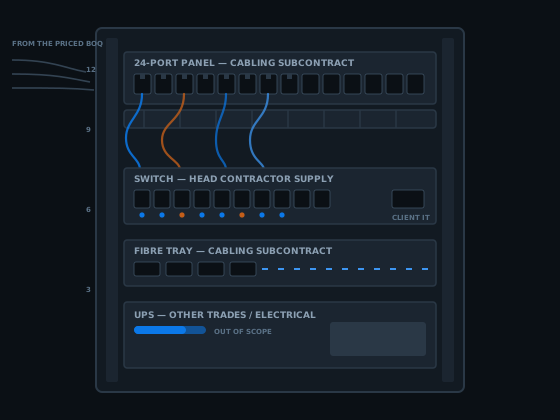
That boundary matters more than it sounds. The switch and the rest of the active equipment usually sit with the client's IT provider, not the cabling package. Power to the rack is an electrical trade package; ceiling grid and access panels are the builder's. A tender that blurs those lines invites a variation argument later — reason enough for a written scope of works, not a verbal one, before data cabling contractors price anything.
The cabling package
Horizontal Cat6A, the fibre backbone, patch panels, outlets, labelling, testing and the section 25 compliance statement at the end.
Active equipment
Switches, wireless controllers and firewalls are typically supplied and configured by the client's IT provider once the cabling is handed over.
Other trades
Electrical for rack power, the builder for ceiling and wall access, security for shared conduit — all scheduled around, not owned.
Tendering: how the quote gets built before the job starts
A tender package rarely gets priced per point the way a residential job does. It is taken off the drawings — outlet counts by floor, comms room locations, riser runs — and priced against a bill of quantities the head contractor can compare line by line. A number with no breakdown behind it is hard to trust and harder to negotiate a variation from later.
Provisional sums are common on fitouts where outlet locations aren't fixed at tender stage. Retention — usually five to ten per cent, held until practical completion and released in stages — is standard on anything running through a head contract. None of this is unique to cabling, and data cabling contractors quoting outside that framework tend to lose the tender before price is even discussed.

What a competitive tender actually needs: a scope that matches the drawings, a BOQ broken down by cable category and outlet type, a program that fits the builder's, and every compliance item — insurance, SWMS, white cards — attached rather than promised. Missing one of those is usually why a tender gets marked incomplete before the price is even read.
Insurance data cabling contractors need before mobilising
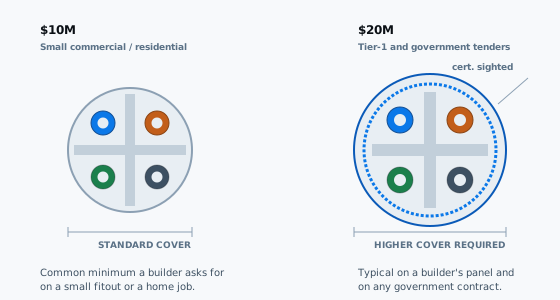
Public liability is the one every head contract asks for first, and the limit moves with the size of the job. Ten million dollars is a common minimum on a small commercial fitout; twenty million is typical once the job sits on a tier-1 builder's panel or involves a government client. Most head contracts expect each subcontractor to hold independent cover rather than relying on the builder's own policy extending to them — read the insurance clause before quoting, because that is where the actual figure is set.
WorkCover works differently. A sole operator with no employees isn't required to hold a policy, but the moment data cabling contractors take on staff, a WorkCover policy becomes compulsory. Head contractors ask for a certificate of currency either way — it is the quickest proof of who is covered, and a subcontractor who can't produce one on request is usually one most builders won't put on site.
| Residential / small job | Commercial fitout | Tier-1 / government | |
|---|---|---|---|
| Public liability | $5–10m common | $10–20m common | $20m+ common |
| White card checked | Rarely asked | Always | Always, at induction |
| SWMS required | If HRCW applies | Usually | Always, reviewed |
| Payment terms | Deposit + balance | Progress claims | Progress claims, retention |
Before anyone sets foot on site
Site inductions and the white card
Any construction site in Queensland requires general construction induction training — universally known as the white card — before a worker can be directed or allowed to carry out construction work, and data cabling contractors are not exempt. Section 317 of the Work Health and Safety Regulation 2011 (Qld) makes no exception for subcontractors or the self-employed; running cable through a building under construction is construction work, and the crew doing it needs the card, not just whoever signed the quote.
A card more than two years old, with no recent construction work behind it, doesn't automatically stay valid. On top of it, most sites run their own site-specific induction — sign-in, emergency procedures, permit-to-work rules, whatever hazards are particular to that build. Twenty minutes, and not negotiable.
The white card
Nationally recognised general construction induction training, required once before working on any construction site, refreshed by ongoing construction work.
The site induction
Specific to that build, arranged through the builder or principal contractor, usually on day one and sometimes repeated for long-running jobs.
SWMS: when the paperwork is compulsory, not optional
A safe work method statement is only legally required for high risk construction work — 18 categories set out at section 291 of the WHS Regulation 2011 (Qld). Not every cabling job triggers one. The category that catches this trade most often is a risk of falling more than 2 metres: roof space access, ceiling work from a ladder, anything from an elevated work platform. A ground-floor office with a 2.4 metre suspended ceiling and a step ladder may not trigger it; the same job in a 6 metre warehouse does.
Where it applies, section 299 requires the SWMS to be prepared before work starts, not backfilled afterwards. It has to describe the work, the hazards and the control measures, and be given to the principal contractor before work begins — who then signs and dates it, keeps it with the site's WHS management plan, and monitors that the work is done the way the SWMS says.
The part people skip: keeping evidence the SWMS was actually handed over, not just that one was written. If the principal contractor's file has no record of receiving it, the paper trail that protects a subcontractor is missing — regardless of how good the SWMS itself was.
Registration, not a QBCC licence — and why that trips builders up
Queensland's building regulator, the QBCC, manages more than 160 licence classes across builders, plumbers, electricians and dozens of other trades. Communications, data or telecommunications cabling isn't one of them. A builder used to checking a QBCC number for every trade won't find one for cabling — that work sits outside QBCC's jurisdiction entirely.
What actually authorises the work is the federal cabler registration this whole site is built around: issued by one of four ACMA-accredited registrars under the Telecommunications (Cabling Provider) Rules 2025, held by a named individual rather than a company. Queensland adds nothing on top — section 55(3) of the Electrical Safety Act 2002 (Qld) confirms an electrical licence is not required for telecommunications cabling either, which is why "fully licensed" is not the credential a builder should be reading for.
A builder qualifying subcontractors for a tender list should ask for two different things depending on the trade: a QBCC number for the electrician, and a registration number and class — plus notified specialised categories, if fibre or underground work is involved — for data cabling contractors. Confusing the two wastes time chasing paperwork that does not exist.
Working under a builder or fitout company
A subcontract agreement sits between data cabling contractors and the head contractor, not the end client, and that changes who is owed what. Variations get approved by the site manager, not negotiated with the tenant. Defects during the defects liability period — commonly twelve months after practical completion — get rectified under the subcontract terms, and insurance often has to stay current for that whole window, not just the works.
Program is set by the head contractor, so rough-in happens before ceilings close and termination gets staged around other trades rather than run as one continuous block. Retention is standard: five to ten per cent of each progress claim held back and released after practical completion, or split across completion and the end of the defects liability period. None of it is negotiable once it is in the subcontract — worth reading before the tender goes in, not after it is signed.
Back-to-back terms
Most subcontracts mirror the head contract's obligations downward — the same defects period, similar insurance requirements, comparable notice periods for variations.
One point of contact
Instructions come from the builder's site manager or project manager, not the client directly, even when the work is plainly for the client's benefit.
The part that actually protects you
Getting paid: the security of payment rules
The Building Industry Fairness (Security of Payment) Act 2017 (Qld) exists because subcontractors used to sit at the back of the queue when cash got tight. A payment claim — which can simply be an invoice referencing the contract — triggers a progress payment on the date the contract sets, or 10 business days later if it is silent, whether or not the head contractor has been paid by the client.
Pay-when-paid clauses, once common in subcontracts, have no legal effect under the Act. A builder cannot lawfully make data cabling contractors' payment conditional on the client paying the builder first. The Act also requires a supporting statement with every payment claim a head contractor makes to a principal, declaring subcontractors have been paid what they are owed — a false one is an offence carrying a penalty of up to 100 penalty units.
None of this removes the need to read the contract. Timeframes, the format required, and what counts as a valid claim are set out in the subcontract itself, and missing the process — not the substance — is the most common reason a legitimate claim gets disputed.
What a builder should check before engaging one
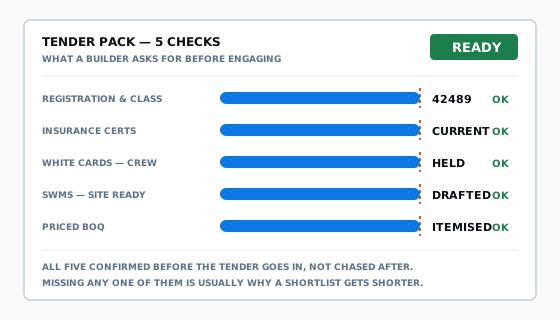
Five things separate the data cabling contractors ready to start from the ones still assembling paperwork after the tender is already won. A builder who checks all five upfront saves a week of chasing once the program is locked in.
Registration and class
The number, the class, and whether the specialised categories the job needs — fibre, for instance — are actually notified to the registrar.
Insurance certificates
Public liability at the limit the head contract specifies, current, not expiring partway through the program.
White cards for the crew
Every person turning up to site, not just the one who quoted the job.
SWMS, site-ready
Drafted and able to be made site-specific quickly, if the work involves height, plant or anything else on the high risk list.
Priced BOQ
Broken down against the drawings, not a single number that is hard to compare or to negotiate a variation against later.
Why it matters
Chasing any one of these after the tender is won delays mobilisation — and delay on a fixed program usually costs someone money.
Comparing data cabling contractors for a shortlist
Price is the easiest thing to compare on a tender and often the least useful — a cheap number with no breakdown tends to grow once variations start. The more useful comparison: does the BOQ reference the drawings, does the insurance limit match what the head contract requires, and is the SWMS specific to this site or a template with the address changed.
Whether cabling is priced as its own package or bundled under an IT and data cabling services line also changes how easy tenders are to compare — a bundled quote hides the cabling number inside a bigger one. A defect turning up months after handover is usually fault finding under the defects liability period, not a new tender, which is another reason the subcontract terms are worth reading properly the first time.
Government and institutional tenders add another layer — panel arrangements, security clearances, procurement rules — covered separately on the page for government and council cabling work. For most commercial fitouts, the five items above are what actually separates data cabling contractors on a shortlist.
Data cabling contractors — questions we get asked
Do data cabling contractors need a QBCC licence to work as a subcontractor in Queensland?
No. The QBCC's list of more than 160 licence classes has no category for data, communications or telecommunications cabling — that work sits outside QBCC licensing entirely. What actually authorises it is the federal cabler registration under the Telecommunications (Cabling Provider) Rules 2025. A builder asking for a QBCC number from a cabling subcontractor is asking the wrong question; the registration number and class are what to check instead.
What insurance do data cabling contractors need before starting on a construction site?
Public liability is the one every head contractor asks for, and $10 to $20 million cover is typical, with the higher figure common on tier-1 builder panels and government tenders. Most head contracts expect each subcontractor to hold independent cover rather than relying on the builder's policy. WorkCover only becomes compulsory once data cabling contractors take on staff — a sole operator isn't required to hold it, though a certificate of currency still gets asked for.
Do data cabling contractors need a white card to work on a building site?
Yes, on a construction site. Section 317 of the Work Health and Safety Regulation 2011 (Qld) stops a business directing or allowing a worker to carry out construction work without completed general construction induction training — the white card. It covers subcontractors and the self-employed, not just employees, and a card earned more than two years ago needs recent construction work behind it to still count.
When do data cabling contractors need a SWMS for cabling work?
Whenever the job falls into one of the 18 categories of high risk construction work set out at section 291 of the WHS Regulation 2011 (Qld). The one that catches cabling most often is a risk of falling more than 2 metres — roof and ceiling access from a ladder or an EWP. Where it applies, the SWMS has to be prepared before the work starts and handed to the principal contractor, not written up afterwards.
How do data cabling contractors get paid under a subcontract with a builder?
Through payment claims under the Building Industry Fairness (Security of Payment) Act 2017 (Qld). A progress payment falls due on the date the contract sets, or 10 business days after the claim if the contract is silent. The Act voids pay-when-paid clauses, so a builder cannot lawfully hold a subcontractor's payment hostage to their own payment arriving from the client first.
Can a builder refuse to pay data cabling contractors because the client hasn't paid yet?
Not lawfully. Pay-when-paid clauses are void under the Building Industry Fairness (Security of Payment) Act 2017 (Qld), so a contract term tying a subcontractor's payment to the builder first being paid by the client has no effect. The builder must also give a supporting statement with each payment claim to the principal, declaring subcontractors have been paid — a false one is an offence carrying up to 100 penalty units.
What should a tender pack for data cabling contractors include?
A registration number and class, current insurance certificates, a generic SWMS ready to be made site-specific, evidence of white cards for the crew, and pricing broken down against the drawings or specification rather than one lump sum. A builder shortlisting data cabling contractors is really testing whether all five turn up together, on time, without being chased for them twice.
Do data cabling contractors need their own public liability insurance or can they rely on the head contractor's policy?
Their own, in almost every case. Unless the head contract explicitly extends the builder's policy to subcontractors, which is uncommon, data cabling contractors are expected to carry independent cover. Read the insurance clause in the head contract before quoting — it is where the required limit, and whether cover must run through the defects liability period, actually gets specified.
What happens when data cabling contractors don't hand a SWMS to the principal contractor before work starts?
The principal contractor has a duty to obtain it before the high risk work begins, sign and date it, and keep it with the site's WHS management plan. If it isn't provided, the work should not start — and if it does anyway, both the subcontractor and the principal contractor carry the exposure. Keeping evidence the SWMS was actually handed over is what protects data cabling contractors later.
Talk to a cabling subcontractor about your next tender
Send the drawings and the head contract's insurance and WHS requirements, and a priced BOQ comes back against them — not a lump sum. If the job is government or institutional, say so up front.
Or call 07 3521 8082. Voicemail means I am up a ceiling; leave a message and I will call back.
Work carried out by an ACMA registered cabler no. 42489 Class Open