Brisbane & South East Queensland
Fibre optic cable installation for Brisbane buildings and sites
A fibre optic cable installation is what you reach for the moment copper runs out of distance — backbone between comms rooms, risers up a multi-storey, the link across the yard to the shed. Here is the physics, the decision, and what the job costs.
Copper stops at 100 m OM4 to 400 m at 10G OS2 to 10 km at 10G
Most people arrive at a fibre optic cable installation by elimination. They measure a run, find it is 140 metres, and discover no amount of good Cat6A will fix it. Glass is not a premium version of copper. It is a different answer to a different problem, and knowing which problem you have saves money in both directions.
What follows is the reasoning behind a fibre optic cable installation rather than a brochure: where the limits come from, how multimode and single mode differ, why splicing method shows up in your test results, and when paying for glass is the wrong call.
Where copper stops and fibre optic cable installation starts
Twisted pair has a hard ceiling. The channel is 100 metres: 90 metres of fixed cable plus up to 10 metres of patch leads across both ends. That is not a manufacturer being cautious — it is the point past which the electrical behaviour of a twisted pair stops being predictable enough to guarantee.
Glass does not work that way. Light loses energy slowly and evenly, so the limit is a decibel figure rather than a metre count. A fibre optic cable installation is designed to a loss budget instead of a tape measure, which is why two links of identical length can carry completely different amounts of margin.
The practical numbers are worth knowing. On multimode, IEEE specifies 10GBASE-SR to 300 metres over OM3 and 400 metres over OM4. On single mode, 10GBASE-LR is specified to 10 kilometres. The jump from copper to glass is not incremental — it takes you from 90 metres of fixed cable to the other side of an industrial estate.

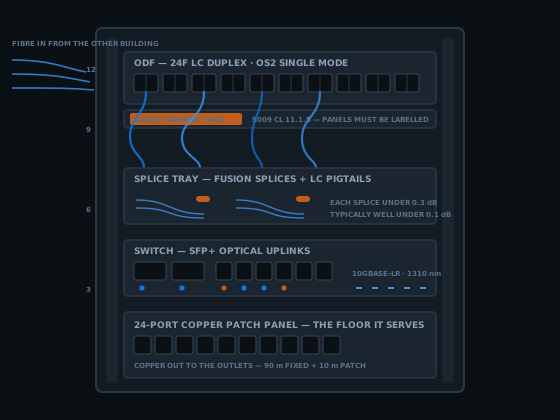
Once you accept the distance problem the design falls out on its own. Copper stays inside a building and serves the outlets. Glass carries traffic between the places copper cannot reach. That split is the whole idea behind a fibre optic network installation: copper is the last hundred metres, fibre is everything longer, and that shape describes nearly every commercial fibre optic cable installation going.
Which is why the first question on a fibre optic cable installation is never "what cable" but "where does it start and where does it stop". Route length, pit and conduit access, joint count and whether a pathway already exists move the price far more than the glass does. Walk the route before anyone quotes a metre of it.
The first real decision
Multimode or single mode — the first fibre optic cable installation choice
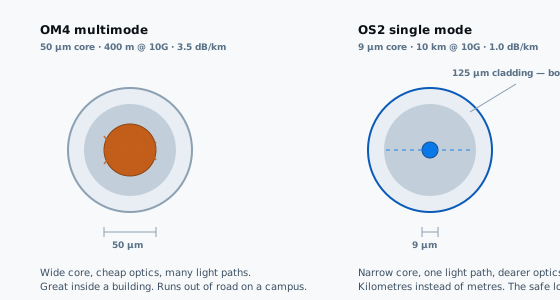
Two families, not interchangeable, and the one you pick sets the ceiling on the whole fibre optic cable installation. A multimode core is wide, around 50 microns, so light enters at many angles and travels many paths at once. The optics are cheap, because a wide target is easy to hit. The cost is dispersion: those paths arrive at slightly different times and the signal smears with distance.
Single mode has a core around 9 microns. One path fits, almost nothing smears, and distance becomes a question of raw attenuation. The transceivers cost more. The cable often does not — single mode is frequently the cheaper of the two by the metre.
| OM3 / OM4 multimode | OS2 single mode | |
|---|---|---|
| Core diameter | 50 µm | ~9 µm |
| 10 Gbps reach | 300 m (OM3) / 400 m (OM4) | 10 km |
| Test wavelength | 850 nm | 1310 nm / 1550 nm |
| Max attenuation | 3.5 dB/km at 850 nm | 1.0 dB/km at 1310 nm |
| Transceiver cost | Lower | Higher |
| Sensible for | Risers, floor to floor | Between buildings, anything long-lived |
Rule of thumb: if the run stays inside one building, multimode is usually the sensible buy. If it leaves the building, or you would be annoyed to re-pull it in ten years, put single mode in the ground. The glass is the part of a fibre optic cable installation you cannot upgrade later without redoing the pathway.
Core count matters to a fibre optic cable installation as much as type does. Pulling a 12-core when you need four costs very little extra on the day and saves an entire second job later. Spares are the cheapest insurance in this trade, and any fibre optic cabling services quote should show you how many you are getting.
Splicing and termination — how a fibre optic cable installation is joined
Glass cannot be punched down. Getting from bare fibre to something you can plug into takes one of three approaches on any fibre optic cable installation, and the one chosen shows up in both the price and the test result.
Fusion splicing
The ends are cleaved and welded with an electric arc, protected in a sleeve and laid in a tray. Typical loss sits well under 0.1 dB. This is how a factory pigtail joins the cable you pulled.
Mechanical splicing
The ends are held in alignment inside a body filled with index-matching gel. Quicker, no splicer to hire, lossier — reference figures allow 0.3 dB per splice and mechanical joints use more of that allowance.
Pre-terminated
A factory assembly, cut to length and tested before it ships. Excellent loss figures, fast on site, and unforgiving if the length was measured wrong.
Splice count is a design decision, not an accident. Every joint spends part of the budget, so a route with three pits and three joints has less margin than the same length pulled through in one shot. On a long fibre optic cable installation the pull plan and the splice plan get settled together, before anything is ordered.
Connectors spend more. Reference figures allow 0.75 dB for a connector pair against 0.3 dB for a splice, so a link with a patch panel at each end starts 1.5 dB in the hole before a metre of glass is counted. That arithmetic is why good design keeps mated pairs down.
Cleanliness is the other half. A speck of dust on a connector end face costs more decibels than a hundred metres of cable, which is why S009 asks that optical interfaces be inspected with a purpose-built instrument and cleaned before connection. Most "faulty" fibre links are simply dirty ones.
Loss budgets — the arithmetic behind a fibre optic cable installation
A copper link either passes its category limits or it does not. A fibre optic cable installation is judged against a budget you calculate for that specific link, which is the part people find unfamiliar. The sum is simple enough to do on the back of a quote.
Take the length, multiply by the attenuation for the fibre type. Add an allowance for each connector pair. Add an allowance for each splice. That total is the most loss the link may show. Then test it with a light source and power meter and compare.
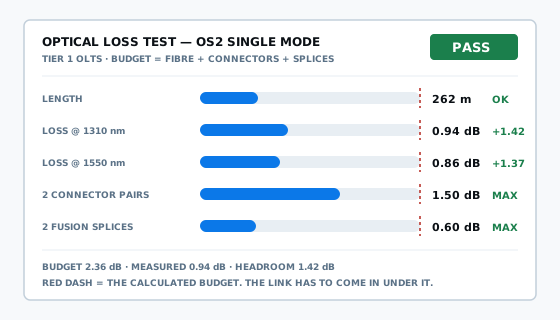
Worked through for the link above: 262 metres of OS2 at 1.0 dB per kilometre is 0.26 dB. Two connector pairs at 0.75 dB is 1.5 dB. Two fusion splices at 0.3 dB is 0.6 dB. Budget 2.36 dB, measured 0.94 dB, headroom 1.42 dB. A result that only just scrapes under is a result that fails in five years.
Notice how much of that budget the connectors ate. On short in-building runs the glass barely registers and the joints are everything, which is backwards from how most people picture a fibre optic cable installation. It is also why adding a patch panel "for tidiness" mid-link is rarely free.
What to ask for at handover: measured loss per fibre in both directions, the calculated budget it was measured against, and the wavelengths used. A single "PASS" with no numbers on it tells you nothing you can act on later.
Testing to that level is standard on any structured job, the same way copper links get certified. For the copper side of that story, the main network cabling page covers how permanent links are tested and what the compliance paperwork has to include.
Between buildings — the rule that decides it for you
Here a fibre optic cable installation stops being a performance choice and becomes a safety one. Clause 17.3.1 of AS/CA S009:2020 sets out how equipment in separate buildings may be interconnected, and first on the list is cabling containing no electrically conductive elements — optical cable with a non-metallic strength member.
The other options carry conditions. Coaxial and paired conductors are allowed only where further clauses are satisfied, and the standard is blunt about the catch: most Ethernet ports and IP service ports are classified as internal equipment and are not designed to have outdoor cabling connected to them at all.
The hazard is not the data. Two buildings sit in two different earthed environments, and a metallic link between them can carry a momentary voltage difference from one to the other. That is what the surge suppression rules exist for, and why S009 gives cabling between buildings an entire informative appendix.
Glass sidesteps the argument. No conductor, no shared earth path, no surge assessment, nothing to bond. On a site with a separate shed, workshop or second tenancy, that is usually what decides a fibre optic cable installation long before anyone mentions bandwidth.
Worth knowing if there is an NBN box involved: fibre-to-the-premises termination devices are normally earthed, which makes them particularly vulnerable to surges induced into outdoor cabling. Where that box lives and what crosses to it is covered on the NBN cabling page, which sets out the boundary between the carrier's equipment and private cabling work.
The mandatory standard behind all of it is a free download from the Australian Telecommunications Alliance, and clause 17.3 is a short read. If you own a site with more than one building on it, that is ten minutes well spent before accepting any quote that proposes copper across the yard.
Risers and backbones — fibre optic cable installation in a multi-storey
Inside one building the distance problem shows up vertically. A four-storey office with a single ground-floor comms room cannot reach top-floor outlets in 90 metres once you count the route the cable actually takes — up a riser, along a ceiling, down a wall. The fix is a cabinet per floor with fibre between them.
That backbone is the spine of the building and the part of a fibre optic cable installation you cannot easily revisit. Every floor cabinet hangs off it, so it gets designed for what the building might need rather than what this tenant needs, and it gets more cores than today's count justifies.
Riser pathway
Fire-rated penetrations, a dedicated riser cupboard where one exists, and separation from the electrical riser. The pathway is usually the constraint, not the cable — in an older CBD building it can be the entire job.
Floor cabinets
Each floor gets an optical distribution frame, splice tray and copper patch panel. Everything on that floor lands there and stays inside the 100 metre channel back to it.
Redundancy and records
Two diverse fibre paths where the site justifies them, and every core identified at both ends. The next person opening that cabinet in six years has to work out what is what without a light source.
Warehouses have the same problem lying down. A 120 metre shed with the comms room in the office corner cannot serve the far end in copper, so a satellite cabinet goes down the other end with fibre to it and copper radiating from there. That is the most common commercial fibre optic cabling installation there is, and it beats the two alternatives people try first: a wireless bridge that works until a forklift parks in the path, or daisy-chained switches that take everything downstream with them when one dies.
Laser safety, labelling and the parts nobody quotes
Optical cabling carries obligations under the Wiring Rules that a copper job does not, and they are the first things missing when a fibre optic cable installation has been done casually. Clause 11.1.5 of S009 requires every optical fibre panel and enclosure to be labelled to warn that hazardous laser levels may be present, with the markings black on a yellow background.
There is more to it than a sticker. Any connector, splice box or component that could emit radiation when opened has to be marked. Inspection apparatus has to be safe for the fibre being inspected — the polite way of saying nobody should look into a fibre with their eye. Fibre outlets in a work area are the one exemption from the explanatory label.
The standard also covers what gets left behind. Offcuts are tiny glass shards, and S009 requires none are left on site, everything going into a proper sharps or hazardous materials container. It is a small clause that tells you plenty about whether the person who did your fibre optic cable installation had read the document.
Registration matters here too. Optical fibre is one of the specialised cabling categories under section 22 of the Telecommunications (Cabling Provider) Rules 2025, which means the relevant units of competency must be completed and the registrar notified of the category. Ask anyone quoting a fibre optic cable installation for their registration number and their categories, then ask for the compliance statement — section 25 requires it be given to you after the work regardless of whether you have paid.
When a fibre optic cable installation is overkill
Plenty of people ask for glass because it sounds like the better option, and a fair share of the time the honest answer is that it will do nothing for them. Here is where a fibre optic cable installation does not earn its keep.
Ordinary houses
A three bedroom home has no run near 90 metres and no equipment with an optical port. Cat6 or Cat6A does everything fibre would for a fraction of the money. The NBN fibre stops at the box on the wall and copper takes it from there.
Small single-floor offices
One tenancy, one comms cabinet, longest run 60 metres. Copper to every outlet and a single switch. Fibre here adds two transceivers and two more points of failure for no measurable gain.
"Future proofing" with no plan
Fibre pulled to a location with nothing to terminate it, no cores documented and no budget calculated is a dark cable in a wall. Spare copper capacity serves that instinct better.
Where the pathway does not exist
If the trench or the core hole dwarfs everything else, that changes the sums entirely. Sometimes the right answer really is a properly engineered wireless link, and it is worth saying so out loud.
Being told the job does not need glass is a good sign about whoever is telling you. The searches people run — fibre optic services and cabling, or fibre optic cabling installation solutions — usually describe a job that is mostly copper with a short glass link in the middle. The reverse is just as true: undersizing a backbone because today's traffic is light gets paid for twice, since the labour to pull a replacement fibre optic cable installation is identical to the labour that went in first time.
What a fibre optic cable installation costs in Brisbane
Nobody in this trade publishes fibre pricing, because no two links are alike. What can be described honestly is what the money buys, so you can read a fibre optic cable installation quote properly instead of comparing two totals that measure different things.
Pathway dominates
Trenching, boring under a driveway, coring a slab, hiring a scissor lift, working after hours in a live building. On most jobs this is the majority of the number and the cable is a rounding error beside it.
Termination method
Fusion splicing pigtails at both ends is labour and specialised equipment. A pre-terminated assembly moves that cost to the factory. Which wins depends entirely on how confident you are in the measured length.
Core count and hardware
The optical distribution frame, trays, adaptors and pigtails at each end. More cores costs more hardware and almost nothing extra in labour, which is why spares are good value.
Testing and documentation
Every core tested at the relevant wavelengths, results recorded against the calculated budget, cores labelled, compliance statement issued. If a quote does not mention testing, ask where it went.
For hourly work — fault finding on an existing link, a re-splice, adding a panel — published rates for comparable cabling work in Brisbane sit around the $185 per hour mark for standard hours, with after-hours attracting a premium. A project fibre optic cable installation is quoted as a fixed number once the route has been walked.
Copper on the same site is easier to compare because it is priced per outlet. If your project is mostly copper with a short backbone link, the data point installation page explains how per-point pricing works and what belongs in it.
Where fibre optic cable installation work happens
Brisbane metro is home ground — the CBD towers, the inner industrial belt through Rocklea and Salisbury, the business parks at Eagle Farm and Murarrie. Beyond that: Ipswich, Logan, Redlands, North Lakes, Springfield, the Gold Coast, the Sunshine Coast and Toowoomba.
The fibre optic cable installation jobs that come up most are multi-building industrial sites, strata buildings with a riser to sort out, schools and clubs with a second structure across a car park, and fitouts where the tenancy has outgrown one comms room. American spellings of the same search — fiber optic cable installation, fiber optic network installation or fiber network installation — all land on the same trade and the same standards. If your site sits outside that list and the job is substantial, ask anyway.
Fibre optic cable installation questions I get asked
When does a Brisbane site actually need fibre instead of Cat6A?
When the distance beats the copper channel, when the link crosses between separate buildings, or when the equipment at each end wants an optical uplink. Inside one building, under 90 metres of fixed cable, copper is usually the better buy. Past that the choice is another comms room and a fibre run back, or nothing.
What is the difference between multimode and single mode fibre in a building backbone?
Multimode has a wide core, around 50 microns, and carries many light paths, so the optics are cheap but the reach is limited. Single mode has a core around 9 microns and one path, so the optics cost more and the distance runs to kilometres. Inside a building multimode is common. Across a site, single mode.
Is fusion splicing better than a mechanical splice on a building fibre link?
Almost always. A fusion splice welds the two glass cores together and typically loses well under 0.1 dB. A mechanical splice holds the ends in alignment with gel and commonly measures several times that. Standards allow up to 0.3 dB for a splice, so both can pass, but fusion leaves you far more headroom for later.
What is an optical loss budget and how is it worked out?
It is the total decibel loss a link is allowed before the equipment stops seeing light reliably. You add the fibre attenuation for the length, plus an allowance for every connector pair, plus an allowance for every splice. TIA reference figures are 0.75 dB per connector pair and 0.3 dB per splice, with 1.0 dB per kilometre for single mode at 1310 nanometres.
Can fibre be run between two buildings on the same Brisbane property?
Yes, and clause 17.3.1 of AS/CA S009:2020 lists cable with no electrically conductive elements first among the ways separate buildings may be interconnected. Optical cable with a non-metallic strength member carries no current, so there is no shared earth path between the two buildings and no surge assessment attached to the link.
Do optical fibre panels and enclosures need laser warning labels in Australia?
Yes. Clause 11.1.5 of AS/CA S009:2020 requires every optical fibre panel and enclosure to be labelled to warn that hazardous laser levels may be present, using a warning label and an explanatory label, black on yellow. Fibre outlets in work areas are the exception and do not need the explanatory label.
Does optical fibre need a different cabler registration to copper?
Optical fibre is one of the specialised cabling categories, alongside structured, coaxial, aerial and underground. Under section 22 of the Cabling Provider Rules 2025 a cabler needs the relevant units of competency completed and must have notified the registrar of the category. Ask whoever quotes your job for their registration number and their categories.
Can fibre be pulled through the same tray or conduit as electrical cabling?
Cable with no conductive elements is exempt from some of the separation requirements that bind copper, which is one of the practical advantages of glass. It still has to be installed so nobody is exposed to an electrical hazard while testing or connecting it, and drawing cable through electrical conduit can require a licensed electrical worker.
What moves the price of a fibre backbone link the most?
The pathway, not the glass. Fibre cable itself is not the expensive part. Trenching a yard, coring a slab, hiring a lift for a riser or working after hours in an occupied building is where the money goes. Termination method matters too: fusion splicing pigtails costs more labour than a pre-terminated assembly, and buys you better loss figures.
Get a fibre optic cable installation quote
Tell me the two ends. What building each one is in, roughly how far apart they are, and what the pathway looks like — trenched, conduit already in, or nothing at all. That is enough to get a sensible fibre optic cable installation number back to you, or to tell you the job does not need glass.
Or just call 07 3521 8082. If it goes to voicemail I am up a ceiling somewhere; leave a message and I will call back.
All work to AS/CA S009:2020 Test results handed over