South Brisbane — West End, Woolloongabba, Fairfield, Yeronga, Moorooka & Annerley
Data cabling South Brisbane, from West End's Queenslanders to Woolloongabba's towers
West End's timber cottages carry three storeys of extension where the original floor plan ran out years ago, Boundary Street runs one of Brisbane's busiest small-business strips end to end, and Woolloongabba is mid-way through the biggest single piece of construction the inner southside has seen in a generation. Data cabling South Brisbane work answers to all three at once, on streets that sit two kilometres from the CBD rather than out on a growth corridor.
ACMA registered cabler no. 42489 Installed to AS/CA S009:2020 Compliance statement every job
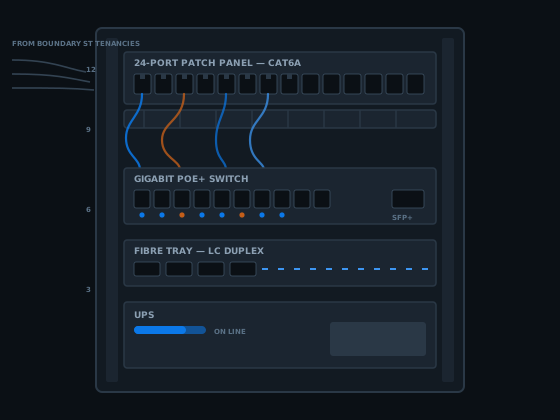
West End's population has grown by more than four-fifths over the past decade, and dwellings have flipped with it — roughly three in four are now units or apartments, not the standalone Queenslanders the suburb built its name on. Plenty of those Queenslanders are still standing, just extended twice over or raised and built in underneath. Next door, Woolloongabba is carrying a data cabling South Brisbane job of a different order entirely: an underground Cross River Rail station going in at its main intersection, and the Princess Alexandra Hospital campus running 1,038 beds a few streets over.
This page covers what actually sets a data cabling South Brisbane job apart from the rest of the region: the housing mix between original cottages and apartment infill, the transit and health precinct reshaping Woolloongabba, an nbn history in this pocket that predates most of Brisbane's rollout, and what a proper install and test regime looks like on either side of the postcode. For the wider region, the data cabling Brisbane hub page covers the whole patch this business works.
What data cabling South Brisbane jobs actually involve
Strip away the postcode and data cabling South Brisbane work is the same trade as anywhere: fixed cable, wall plates, patch panels and a comms point everything else plugs back into. What's different is the building stock — narrow-lot Queenslanders raised and extended two or three times over, low-rise walk-ups from the 1960s and '70s, and apartment towers still going up around the new station.

The 100 metre channel limit that governs every run — 90 metres of fixed cable plus up to 10 metres of patch leads at each end — doesn't shift from West End to Woolloongabba. What changes is how the cable gets to the outlet at all: a Queenslander's subfloor gives a path most slab or apartment builds don't have, and a body corporate building adds a step a standalone house never deals with. Most jobs still want a phone line run alongside the data points, and that side of the work sits on its own telephone cabling installation page.
West End to Annerley: Queenslanders, cottages and apartment infill
West End is the clearest example of the shift. Its population has grown more than four-fifths in a decade to near 18,000, and the dwelling mix moved with it — roughly three-quarters flats and apartments against one in five standalone houses, a flip from the workers'-cottage suburb it used to be. Boundary Street carries the commercial spine through the middle: cafés, restaurants, a produce market and the West Village precinct built on the old tile factory site. Every tenancy along it is its own small data cabling South Brisbane job — EFTPOS, kitchen printers, CCTV, a guest Wi-Fi network kept off the till.
South of West End, Fairfield, Yeronga, Annerley and Moorooka keep more original character housing — 1920s and '30s timber cottages on stumps, plenty raised for a second storey underneath rather than pushed out sideways on a narrow block. Moorooka's Beaudesert Road strip has run as a multicultural shopping precinct since Ethiopian and Eritrean families opened businesses there in the late 1980s, and Yeronga's old TAFE campus is becoming 339 new dwellings on one 3.1 hectare site — a retrofit into something already built, not a greenfield job.
That stock also sits low in places. The river peaked at 3.85 metres at the city gauge in the February 2022 flood, and Forsyth Street in Fairfield and Hyde Road in Yeronga both went under, which is why homes there often get re-stumped higher afterwards.
The bit most South Brisbane quotes skip past
Woolloongabba: Cross River Rail, the Gabba precinct and the PA Hospital
Woolloongabba is carrying more construction at once than anywhere else nearby. An underground Cross River Rail station is going in at the Main Street intersection, work still active on site as of mid-2026, anchoring a wider precinct plan flagged for housing, retail and an entertainment venue once fit-out is done. The Gabba itself will host athletics and the 2032 Olympics opening and closing ceremonies, then be demolished — cricket and AFL are shifting to a new stadium planned for Victoria Park, closer to the CBD.
A few streets over, the Princess Alexandra Hospital runs 1,038 beds and around 5,800 staff across a catchment of 1.6 million people, and the health precinct keeps growing — an eight-storey Buranda Health Hub is going up on Wolseley Street against the hospital boundary. Between the station, the stadium precinct and the hospital campus, data cabling South Brisbane work in Woolloongabba has more new commercial floor space landing than the rest of the pocket combined.
nbn technology across South Brisbane's inner suburbs
South Brisbane's nbn footprint has a longer history than most of the region. Telstra closed its South Brisbane telephone exchange in early 2013 for the new Queensland Children's Hospital, and rather than relocate it ran fibre to the premises directly to around 18,000 affected services — years before nbn Co existed as most people know it today. nbn Co later overbuilt much of that footprint with its own fibre, so a lot of West End and inner South Brisbane sits on full fibre already.
Further out, the picture is more mixed. Pockets of Moorooka and Annerley run on hybrid fibre coaxial, laid originally for pay TV in the 1990s and later folded into nbn, while other streets sit on fibre-to-the-node with an upgrade path to full fibre. None of it changes what happens at the wall — the boundary point is nbn Co's, and every data cabling South Brisbane job past it is private, registered-cabler work. In an apartment block, that equipment generally stops at a communications room or riser cupboard, and reaching it means asking the body corporate first, since approval usually runs slower than the cabling itself.
Commercial data cabling South Brisbane businesses need
Commercial data cabling South Brisbane work splits across three very different briefs: a hospitality tenancy on Boundary Street, a medical suite near the Princess Alexandra Hospital, and an office fitout in one of the newer buildings going up around West Village or the train station precinct. The core of the job matches commercial data cabling anywhere in Brisbane — staged pulls, tested links, a proper handover — but the site conditions in this pocket rarely look like a greenfield fitout.
Hospitality and retail
EFTPOS, kitchen printer runs, a guest network kept off the till, and CCTV.
Medical suites near the PA
Reliable, tested links for booking systems, imaging and patient records.
Office fitouts near the station
Clean floors, no legacy cabling — but no existing comms room to reuse either.
Cameras & access control
PoE cabling for cameras and door controllers — security work wearing a data hat.
The bit most quotes leave out
Why registration matters for data cabling South Brisbane work
The rule covering data cabling South Brisbane work is federal, and it doesn't care whether the site is a Queenslander in Annerley or a new tower near the station. Fixed cabling that connects to a telecommunications network must be installed by a registered cabling provider, or by someone directly supervised at all times by one, under section 21 of the Telecommunications (Cabling Provider) Rules 2025. It sits apart from any electrical licence — the Electrical Safety Act 2002 (Qld) says at section 55(3) that a licence isn't needed for telecommunications cabling specifically.
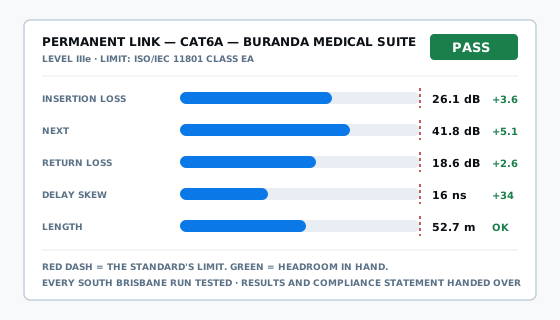
Every job on this page runs under the same ACMA cabler registration as work anywhere else — registration no. 42489, open class, covering structured, fibre and coaxial work without a separate endorsement for each. All of it is installed to AS/CA S009:2020, the Wiring Rules, a free download from the Australian Telecommunications Alliance. Every permanent link gets tested against that standard before handover, and the written compliance statement required under section 25 goes out regardless of whether the invoice is paid.
Cat6 or Cat6A for a data cabling South Brisbane install
The housing split in this pocket makes the choice fairly clear-cut for most data cabling South Brisbane jobs. A renovated cottage in Annerley or Moorooka with a run under 30 metres does the job on Cat6 — gigabit to the full 100 metres, and the labour cost is identical either way. A new apartment build near Woolloongabba station, or any tenancy going in with PoE cameras and access control, is better served starting with Cat6A, because re-pulling cable through a finished slab or a shared riser is a much bigger job than doing it once, properly.
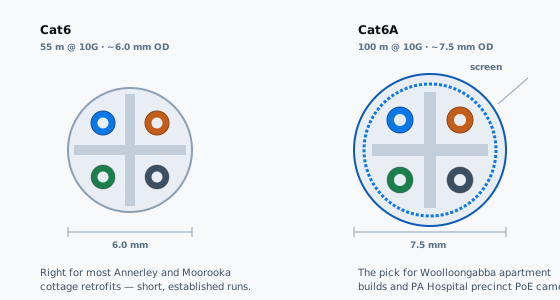
| Cat6 | Cat6A | |
|---|---|---|
| 1 Gbps | 100 m | 100 m |
| 10 Gbps | ~55 m | 100 m |
| Screening | Usually unscreened | Screened against alien crosstalk |
| Outside diameter | ~6.0 mm | ~7.5 mm |
| Suits | Established cottages, short runs | Apartment builds, PoE, Woolloongabba precinct |
Rule of thumb for any data cabling South Brisbane job: commercial tenancy, long run, or a PoE camera on the network, install Cat6A. A three-bedroom Queenslander with a 25 metre run isn't a compromise on Cat6 — it's the right cable for the job.
What data cabling South Brisbane quotes actually cost
Access moves a data cabling South Brisbane quote more than the cable spec does. A raised Queenslander with clear subfloor access is a quick job, because the cable never has to fight the building to get where it's going. The same outlet count in an apartment near Boundary Street, where the cabler needs body corporate sign-off before touching a riser cupboard, takes longer before a cable gets pulled — worth asking about at quote stage, not after the booking is confirmed.
Structured cabling is generally priced per outlet — cable, both terminations, wall plate, patch panel port, testing and labelling — with the per-point rate falling as the count rises. Fault finding and small additions are priced hourly instead; published rates for comparable work sit around $185 per hour for standard hours, with a premium for after-hours or emergency callouts. The full breakdown sits on the data cabling cost page, along with what to check before signing off any quote.
Home network cabling in South Brisbane's cottages and units
Most home data cabling South Brisbane enquiries start life as a Wi-Fi complaint, and the cause is usually the same one everywhere: one router in a corner trying to cover a floor plan — or an extension — it was never going to reach. A cabled ceiling or floor point feeding a proper access point fixes more coverage problems than any router upgrade, and the detail on planning that sits on the home network cabling page.
In a Queenslander with subfloor access, that point is usually a short run up through the floor with no wall damage — the trickier ones are the double-storey extensions where the original roof cavity doesn't reach the new section. In a unit, the job depends on what's already in the riser and what the body corporate allows; sometimes the cleanest fix is a single well-placed access point rather than chasing cable through a strata wall that isn't going to give up easily.
South Brisbane and the suburbs around it
Data cabling South Brisbane work borders two other patches this business covers regularly. South and a little west, data cabling Logan picks up past the Ipswich Motorway interchange, and east across toward the bay, data cabling Redlands covers the suburbs backing onto Moreton Bay. Both get quoted the same way this pocket does — access first, cable category second, testing always included, never assumed.
Further south again, the Gold Coast corridor picks up around data cabling installation in Burleigh Heads, a similar mix of established housing and newer apartment stock. Comparing more than one quote for a data cabling South Brisbane job? The rundown of what to look for sits on the data cabling companies in Brisbane page — registration, testing and what should already be in the price.
Data cabling South Brisbane questions we get asked
What's different about data cabling a renovated Queenslander in West End compared to a new apartment near Woolloongabba station?
A raised or extended Queenslander in West End usually still has subfloor or roof cavity access somewhere, so cable can reach most rooms without opening a wall. A new apartment near Woolloongabba station has none of that — the cabler works with whatever sits in the riser and communications room, and needs body corporate approval before touching either.
Does the February 2022 Brisbane River flood still affect data cabling in Fairfield or Yeronga?
In the low-lying streets, yes. The river peaked at 3.85 metres at the city gauge that February, and Forsyth Street in Fairfield and Hyde Road in Yeronga both went under. Homes there are often re-stumped higher afterwards, and any subfloor run needs to sit above the new flood line — worth confirming before a cabler quotes the job.
What nbn technology runs through West End and inner South Brisbane?
A good chunk of it sits on fibre to the premises. Telstra closed the South Brisbane telephone exchange in early 2013 for the new Queensland Children's Hospital and ran FTTP to around 18,000 services rather than relocate it, and nbn Co later overbuilt much of that footprint with its own fibre. It isn't universal, so it's worth checking the specific address.
What data cabling does a café or restaurant fitout on Boundary Street West End actually need?
EFTPOS and kitchen printer runs, a guest Wi-Fi network kept off the till, and usually CCTV — cabling most hospitality fitouts don't budget for until the POS terminal drops out mid-service. Boundary Street tenancies are typically small, so the job is quick once shell access is confirmed, but payment systems still need their own isolated run.
Can a private cabler run a new data point in a body corporate apartment near Woolloongabba's Cross River Rail station?
Yes, but the body corporate has to approve access to the communications room or riser cupboard first, since that's common property. Once access is agreed, the cabling itself is ordinary registered-cabler work — the approval step is usually the slower part of the job, so it's worth starting that conversation before booking a visit.
What cabling does a medical suite near the Princess Alexandra Hospital in Woolloongabba need?
Reliable, tested links for booking software, imaging and patient records, usually Cat6A given how much a specialist practice depends on the network staying up mid-consult. The Princess Alexandra Hospital campus runs over a thousand beds across a catchment of 1.6 million people, and the private practices around Buranda and Woolloongabba are cabled to the same standard as the hospital next door.
Is Cat6 enough for an older timber home in Annerley or Moorooka, or does it need Cat6A?
For most 1920s and 1930s cottages in Annerley or Moorooka, Cat6 is the right call — the runs are short, gigabit is plenty, and the labour is the same either way. Cat6A earns its place once the site turns commercial, the run gets long, or PoE cameras and access control are going on the network.
How many data points does a raised Queenslander extension in Yeronga or Fairfield need?
Most extended three or four bedroom Queenslanders in Yeronga or Fairfield end up with four to six outlets: the study, the main living area, a bedroom or two, and a central ceiling point for a wireless access point. The extension is usually the part with no existing cavity, so it's worth planning before the new ceiling closes.
Who do I call for a data cabling fault in a shopfront on Moorooka's Beaudesert Road?
A registered cabler, not the IT helpdesk. A port stuck at 100 megabit instead of gigabit, or drops that come and go after a fitout, are physical layer faults, and testing the actual link against the standard is the only reliable way to find them — Beaudesert Road's older shopfronts often carry cabling that was never tested in the first place.
Does South Brisbane's mix of Queenslanders and apartment towers make data cabling harder than out at Logan or Ipswich?
Different, more than harder. Logan and Ipswich mostly deal with an established roof cavity or a slab with roof-only access; data cabling South Brisbane work adds body corporate approval, communications risers and heritage-style renovations on tighter inner-city blocks. None of it stops the job — it just changes what gets confirmed before the quote is fixed.
Get a data cabling South Brisbane quote
Tell me what the building is — renovated Queenslander, unit block, hospitality tenancy or medical suite — and roughly how many points you need. Most data cabling South Brisbane jobs can be scoped from a few photos and a phone call. If it's a fault rather than an install, say what it's doing; that usually narrows it down before anyone drives out.
Or just call 07 3521 8082. If it goes to voicemail I am up a ceiling somewhere; leave a message and I will call back.
ACMA registered cabler no. 42489 All work to AS/CA S009:2020