Brisbane & South East Queensland
Data cabling repairs: finding the fault before you touch a single new cable
Most data cabling repairs calls start with a symptom, not a diagnosis — a port that used to run at a gigabit and now crawls at 100 Mbps, an outlet with a link light that means nothing, or a cable someone's stud gun found during a fit-out. The job is to trace the actual fault before anything gets replaced, using the same test gear and standard a new install is certified against, then hand back a link that's proven, not just relit.
ACMA registered cabler no. 42489 Faults traced, not guessed Retested to AS/CA S009:2020
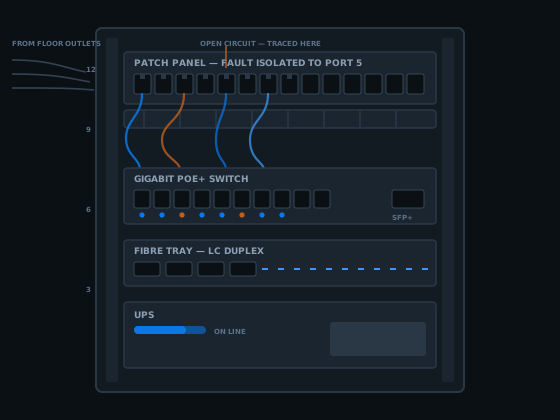
A data cabling repairs job is a different shape of work to a new install. Nobody's asking what category of cable to run — something that worked has stopped working, and the first task is finding out why before touching anything. That means treating the fault the same way any registered cabler would: test first, isolate the actual failure point, then decide whether it's a five minute reterminate or a genuine cable replacement.
This page works through the four things that generate almost every data cabling repairs call — link lights that lie, ports stuck at a fraction of their rated speed, cable damaged during someone else's trade work, and the process of actually tracing a fault instead of guessing at one. For the cost side specifically, see what data cabling work costs in Brisbane more broadly.
What counts as a data cabling repairs job
Repairs sit apart from new cabling in one important way: the infrastructure already exists, and something in it has failed. That covers a wide range — a data point that's stopped working, a run that used to carry a gigabit and now negotiates lower, a cable physically damaged by another trade, or a termination that's simply aged out. What ties them together is that the fix starts with a test, not a guess.
It's different from a callout for a brand new outlet, and it's priced differently too — most data cabling repairs work is billed hourly rather than per point, because nobody knows in advance whether the fault is a two minute fix or an hour of sectional testing. The scope only becomes clear once the fault is found, which is exactly why finding it properly is the whole job.
Link lights that lie: why the light doesn't mean the link works
A link light tells you two devices agreed to talk. It doesn't tell you all four pairs in the cable are healthy, or that the connection will hold up under real traffic. A cable with one damaged pair can still negotiate a link, light up green, and carry data — just slower, or with enough errors that video calls stutter and file transfers time out for no obvious reason.
This is the single most common misunderstanding on a data cabling repairs job: someone points at a lit port as proof the cabling is fine, when the light only confirms a partial handshake. Proper fault finding tests the pairs individually — a wire map, not a glance at an LED — because that's the only way to see what the light is hiding.
Ports negotiating at 100 Mbps instead of a gigabit
Gigabit Ethernet uses all four pairs in the cable. 100 Mbps only needs two. That single fact explains most of the "used to be fast, now it's slow" calls: if one pair fails — crushed, corroded, or terminated badly — the link doesn't drop out, it falls back to the lower standard both ends can still manage. The connection looks normal. The speed doesn't, and most people blame the router or the internet plan before they think about the cable.
It's a classic data cabling repairs scenario precisely because nothing about the connection looks broken. Tracing it means testing wire map and performance on all four pairs, not just confirming the link comes up — a port stuck at 100 Mbps can sit undiagnosed for months because it's still technically working, just quietly running at a quarter of what it should.
Runs cut during a fit-out — the most common repair call
Office fit-outs move fast, and cable sits inside walls and ceilings that other trades are actively cutting into. A stud gun through a wall cavity, a saw through a bulkhead, a partition wall going up over an existing run — none of it is malicious, and almost none of it gets noticed until someone plugs in a desk and gets nothing, which is when the data cabling repairs call gets made.
The fix depends entirely on where the damage sits. A cut near one end can often be re-terminated onto a new connector, provided the remaining length still fits the channel limit. A cut mid-run, or damage close to a joint that's already marginal, usually means pulling a new cable is faster and more reliable than trying to splice around it.
The part most repairs skip
How a data cabling repairs fault is actually traced
Tracing starts at the patch panel, not the wall. A cable certifier tests the permanent link end to end — wire map, length, insertion loss, NEXT and return loss — against the standard the cable was installed to, and reports exactly where the reading goes bad. That narrows a fault from "somewhere in this run" to a specific metre mark, which matters when the run is buried in a roof cavity or under a slab.

A tone generator and probe still earn their keep for physically finding a cable inside a ceiling space once the certifier has narrowed the search, and a length reading against the known cable run tells you roughly how far along the fault sits. None of this is guesswork — it's the same test discipline used to certify a brand new install, just pointed at a cable that's already been in service.
What it isn't is opening every access panel between the patch panel and the outlet hoping to spot the damage. On a data cabling repairs job, the test result decides where to look before a single ceiling tile comes out, which is the difference between an hour of billable time and a full day of exploratory work.
What's usually behind the fault, once it's found
Most faults trace back to one of a handful of causes, and the symptom on the desk usually points toward one of them before the cable's even been touched. The table below is the pattern a lot of data cabling repairs jobs follow — not a diagnosis on its own, but a reasonable starting point for where to test first.
| Symptom | Likely cause | What the test shows |
|---|---|---|
| Link light on, no traffic | Only one or two pairs making contact | Wire map fault — open or miswired pair |
| Gigabit port linking at 100 Mbps | One pair not connecting cleanly | Wire map shows a pair open or shorted |
| Works, then drops out | Marginal termination, vibration or heat movement | Passes wire map, fails or marginal on NEXT |
| No light at all | Cable severed or connector fully failed | Open circuit on the length test |
| Slow but "connected" | Damage or interference along the run | High crosstalk or poor return loss reading |
None of these are guaranteed — the only way to know for certain is the test result — but a technician who's seen enough of them starts narrowing the search before the cable certifier is even plugged in. Experience shortens the job. It doesn't replace the test.
Testing and re-certifying after a repair
A repaired link gets tested exactly the way a new one does. Reterminating a connector or splicing in a new section of cable doesn't automatically restore performance — the only way to know the fix actually worked is to run the same certification test a brand new install goes through and compare the result against the limit.
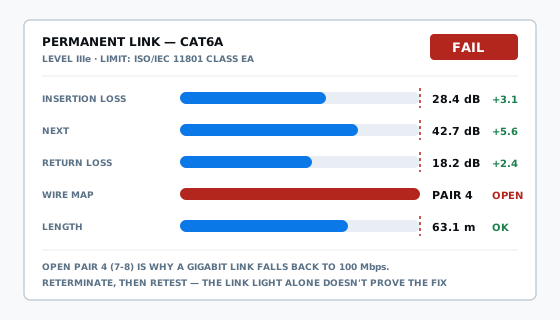
That matters because a repair that only restores the link light can leave a marginal connection in place — one that passes today and fails again in six months when a termination shifts slightly. Retesting after the fix is what separates a genuine repair from a quick patch that just moves the problem further down the calendar.
What data cabling repairs cost in Brisbane
Repairs are priced differently to new cabling because the labour is unpredictable in a way a fresh install isn't. Nobody can quote a fixed number for "find the fault" before the fault is found — it might be a loose patch lead reseated in five minutes, or an hour of sectional testing through a roof cavity to isolate one bad pair in a 40 metre run. That's why data cabling repairs work is billed hourly rather than per point.
Published Brisbane rates for comparable work sit around $185 an hour for standard hours, with after-hours and emergency callouts carrying a premium. What actually drives the bill up isn't the fault itself — it's access. A fault in an open roof cavity is a different job to the same fault behind a rendered ceiling with no manhole anywhere near it.
When it's cheaper to replace than repair
A repair is the right call for a data cabling repairs job when the damage is localised and the rest of the run tests clean — a reterminated end, a spliced section, a swapped patch lead. It stops being the cheaper option once the cable's been damaged in more than one place, once the jacket's compromised along its length, or once retesting keeps turning up a marginal result even after the obvious fault is fixed.
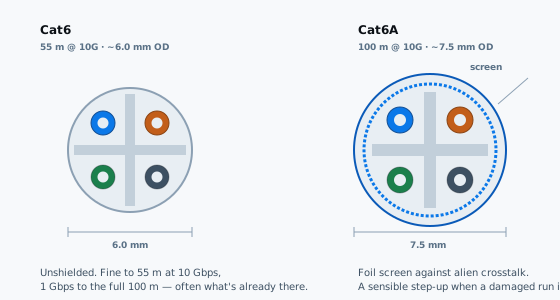
At that point pulling a new cable — and sometimes stepping up from Cat6 to Cat6A while the access is already open — ends up costing less than a second and third repair visit to the same run. It's worth asking the question honestly rather than reterminating the same cable a third time.
Who's allowed to carry out data cabling repairs
The registration requirement doesn't relax because the job is small. Cabling that connects to a telecommunications network — new or repaired — must be performed by a registered cabling provider, or by someone directly supervised at all times by one, under section 21 of the Telecommunications (Cabling Provider) Rules 2025. A five minute reterminate is still cabling work in the eyes of the rule.
If what you actually need is new data points rather than a fix for an existing one, that's a different scope — see the guide to a data cabling installer for how a fresh install is planned and quoted. Fault finding and new installation use the same registration and the same test standard; they're just different jobs on the same trade.
Government and defence sites add their own access and reporting requirements on top of the registration itself — worth checking separately if that's where the fault sits, and covered on the page for government data cabling contractors. The standard behind all of it is AS/CA S009:2020, a free download from the Australian Telecommunications Alliance.
Where we handle data cabling repairs across Brisbane
Brisbane metro is home ground, plus Ipswich, Logan, Redlands, North Lakes, Springfield, the Gold Coast, the Sunshine Coast and Toowoomba. A repair callout stays practical closer in — a two hour round trip for one bad pair rarely makes sense for anyone — while a fault inside a larger commercial fit-out is worth the drive further out, the same as a new install would be.
Data cabling repairs questions people ask
What does a data cabling repairs job in Brisbane actually involve?
It starts with the symptom, not the fix — a dead outlet, a port stuck at 100 Mbps, or a cable someone caught with a stud gun during a fit-out. A data cabling repairs visit tests the run with a cable certifier to find exactly where the fault sits, then reterminates or replaces only that section, and retests before calling it done.
Why does a network port show a link light but still not work properly?
A link light only confirms enough of the pairs are making contact to negotiate a connection — it says nothing about whether all four pairs are clean. A cable with one damaged pair can still light up and carry traffic slowly or unreliably, which is why data cabling repairs work relies on a proper wire map and performance test, not the light on the wall plate.
Why would a gigabit port suddenly negotiate at 100 Mbps instead?
Gigabit Ethernet needs all four pairs in the cable working. 100 Mbps only needs two. If a termination fails, a pair gets crushed, or a connector corrodes, the link can fall back to 100 Mbps rather than drop out completely — the connection still works, just at a quarter of the speed, which is often mistaken for a switch or NBN problem instead of a cabling fault.
Can a cable that was cut during a fit-out be repaired, or does it need replacing?
It depends on where the cut is and how much slack is in the run. A break close to one end can often be re-terminated onto a new connector once the length is retested against the channel limit. A cut mid-span, or one near an already-marginal termination, usually means running a new cable is faster and more reliable than splicing.
How do you trace a data cabling fault without opening every wall?
A cable certifier tests from the patch panel outward and reports where the signal stops behaving correctly, which narrows the fault to a section rather than the whole run. Combined with knowing the building's cable paths — roof cavity, subfloor, wall chase — that reading usually points to one access point instead of a wall covered in exploratory holes.
Are data cabling repairs charged hourly or per point?
Hourly. Fault finding doesn't fit a fixed per-point rate because the time to trace a fault varies hugely — sometimes it's a five-minute reseat of a loose patch lead, sometimes it's an hour of sectional testing to find one bad pair in a 40 metre run. Published Brisbane rates for comparable work sit around $185 an hour for standard hours.
Do you re-certify a cable after a data cabling repair?
Yes. A repaired link gets tested the same way a new one does — insertion loss, NEXT, return loss, wire map and length against the category it was installed to. A link light coming back on after a repair proves the connection exists, not that it performs, and the only way to know is to test it properly.
Can rodents actually cause a data cabling fault?
Yes, and it's a genuine cause on Brisbane data cabling repairs calls, particularly in roof cavities and subfloors. Rodents chew cable jackets and occasionally the conductors themselves, which shows up as an intermittent or fully open fault depending on how much damage was done. It's found the same way as any other fault — trace, isolate, then decide whether to repair or replace that section.
Who is legally allowed to carry out data cabling repairs in Brisbane?
The same rule that applies to a new install applies to a repair: cabling that connects to a telecommunications network must be performed by a registered cabling provider, or by someone directly supervised at all times by one, under the Telecommunications (Cabling Provider) Rules 2025. A repair is still cabling work — the registration requirement doesn't relax because the job is small.
Is a slow gigabit link always a cabling fault, or could it be the switch?
Not always — a failing switch port, a bad patch lead, or a misconfigured NIC can all mimic a cabling fault. That's exactly why data cabling repairs work starts with testing the permanent link itself before anything gets replaced. If the cable tests clean end to end, the fault sits in the equipment plugged into it, not the cabling.
Get a data cabling repairs quote
Tell me what the symptom is — dead port, slow link, a fit-out that might have caught a cable — and roughly where it is in the building. Most data cabling repairs calls can be scoped from a description and a couple of photos before anyone drives out, which saves you paying for a look that a phone call could have ruled out.
Or just call 07 3521 8082. If it goes to voicemail I am up a ceiling somewhere; leave a message and I will call back.
ACMA registered cabler no. 42489 All work retested to AS/CA S009:2020