Brisbane & South East Queensland — the business case
The benefits of structured cabling: what one proper install saves over years of ad-hoc cabling
Ad-hoc cabling looks cheaper on the day. Someone runs a cable to the one desk that needs it, charges for the visit, and leaves. Do that five or six times over a decade and you have paid for five or six site visits, five or six lots of setup, and a ceiling opened five or six times. The benefits of structured cabling show up when you count all of that instead of just the first invoice.
ACMA registered cabler no. 42489 Installed to AS/CA S009:2020 Built to scale without a rebuild

The short version: the benefits of structured cabling are cheaper faults, easier moves, cabling that outlasts several rounds of new equipment, and a floor that can take on more staff, more devices and more cameras without anyone opening a ceiling again. None of it shows up on day one. All of it shows up by year three.
This page is the business case, not the technical one. For the subsystems, the comms room geometry and the 100 metre channel that shapes a job, see structured cabling installation in Brisbane. For the mechanics of a quote, start with data cabling cost in Brisbane — this page is about why paying for the benefits of structured cabling once beats paying for them in instalments.
The benefits of structured cabling, in short
Strip away the jargon and the benefits of structured cabling come down to one idea: pay once, properly, and stop paying for the same problem in instalments. A structured install treats the building as a system — one design, one set of outlets sized for more than today's headcount, one certified handover — instead of a string of separate favours done whenever something breaks or someone new starts.
That single choice is what produces every one of the benefits of structured cabling listed here. Lower cost over the life of the fitout, because setup and access are paid for once. Fewer faults, because every link is tested instead of assumed. Faster changes, because a move is a patch lead, not a new cable. Better resale or lease appeal, because the cabling is documented rather than a mystery. And room for the business to actually grow into the space it is paying for.
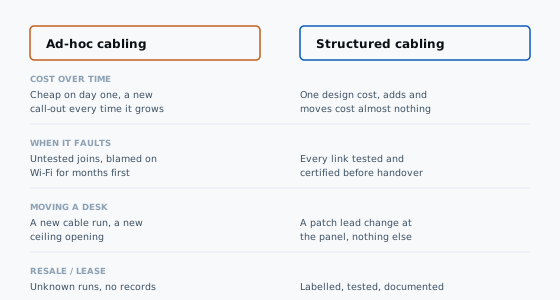
Lower cost over time
One design cost instead of a call-out charge every time the office changes shape.
Fewer support calls
Tested, certified links instead of joins nobody checked and everybody blames the router for.
Faster, cheaper changes
Moving a desk is a patch lead swap at the panel, not a new run through the ceiling.
Higher resale or lease appeal
Labelled, tested cabling with paperwork on file, not an unknown quantity behind the walls.
Room to grow
Spare outlets and switch ports already in place for the next hire or the next camera.
One compliance record
A single written statement covering the job, instead of six unrecorded call-outs to chase up.
Where the benefits of structured cabling get counted
The real benefits of structured cabling show up in the total cost of ownership
Compare two invoices and structured cabling almost always looks dearer on day one. Compare two totals five years later and the order usually flips. The reason is not the cable — it is what repeats every time someone comes back to add one more point, and it is exactly where the benefits of structured cabling actually get counted.
A single ad-hoc call-out carries the same travel time, the same time spent finding a route, and the same minimum charge whether it delivers one outlet or four. Published Brisbane rates for comparable work sit around the $185 per hour mark for standard hours, and the first hour of any visit is mostly setup before a single metre of cable gets pulled. Do that three or four times over a decade and the repeated setup cost alone can rival what the spare capacity would have cost as part of one job.
What repeats every call-out
Travel, finding a route, minimum charge, and — on a building that has grown since the last visit — working out what is already there before touching anything new.
What the benefits of structured cabling pay for once
The design, the comms room build, the certification kit setup and the labelling scheme. Every point added afterwards shares that one cost instead of carrying its own.
The honest caveat: this only pays off if the space actually changes. A building that will look exactly the same in ten years gets little from the extra spare capacity — the benefits of structured cabling are a bet on growth and change, and it is a bet that most commercial premises win.
Flexibility: moves, adds and changes without re-cabling
Every outlet on a structured install runs back to one point on hardware — a patch panel — rather than daisy-chaining or terminating wherever was convenient on the day. That single design rule is what makes a desk move trivial. Someone unplugs a patch lead from port fourteen and plugs it into port thirty-one, and the fixed cable in the wall never gets touched.
Ad-hoc cabling does not have that hardware to move between. A cable run to a specific desk mostly only serves that desk, so a reshuffle usually means a new run rather than a five-minute patch change. That gap is one of the benefits of structured cabling that shows up fastest — often inside the first six months, the first time furniture actually moves.
The full picture of how that star wiring is built — the entrance facility, the backbone, the floor distributor and the 100 metre channel that shapes where the comms room sits — is on structured cabling installation in Brisbane. This page is about why the benefits of structured cabling are worth the extra cost of building it that way in the first place.
Reliability and fewer support calls
A link light proves a cable is connected. It does not prove the link performs. Plenty of ad-hoc terminations negotiate a gigabit on day one and then start dropping out once the building fills with electrical noise or a joint ages, and by then the fault gets blamed on the router, the ISP or the laptop for months before anyone measures the actual cable — a cost the benefits of structured cabling are specifically meant to avoid.
Every link on a structured install gets tested against the standard it was built to, and the result is handed over rather than assumed, along with the written compliance statement required under section 25 of the Telecommunications (Cabling Provider) Rules 2025. That single step removes an entire category of intermittent faults — the ones that never show up on a five-minute visual check and only appear once the office is busy. Fewer of those calls is one of the more boring benefits of structured cabling, and also one of the ones people notice fastest once it stops happening.
The detail on what actually gets measured — insertion loss, crosstalk, return loss, length — and why headroom matters more than a bare pass, is on cable testing and certification.
Resale and lease value of a properly cabled commercial space
Cabling is invisible until someone has to work with it. An agent walking a buyer through a tenancy, or an incoming tenant's IT contractor doing due diligence before signing, cannot see what is behind the walls — they can only see whether there is a record of it. Labelled outlets, a documented panel schedule and a written compliance statement answer the question before it gets asked. An unlabelled rack with no test results does the opposite — and the registration behind the work is worth checking too, since it is issued to the individual cabler, not the company, as the ACMA explains.
That documentation is one of the quieter benefits of structured cabling, and it compounds. A tenant who can see exactly what is installed and that it was tested to the standard does not need to price in the risk of finding out the hard way. A landlord fitting out a floor speculatively is handing the next tenant a system they can actually use rather than a pile of cable someone will need to trace before touching it.
None of this replaces a proper valuation, and cabling is a small line in a much bigger decision. What it removes is a specific, avoidable question mark, and that is the benefits of structured cabling case in miniature — buyers and tenants do price in question marks.
Where the benefits of structured cabling compound
The benefits of structured cabling for a growing business
Most businesses that grow do it in the same few ways: more staff, more devices per desk, another wireless access point to cover a corner that stopped working once three extra people sat in it, and eventually a camera or an access-controlled door that nobody planned for on day one. Every one of those is a data point that has to land somewhere, and it is exactly the pattern that makes the benefits of structured cabling compound over a few years rather than stay flat.

A structured install designed with headroom absorbs all of that quietly. A comms room sized for more switch ports than the opening headcount needs, a handful of extra runs pulled to likely ceiling and wall positions during the original job, and a labelling scheme that makes it obvious what is spare — none of that costs much on install day, and all of it turns "we need three more data points and a camera" into an afternoon instead of a project. For the devices themselves, see wireless network installation and data point installation.
Headroom: spare capacity for cameras and access points you have not installed yet
The comms rack is the part of the job most likely to get value-engineered down to exactly what is needed today, and it is the wrong place to save money. A rack with two or three spare rack units and a handful of unused switch ports costs a modest amount more on the day and removes the need for a second visit the first time the business adds a PoE camera, a door controller or another access point.
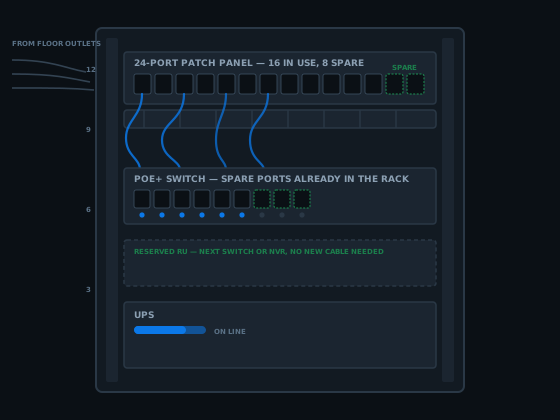
A workable rule of thumb is roughly twenty per cent more outlets and switch ports than the day-one headcount requires, plus one or two ceiling runs held back specifically for a future wireless access point or camera. It is cheap while the ceiling is already open and expensive once it is closed — the gap between those two numbers is one of the benefits of structured cabling that costs the least to add and the most to retrofit. Where the rack itself lives and how it is built is covered on comms room and rack installation.
The honest trade-off: when ad-hoc cabling is still fine
None of this means every job should be structured. A rented office on an eighteen-month term with two or three outlets that will genuinely never move gets little from the benefits of structured cabling — a patch panel, a labelling scheme and spare capacity nobody will use before the lease ends. Paying for the full discipline there is money spent on a bet the business will not be around long enough to collect on.
The case for the benefits of structured cabling gets stronger fast once any of three things are true: the space will be occupied for years rather than months, the headcount is expected to grow, or the fitout includes anything that tends to get added later — cameras, access control, extra access points. Most commercial tenancies tick at least one of those boxes, which is why structured cabling is the default recommendation for offices and ad-hoc cabling stays a legitimate, cheaper choice for small, static, short-term spaces.
Signs your business would benefit from structured cabling now
A few patterns show up again and again in the businesses that end up commissioning a proper install after years of ad-hoc cabling. None of them are dramatic on their own — together they are a reasonable trigger to stop patching and start collecting the benefits of structured cabling properly.
Hiring is active
New desks are appearing faster than the network was designed for.
Devices per desk are climbing
A laptop, a dock, a second monitor and a desk phone all wanting a wired connection.
Cameras or access control are on the list
PoE devices that need their own runs and their own switch ports, planned or not.
Intermittent faults keep recurring
The kind that get blamed on Wi-Fi first and turn out to be an untested join.
A fitout or lease renewal is coming
The cheapest time to build in capacity is while the ceiling is already open.
Nobody can say what is behind the wall
No labelling, no test results, no record of who ran what and when.
Any one of those on its own is not a strong enough reason by itself. Two or three together are usually enough to justify a conversation, even if the answer ends up being a partial upgrade rather than a full rebuild.
What it costs, and where the number actually comes from
This page has deliberately stayed away from dollar figures, because a defensible number depends on the building, the outlet count and what is above the ceiling — exactly the variables covered on data cabling cost in Brisbane, which walks through per point versus hourly pricing and what actually moves the total. That page is where the benefits of structured cabling turn into an actual figure you can compare. The short version of the same question sits at how much professional network cabling costs.
One design detail worth flagging here rather than burying in a cost page: doing the job properly also means keeping cabling the required distance from power circuits from the start, not routing around whatever conduit happened to be free. Retrofitting that separation after the fact is exactly the kind of rework this whole page is arguing against — see the minimum separation distances between power and data cables that apply in Australia.
The benefits of structured cabling questions I get asked
What are the benefits of structured cabling over ad-hoc cabling for a small business?
Mainly cost over time and fewer surprises. Ad-hoc cabling looks cheaper the first time someone runs a cable to one desk, but each later addition repeats the travel, setup and access cost. A structured install pays that once and absorbs years of small changes through spare capacity already built in.
Do the benefits of structured cabling justify the extra cost on a short lease?
Not always. On an eighteen month lease with two or three points that will never move, the full discipline of a structured install is more than the job needs, and ad-hoc cabling is a reasonable, honest choice. The case gets stronger fast once the lease is longer or the headcount is growing.
How long before structured cabling pays for itself compared with ad-hoc call-outs?
It depends how often the space changes, but most growing offices see the ad-hoc total overtake a structured install somewhere between year three and year five, once two or three extra call-outs have each repeated a full setup and access charge that a structured design would have absorbed for free.
Does structured cabling increase the resale or lease value of a commercial property?
It supports the case rather than setting the price on its own. A space with labelled, tested cabling and a written compliance statement on file is easier for an agent or an incoming tenant to assess than one with unknown legacy runs, and it removes a question mark a buyer would otherwise price in.
Can structured cabling support extra PoE cameras and access points added later?
Yes, if the spare capacity was planned for at design time. A comms room sized with headroom, a few extra runs pulled during the original install, and switch ports left free mean a new camera or access point is a patch lead and a mounting job, not a new cabling visit.
How much spare capacity should a structured cabling install include for future growth?
A common rule of thumb is around twenty per cent extra outlets and matching switch ports over what the day-one headcount needs, plus one or two ceiling runs held back for a future access point or camera. It costs little extra on install day and a lot to add after the ceiling closes, which is the core of the benefits of structured cabling case for a growing team.
Does structured cabling reduce IT support calls compared with ad-hoc cabling?
Usually, because every link is tested and certified against the standard before handover instead of just checked for a link light. Marginal ad-hoc joins tend to work at first and drop out under load months later, and those intermittent faults get blamed on Wi-Fi or the switch long before anyone tests the cable.
Is structured cabling worth it for a home office or a small two-person setup?
Often not the full commercial discipline — a couple of outlets that will never move do not need a patch panel and a labelling scheme. What is still worth doing is cabling to the standard and testing the links, which costs little more and rules out the cheap cable and untested joins that cause faults later.
What happens to the benefits of structured cabling if the work is never tested or certified?
Most of them disappear. An untested link might carry a gigabit on day one and still fail months later once the building fills with electrical noise or a termination ages, so the cost of ownership and reliability gains only hold if every permanent link is actually tested against the standard and the results are kept.
Get a quote and put the benefits of structured cabling into real numbers
Tell me what the building is, roughly how many people and devices you are cabling for now, and where you expect headcount or cameras to land over the next couple of years. That is enough to put a real spare-capacity allowance on the quote instead of a guess.
Or just call 07 3521 8082. If it goes to voicemail I am up a ceiling somewhere; leave a message and I will call back.
ACMA registered cabler no. 42489 All work to AS/CA S009:2020