Brisbane & South East Queensland
Fibre optic cabling installation solutions: what to specify before you get quotes
A fibre optic cabling installation solutions quote is really four small decisions dressed up as one line item: armoured or not, an indoor or outdoor jacket, terminated in a factory or on site, and loose-tube or tight-buffered inside. Get those right before anyone quotes a metre of glass and the number makes sense. Get them wrong and you pay to redo it.
Four calls before any quote Spec sheet, not guesswork Compared, not assumed
Two fibre optic cabling installation solutions quotes can specify the same core count and the same length and still be nothing alike, because the cable itself comes in more than one construction. Armoured or not. Rated for indoors or out. Terminated at a bench in a factory or with a splicer on your site. Loose-tube or tight-buffered inside. None of that shows up in a one-line "fibre cable, 80 metres" quote, and all of it changes the number.
This page is about specifying the cable, not the physics behind it — for loss budgets, splice tolerances and the multimode-versus-single-mode reasoning, the fibre optic cable installation page covers that ground properly. What follows is what belongs on paper before a fibre optic cabling installation solutions quote comes back, so two quotes can actually be compared.
The four decisions behind a fibre optic cabling installation solutions quote
Ask five different installers to quote the same run and you can get five different cables back, because "fibre" is not a single product. It is a family of constructions, and which one belongs in your wall, your conduit or your trench depends on where the cable goes and what happens to it once it is there.
The four calls that matter are armour, jacket rating, termination method and internal construction. None of them touch the optics — a loose-tube outdoor cable and a tight-buffered indoor cable can carry identical glass and perform identically once terminated. What differs is how the cable survives getting there, and how much labour it takes to finish.
Skip these four decisions on a fibre optic cabling installation solutions job and the installer picks for you, usually towards whatever is already in stock. That is fine when it happens to match the job. It is an expensive surprise when a gel-filled outdoor cable turns up for a route through a return-air ceiling space, or unarmoured cable gets asked to survive a trench with no conduit in it.
The rest of this page works through each decision in turn, then shows what a properly specified fibre optic cabling installation solutions quote should list, so you are comparing two quotes on the same terms rather than two different products with the same name.
Decision one
Armoured or unarmoured — protecting the run
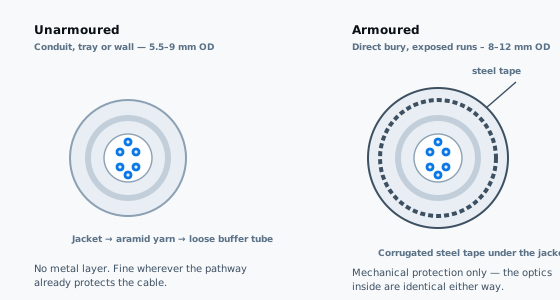
Armoured fibre carries an extra layer under the outer jacket — a corrugated steel tape, or interlocking aluminium on some cables — added purely for mechanical protection. It does nothing for the optics inside. Its job is to survive a shovel, a rodent, or years of ground movement that unarmoured cable was never built to take.
Unarmoured cable is lighter, cheaper, and the sensible default the moment a conduit, a cable tray or a building wall is already doing the protecting. Running armour through a comms room adds stiffness and cost for no benefit, since nothing in there is going to chew through the jacket.
Rule of thumb: armoured for anything direct-buried without conduit, anything with known rodent activity, or an exposed run that could be struck. Unarmoured everywhere the pathway already protects the cable — inside conduit, tray, riser or wall. That is the whole point of specifying armour on a fibre optic cabling installation solutions job before the trench gets dug, not after.
The trade-off is easy to say in one sentence: armour is insurance bought at the point the cable is most vulnerable. Skipping it on a fibre optic cabling installation solutions job to save a few dollars a metre is the false economy that turns into a full re-dig once the link starts failing two years in.
Indoor-rated or outdoor-rated jacket — where the cable actually lives
Outdoor fibre is usually built wet — the buffer tubes flooded with a water-blocking gel, or wrapped in water-blocking tape and yarn instead, so moisture and Brisbane's temperature swings do not compromise the fibres over years buried or strung on a pole. The jacket itself is UV-stabilised polyethylene, tough enough for direct sun.
Indoor cable is built dry. No gel to migrate and drip out of a connector months later, and a jacket rated to limit how a fire spreads and how much smoke it makes if it ever burns — riser-rated for a vertical shaft, plenum-rated for the air-handling space above a ceiling. Neither rating exists on outdoor cable, because outdoor cable was never meant to sit in a ceiling void carrying conditioned air. Most disputes about a fibre optic cabling installation solutions job come down to exactly this mismatch.

The two are not interchangeable and the practical answer is a transition point, not one cable for the whole run. Outdoor cable does the buried or aerial section, stops at a splice enclosure near the entry point, and a dry indoor-rated cable — spliced or connectorised there — carries on to the rack. Running gel-filled outdoor cable straight through into a ceiling space is a shortcut some fibre optic cabling installation solutions jobs still take, and a fire inspector will eventually ask about it.
Which rating a run needs is decided by where it actually sits, not by what is cheapest at the wholesaler that week. A fibre optic cabling installation solutions quote that specifies one cable type for an outdoor-to-rack run without mentioning a transition point is worth questioning. The mandatory standard behind cabling practice here is AS/CA S009:2020, a free download from the Australian Telecommunications Alliance, and it is a fair read if you want to see why an indoor and an outdoor jacket are never really the same product.
Pre-terminated and plug-and-play, or field-terminated on site
A pre-terminated assembly — sometimes sold as plug-and-play — arrives from the factory with connectors already fitted, polished and tested against a measured length. MTP/MPO trunk cables carrying twelve or twenty-four fibres in one connector are almost always handled this way, because that connector is genuinely difficult to fit well outside a factory. Turn up, plug in, test, done — the fastest fibre optic cabling installation solutions method there is.
Field termination means finishing the cable on your site — fusion splicing bare fibre to a factory pigtail, or occasionally a mechanical splice or a direct connector fit for a single strand. It costs more in labour and needs a technician with a splicer, but it copes with a length nobody measured accurately, which describes most retrofit and fault-repair work.

| Pre-terminated / plug-and-play | Field-terminated | |
|---|---|---|
| Speed on site | Fast — plug and test | Slower — splice or connectorise there |
| Loss consistency | Locked in at the factory | Depends on the technician on the day |
| Length flexibility | None — ordered to the metre | Cut to whatever the site measured |
| Best for | Known, repeatable backbone runs | Unknown lengths, retrofits, repairs |
Neither is universally right. A new-build backbone with a designed route is a pre-terminated job — the length is known before anyone leaves the office. An existing building where nobody trusts the drawings is a field-terminated job, because ordering a pre-terminated assembly to the wrong length means reordering and waiting. Whichever way a fibre optic cabling installation solutions quote goes, the method should be named, not assumed.
Loose-tube or tight-buffered — how the individual fibres are held
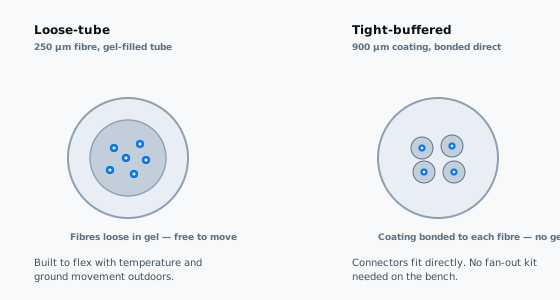
Inside a loose-tube cable each fibre carries a thin 250 micron coating and sits loosely inside a small tube, usually several fibres to a tube, with the space around them filled by gel or water-blocking tape. The fibres are not gripped, so they can move slightly as the cable flexes or the temperature changes — exactly what a buried or aerial run needs to survive without stressing the glass.
Tight-buffered cable adds a 900 micron plastic coating bonded directly over each fibre. There is no gel, connectors can be fitted straight onto that 900 micron coating without a fan-out kit, and the construction is simply easier to work with on a bench or in a rack. It is also bulkier and more expensive per fibre for the same count.
| Loose-tube | Tight-buffered | |
|---|---|---|
| Fibre coating | 250 µm, gel or dry tube | 900 µm, bonded direct |
| Termination | Needs a fan-out kit | Direct — no kit needed |
| Typical home | Outdoor, direct-bury, aerial | Indoor, patch cords, comms rooms |
| Density | More fibres per cable size | Fewer, more material per fibre |
Get the two crossed over and the job does not fail outright, it just gets harder than it needed to be — tight-buffered cable pulled through a duct built for outdoor conditions does the job today and struggles over the years the gel-filled version was designed for. Loose-tube cable landed in a rack works, but wastes a technician's time on a breakout kit for no reason. The construction rarely gets asked about on a fibre optic cabling installation solutions job, which is exactly why it is worth asking.
Reading a fibre optic cabling installation solutions quote
A quote that says "fibre optic cable, 60 metres, supply and install" has told you almost nothing. It has not said whether that cable can survive the trench it is going in, whether it will pass a fire inspection in the ceiling it crosses, whether it turns up ready to plug in or needs a technician on site for a day, or how many of the fibres are actually usable once the desks or racks are in — questions any fibre optic cabling installation solutions buyer should be asking before signing.
A proper fibre optic cabling installation solutions quote itemises the construction — armoured or not, indoor or outdoor jacket, loose-tube or tight-buffered — states the termination method and connector type by name, gives the core count including spares, and says whether testing and a compliance statement are included. Five lines instead of one, and every one of them changes the number.
What to ask before comparing two quotes: is the jacket rated for where the cable actually runs, is the termination method named rather than implied, and how many spare cores are in the count. Ask any fibre optic cabling installation solutions provider for that in writing — those three questions expose more corner-cutting than chasing a lower price ever will.
What goes wrong when the wrong construction gets specified
Most fibre problems that turn up months after a fibre optic cabling installation solutions job are not fibre problems at all. They are construction problems, chosen wrong at quoting stage and only obvious once the cable has been living in its real environment for a while.
Gel-filled cable in a ceiling void
Outdoor cable run straight into a return-air space instead of transitioning to a rated indoor cable near the entry point. Works fine on the day, then fails a fire inspection or an insurance audit years later.
Unarmoured cable direct in the ground
No conduit, no armour, and a link that tests perfectly at handover. The failure shows up as an intermittent fault eighteen months later — usually rodent damage or a nick from someone else's trenching.
A pre-terminated assembly to a guessed length
Factory-terminated cable ordered to a length nobody actually measured. It arrives short, or long enough to leave an ugly coil in the rack, and the fix is another assembly and another wait.
None of these three show up on a test result at handover, which is exactly why they are cheap to miss and expensive to fix later. Walking the route and asking the four questions before ordering anything avoids all three.
Construction also intersects with registration on a fibre optic cabling installation solutions job. Optical fibre is one of six specialised cabling categories under the Telecommunications (Cabling Provider) Rules 2025, and underground cabling — relevant the moment armour and direct burial are on the table — is a separate category again. Ask whoever quotes the job which categories they hold, not just whether they "do fibre".
Where fibre optic cabling installation solutions work happens
Brisbane metro covers most of it — CBD fitouts with a riser to sort out, industrial sites through Rocklea, Salisbury and Eagle Farm with a second shed to reach, and strata buildings where one comms room was never going to cover every tower. Beyond that: Ipswich, Logan, Redlands, North Lakes, Springfield, the Gold Coast, the Sunshine Coast and Toowoomba.
The jobs that turn these four decisions into real money are almost always the same shape: an outdoor run between structures, a backbone up a riser, or a retrofit into a building where nobody trusts the existing drawings. For a straightforward single-building backbone rather than a multi-building link, the fibre network installation page covers that campus-and-warehouse version of the same decision, including the civil work a between-buildings run usually needs. That is the shape most fibre optic cabling installation solutions enquiries take across the region.
Fibre optic cabling installation solutions questions I get asked
What is armoured fibre optic cable and when does a Brisbane job need it?
Armoured fibre has a corrugated steel or interlocking aluminium tape under the outer jacket, added purely for mechanical protection. It matters when the cable goes direct into the ground without conduit, through an area with known rodent activity, or anywhere it could be crushed or struck. Inside a building, running through tray or conduit, armour is usually unnecessary weight and cost.
Should outdoor-rated fibre cable be run straight into a building without a transition point?
Not as standard practice. Outdoor cable is usually gel-filled or water-blocked to survive moisture and temperature swings, and that construction is not meant to run far indoors. The sensible approach is a transition splice or enclosure near the entry point, joining to a dry, indoor-rated cable for the run to the rack. Skipping it is a shortcut some cheaper jobs take.
What is the practical difference between pre-terminated and field-terminated fibre optic cable?
Pre-terminated cable arrives from the factory with connectors already fitted, polished and tested against a measured length — plug it in and go. Field-terminated cable is finished on site, usually by fusion splicing bare fibre to a factory pigtail. Pre-terminated is faster and its loss figures are locked in before delivery; field termination copes with a length nobody measured accurately.
Is loose-tube or tight-buffered fibre optic cable better for a Brisbane comms room fit-out?
Tight-buffered, for most indoor fit-outs. Each fibre carries its own 900 micron coating, there is no gel to clean up, and connectors can be fitted directly without a breakout kit. Loose-tube cable holds fibres inside a gel-filled tube built for outdoor temperature swings and moisture, and needs a fan-out kit before it can be terminated — better suited to the outdoor run leading in.
What is plug-and-play fibre cabling and does it cost more than a spliced link?
Plug-and-play describes a factory-terminated assembly — usually an MTP/MPO trunk or LC pigtail — built and tested to length before it reaches site. The cable itself often costs more than raw fibre because the factory has done the termination and testing, but the labour saved on site usually brings the total closer to a spliced link than the cable price alone suggests.
How many spare fibre cores should a fibre optic cabling installation solutions quote include?
More than today's device count, because pulling a fresh cable later costs the same labour as pulling it the first time. A four-core requirement commonly goes in as eight or twelve, since extra cores cost very little once the pathway is already open. What is expensive is discovering the spare capacity does not exist the day a new link is actually needed.
Can indoor-rated fibre cable be used to run between two buildings on the same site?
Not properly, no. Indoor cable is built dry, without the gel or water-blocking a buried or aerial run needs to survive weather and ground movement, and it has no UV protection either. A link leaving one building and entering another wants an outdoor-rated, and often armoured, cable for the section outside, transitioning to indoor cable once it is back inside a wall.
What connector type should be specified on a pre-terminated fibre assembly?
LC is the common choice for equipment ports on a modern Brisbane fit-out, small enough for high port density, while MTP/MPO connectors suit backbone trunks carrying twelve or twenty-four fibres in one plug. The connector belongs on the quote by name, not left as 'connectorised', because SC and ST hardware is still out there and none of the four are interchangeable.
Does armoured or underground fibre cable need a different cabler registration category?
Optical fibre is its own specialised category under the Cabling Provider Rules regardless of whether the cable is armoured, and underground cabling is a separate category again for anyone directly burying it without conduit. A cabler working on an armoured, direct-buried fibre run may need both categories notified to the registrar, not just the one — worth asking about on a civil-heavy job.
What should a written fibre optic cabling installation solutions quote actually itemise?
A fibre optic cabling installation solutions quote should itemise the construction specified for each run — armoured or not, indoor or outdoor jacket, loose-tube or tight-buffered — the termination method and connector type, core count including spares, and whether testing and a compliance statement are included. A quote that just says 'fibre cable, X metres' has left out every decision that changes the price.
Get a fibre optic cabling installation solutions quote you can compare
Tell me what the cable needs to survive — buried, aerial, through a ceiling, into a rack — and roughly how far it runs. That is enough to tell you which construction actually fits a fibre optic cabling installation solutions job, and to quote it as four decisions instead of one guess.
Or just call 07 3521 8082. If it goes to voicemail I am up a ceiling somewhere; leave a message and I will call back.
All work to AS/CA S009:2020 Construction specified in writing