Brisbane & South East Queensland
Registered cabler Brisbane: what a data cabler may lawfully do
A data cabler in Australia is not licensed, not accredited and not approved. They are registered — as an individual, in one of three classes, under a federal instrument that decides which jobs they may take and what paperwork you are owed at the end.
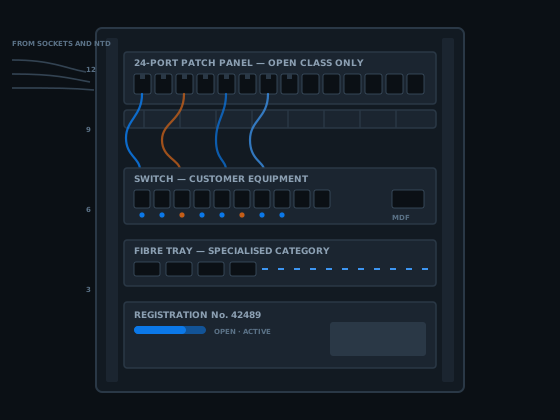
Work carried out by an ACMA registered cabler no. 42489 Class Open Installed to AS/CA S009:2020
Most of what gets written about hiring a data cabler in Australia is wrong in the same three ways: it calls the registration a licence, it attaches it to a business instead of a person, and it treats a fibre or underground endorsement as something you get by finishing a course. None of that survives a read of the actual rules.
The instrument is the Telecommunications (Cabling Provider) Rules 2025, which commenced on 31 March 2025 and replaced the 2014 rules. It is short, free to read, and it decides who may touch the fixed cabling in your building. Everything below comes from it, section by section, with the Queensland overlay at the end.
What a data cabler is under Australian law
Cabling work that connects to a telecommunications network must be performed by a registered cabling provider, or by someone directly supervised at all times by one. That is section 21 of the Telecommunications (Cabling Provider) Rules 2025. In plain terms: a data cabler, or someone standing next to one. No exemption for small jobs, and none for your own house.
Registration is issued to an individual and only to an individual — section 12(1)(a). A company cannot hold one. That is the fact most cabling marketing gets wrong, and it is why you will not see this site claim the business is registered. A business engages a registered data cabler; the number belongs to the person.
Applications go to a registrar, not to the regulator. Four registrars are accredited by the ACMA, and each must keep a database of every registration it issues: name and contact details, the kind of registration, the period and expiry date, whether it is active, suspended, expired or revoked, and any additional units of competency completed.
The applicant picks a period of one year or three years under section 13(2). At least 28 days before it lapses the registrar must warn the holder they will not be authorised to perform or supervise cabling work until it is renewed. On issue the registrar gives proof of registration — which the rules note may be a card or a certificate.
Why the trade is registered federally rather than licensed by a state comes down to two harms. Customer cabling shares walls and trays with mains, so a termination in the wrong place puts voltage where nobody expects it. And bad customer cabling does not stay private — it generates faults a carrier ends up chasing. Breach carries up to 100 penalty units under section 421(4) of the Telecommunications Act 1997.
The short version: a registered data cabler is a named individual, in one of three classes, holding a current registration from one of four registrars, with any specialised categories separately notified. Registration is not a quality mark — it says the person may lawfully do the work and owes you a statement at the end.
Section 11
The three classes of cabling registration
There are exactly three kinds: open, restricted and lift. They are not tiers of skill so much as boundaries of scope, defined by where the customer cabling is allowed to terminate. A data cabler holds one of them at a time.

| Open | Restricted | Lift | |
|---|---|---|---|
| Socket | Yes | Yes | Lift only |
| Network termination device | Yes | Yes | Lift only |
| Main distribution frame | Yes | No | No |
| Patch panel termination | Yes | No | No |
| Specialised categories | All 6 | Aerial, broadband, underground | Broadband only |
| Work experience to qualify | 360 hours | 80 hours | Electrical licence pathway |
Open covers cabling terminating at, or connecting to, the network boundary on a socket, a network termination device or a main distribution frame. Restricted covers a socket or NTD only, and adds a condition about the premises: supply voltage must not exceed typical domestic single-phase or three-phase levels, or if it does, those voltages must be identifiable and the power cables inaccessible to everyone doing the work.
Lift is its own world — the cross connection point next to the lift motor room, the control cubicle inside it, and the lift cars or platforms. It is held alongside an electrical licence, not as a general data cabler qualification.
Schedule 1 shows the gap between the two main classes. An open class data cabler needs the relevant units from the Electrotechnology or ICT training packages, at least 360 hours of cabling work experience, and a regulations test of at least 50 questions passed at 80 per cent. Restricted needs 80 hours and at least 30 questions. That test is a law and standards exam, not a cable-pulling one — which tells you what the scheme cares about.
What a restricted data cabler is not allowed to touch
This is the part with real consequences for anyone quoting an office, and section 9(2) spells it out. A restricted registration does not authorise a data cabler to perform or supervise work falling into any of five buckets.
Anything at the MDF
Cabling terminating at, or connecting to, the network boundary on a main distribution frame — the building's demarcation point.
Jumperable distributors
Work between customer equipment and a jumperable distributor or frame that terminates at that distributor or frame.
Shared sheaths
Work involving cable pairs inside a sheath shared with other services — the multi-pair cable feeding a whole building.
Patch panels
Work between customer equipment and a patch panel that terminates at the patch panel. Read that twice — it is a comms rack, described.
Electricity poles
Installing customer cabling on poles and structures used, or intended for use, for the distribution of electricity.
The practical effect
A restricted data cabler is a domestic and small-premises tradesperson. Put one on a floor of Cat6A landing in a 24-port patch panel and the class alone makes the work unauthorised, however neat it looks.
The rules include a note on what restricted work typically looks like: cabling behind an alarm panel or modem, cabling behind a customer switching system, additional phone points beyond the first in a multi-storey building, home automation. Useful, ordinary work. Just not the comms room. A serious commercial data cabling project in Brisbane is open class work from the first termination.
Endorsements: the two-limb test almost everyone gets wrong
Specialised cabling is defined as six kinds: aerial, broadband, coaxial, optical fibre, structured and underground. These get called endorsements. They are not classes — they sit on top of the class a data cabler already holds.
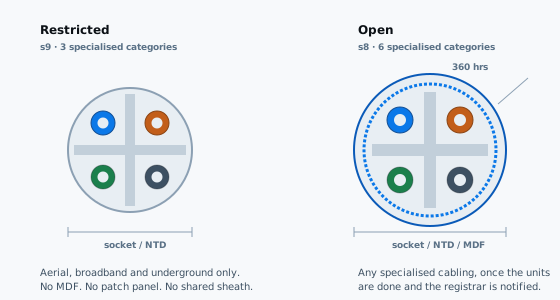
Section 22(2) sets two limbs and both must be satisfied. The provider must have completed the additional units of competency for that kind of specialised cabling. And the provider must have notified the registrar who issued their registration that those units are done — at application or afterwards.
Finishing a fibre splicing course is limb one. It is not limb two. Until the registrar has been told and the database updated, the units authorise nothing. The registrar may also update the holder's proof of registration to show it, which is what puts the categories on the card you get shown on site.
Which class may hold which
An open holder may perform or supervise any specialised cabling. A restricted holder is confined to aerial, broadband and underground; a lift holder to broadband. So a restricted data cabler can never lawfully do optical fibre, coaxial or structured cabling, whatever training they have done.
Why this site is careful here
Because the two-limb rule cuts both ways, no list of held endorsements is published here. What is published is the registration number and the class. If a specialised category matters to your job, ask directly and check the answer with the registrar.
Structured cabling has its own definition, and it is worth knowing because it swallows so much modern work: a network of customer cabling infrastructure installed in a systematic manner that enables scalability and ease of management. Voice, data, video, alarms and building systems over shared media. So the data cabler on that job needs the structured category notified, not just the class. Almost every IT network installation in a commercial building sits inside that category.
The supervision rule, and what "at all times" means
There is exactly one lawful way for an unregistered person to perform cabling work. Section 21(d) requires direct supervision at all times by a registered cabling provider who meets three conditions.
Holds the right registration
A registration authorising them to perform the kind of work being done. A restricted holder cannot supervise open class work they could not perform themselves.
Has the specific competency
Has complied with the competency requirements specific to the work — including the specialised categories, if the job uses them.
Accepts full responsibility
Accepts full responsibility for the work performed. The statement at the end comes from the registered person, not the offsider.
"Directly supervised at all times" is doing real work in that sentence. It is not a data cabler back at the office answering the phone, and it is not a site visit at morning tea. Where an unregistered hand is pulling and terminating, the registered data cabler is there for it.
Done properly that is lawful, and it is how the trade trains people. Done as a paper arrangement, with a registered name attached to work nobody watched, it is not. Ask who will actually be on your site — that answer tells you more than almost any other.
AS/CA S009:2020 — the standard every data cabler works to
Section 23 is one sentence and carries the whole technical weight of the scheme: a cabling provider must ensure all cabling work undertaken by them, or by a person under their supervision, complies with the Wiring Rules.
The Wiring Rules are AS/CA S009:2020, Installation Requirements for Customer Cabling, and the definition picks up any replacement standard automatically. It is a free download from the Australian Telecommunications Alliance — the rare Australian Standard a customer can read before spending money.
Section 24 adds an obligation people forget: any customer cabling or equipment installed or used during the work must comply with the Labelling Notice. That is the compliance-marking regime for the products themselves, and it is the legal reason unmarked cable off a marketplace listing is not a saving — it is a defect the data cabler wears.
Two things get conflated here. S009 is the mandatory installation standard with legal force. Performance standards describe how a finished link should behave electrically, and they are what a certification tester measures against. Both matter to a working data cabler; only one of them is law.
The compliance statement you are owed at the end
Section 25 is the part a customer can actually enforce, and almost nobody knows it exists. After completing cabling work the registered data cabler who did it or supervised it must prepare a written statement and give it to you as soon as practicable — expressly regardless of whether payment has been made.
The content is specified: the provider's name, contact details and proof of registration; an identification of the cabling work; and a statement that the work is complete and complies fully with the Wiring Rules. Contact details must include an email address or a phone number. It need not be a fancy certificate — the rules note it may be an entry on the invoice or receipt.
There are narrow exceptions. Running, transposing or removing jumpers on distribution frames does not trigger it, and neither does replacing minor cabling equipment such as a plug, socket, module or over-voltage unit. Swapping a faulty wall plate is not a statement job. Installing new links is.
The data cabler must also keep a copy for at least a year and make it available to the ACMA on request. If someone hesitates when you ask for one, that hesitation is your answer. Ask at quote stage, in the same breath as asking whether testing is included, when you are comparing data cabling services line by line.
Queensland: no electrical licence needed for this work
This causes more confusion in Brisbane than any other point on the page. An electrical contractor's licence does not authorise customer cabling, and it is not required for it either.
The Electrical Safety Act 2002 (Qld) says at section 55(3) that an electrical work licence is not required for the purpose of installing or repairing telecommunications cabling. Queensland has left the field to the federal scheme. So "fully licensed electrician" on a data cabling quote tells you nothing about whether that person may lawfully run the cable.
The reverse trap is just as common: a registered data cabler is not authorised to do electrical work by virtue of the cabling registration. The two schemes sit beside each other, and on a fitout you will often need both trades. The longer version of this argument — including what to do when a builder insists the sparky will run the data at the same time — is on the page about whether you need an electrician for data cabling.
How to verify a data cabler before you hire one
All of the above is useless if you cannot check it in five minutes. You can. This sequence works whether the quote came from a one-person operation or a national contractor.
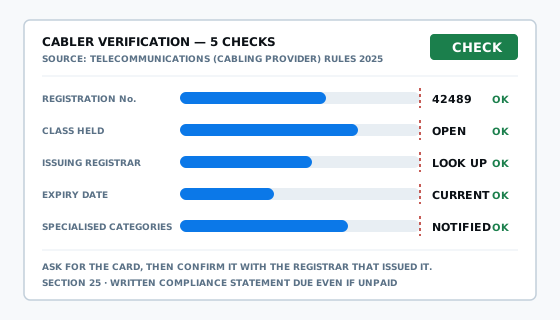
Ask for proof of registration
A card or certificate issued by the registrar, carrying the individual's name, number and class. A registered data cabler has it and will not be offended by the question.
Note which registrar issued it
Four registrars accredited by the ACMA hold the records: ACRS, ASIAL, FPA Australia and TITAB. Each keeps a searchable register, and the card tells you which to go to.
Confirm it is current
Registrations run one or three years and can be suspended or revoked. The database records active, suspended, expired or revoked. A number on a card is not proof it is live.
Match the class to the job
Sockets and NTDs in a house: restricted is enough. Anything landing at an MDF or patch panel: open, or the work is unauthorised. Ask what the terminations will be, then ask the data cabler which class covers them.
Check notified categories
If the job involves fibre, coaxial, underground or aerial cabling, that category must have been notified to the registrar. The database records completed additional units.
Ask about the statement
Confirm at quote stage that a written compliance statement is issued at handover. It is required, so the question is not unreasonable — and the reaction is informative.
The ACMA's own material on cabler registration is worth a skim before you make the calls. One thing not to do: treat a directory listing, a website badge or a membership logo as verification. The only evidence a data cabler holds a current registration is the registrar's record.
What this changes about comparing data cabler quotes
Three data cabler quotes for the same job usually differ by more than price, and these questions surface the difference. A cheap number often reflects a narrower class, a missing specialised category, or an intention to skip the paperwork.
The checklist is short. Whose name and number is on the job. Which class. Whether the person quoting will be on site or is supervising someone else. Whether testing and the statement are included. Those four answers separate a real data cabling contractor from someone treating cabling as a sideline.
It also changes how you read scope. A quote that says "run data" without saying where the cable terminates is unreadable — the termination point decides which class may do the work. The pages on what a cabling technician actually does and on choosing a data cabling installer cover what a properly written scope looks like.
Government and institutional work adds tender and compliance conditions on top of the federal rules — that is on the page for government cabling contracts. At the other end, small jobs like cabling ceiling access points are still cabling work under the rules, statement and all. So is fault finding: any re-termination that comes out of it triggers the statement obligation. There is no informal category of cabling work sitting outside the scheme.
For the practical side — what gets installed, how it is tested and what it costs — start at the data cabling Brisbane page, or the network cabling overview for the whole picture. This page is the compliance backbone underneath both.
Data cabler questions people actually ask
Is a data cabler registration issued to a person or to a company?
To a person. Section 12(1)(a) of the Telecommunications (Cabling Provider) Rules 2025 says a cabling registration may only be issued to an individual. A company can employ registered cablers and can stand behind their work, but the registration itself never belongs to the business. That is why the honest wording is always a named individual and a registration number, not a logo on a van.
How long does a data cabler registration last before it expires?
An applicant chooses a period of registration of either one year or three years under section 13(2). The registrar must warn the holder at least 28 days before it expires, and must tell them they are not authorised to perform or supervise cabling work from the expiry date until it is renewed. An expired registration can still be renewed within ten years.
What cabling work is a restricted data cabler not allowed to do?
Section 9(2) rules out five things: work terminating at a main distribution frame, work between customer equipment and a jumperable distributor or frame, work involving cable pairs in a sheath shared with other services, work terminating at a patch panel, and installing cabling on poles used for electricity distribution. That excludes most commercial structured cabling.
What are the specialised cabling categories a data cabler can hold?
Six are defined in the rules: aerial, broadband, coaxial, optical fibre, structured and underground cabling. They are not classes of registration — they sit on top of one. An open holder may perform any of them, a restricted holder is limited to aerial, broadband and underground, and a lift holder to broadband alone.
Does completing a fibre course make a data cabler endorsed for fibre?
Not on its own. Section 22(2) sets two limbs. The provider must have completed the additional units of competency for that kind of specialised cabling, and must have notified the registrar who issued their registration that the units are done. Units sitting in a drawer, never notified, do not authorise the work. The registrar records completion in its database.
Can an apprentice pull cable if they are not a registered cabler?
Only under direct supervision at all times. Section 21(d) requires the supervisor to hold a registration authorising that kind of work, to have met the competency requirements specific to the work being done, and to accept full responsibility for it. Direct supervision at all times means present and supervising, not contactable by phone from another site.
What has to be written on the compliance statement a data cabler gives me?
Under section 25(3) it must carry the provider's name, contact details and proof of their registration, identify the cabling work, and state that the work is complete and complies fully with the Wiring Rules. Contact details must include an email address or phone number. It can be an entry on the invoice rather than a separate certificate.
Do I need an electrical licence in Queensland to be a data cabler?
No. Section 55(3) of the Electrical Safety Act 2002 (Qld) says an electrical work licence is not required for the purpose of installing or repairing telecommunications cabling. The federal cabling registration is the qualification that matters. An electrical licence on its own authorises nothing in the customer cabling space.
How do I check a data cabler in Brisbane is actually registered right now?
Ask for the proof of registration — a card or certificate — then confirm it with the registrar that issued it. Four registrars accredited by the ACMA hold the records: ACRS, ASIAL, FPA Australia and TITAB, and each maintains a searchable register. Check the number, the class, the expiry date, and whether the specialised categories you need have been notified.
What is the penalty if unregistered cabling work is done on my building?
Breaching the cabling provider rules carries a penalty of up to 100 penalty units under section 421(4) of the Telecommunications Act 1997. The practical cost usually lands elsewhere first: no compliance statement to hand a landlord, an insurer or an auditor, and no evidence the fixed cabling in the building was installed lawfully.
Talk to a registered data cabler about your job
Tell me what the building is, where the cable has to land, and whether there is an existing comms room. If the class or the categories matter to your job, ask — the number and the class are on every quote that leaves here.
Or call 07 3521 8082. Voicemail means I am up a ceiling; leave a message and I will call back.
Work carried out by an ACMA registered cabler no. 42489 Class Open