Brisbane & South East Queensland
Telephone cabling installation for the lines your data network doesn't replace
This is the cabling that runs a PABX extension, an analogue phone point, and the odd device around the building still expecting a dial tone — fire panels, lift phones, EFTPOS lines. It isn't the same trade as your data points, even though the two usually go in on the same visit.
ACMA registered cabler no. 42489 Installed to AS/CA S009:2020 Compliance statement every job
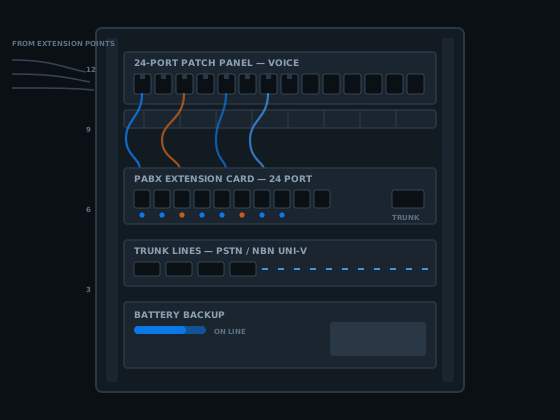
Most network cabling pages talk about data and leave the phones out, as if every office swapped straight from a switchboard to a headset and an app. Plenty didn't. A telephone cabling installation is still its own line of work in a lot of Brisbane buildings — the PABX cabinet in the comms room, an analogue extension still feeding a fax machine, the copper pair that lets a fire panel dial out when the network is down.
This page sits alongside the wider data cabling Brisbane pages on this site — read that one for structured cabling generally. Here I'm covering the trade that runs next to it: what a telephone cabling installation actually involves, why offices keep running it alongside data, and — because it's worth checking rather than assuming — whether it needs the same registration data cabling does.
What a telephone cabling installation covers
A telephone cabling installation is the fixed copper that carries a phone signal from a private exchange, or the building's incoming line, out to a handset, fax or dial-out device. Like data cabling, it's pulled once and expected to outlast the phone system plugged into it — but it usually isn't the only thing running to a desk; a phone point often shares a wall plate with a data point right next to it.
Six things make up most of the work on a telephone cabling installation, whether it's two new extensions or a full PABX re-cable across a floor.
PABX extensions
Cable pulled from the PABX cabinet to a handset, terminated at both ends and landed on a free port on the exchange.
Analogue phone points
A wall plate carrying a dial tone, still specified for fax machines and back-of-house phones that never moved to a digital handset.
Voice patch panels
Extensions land on their own patch panel, or share one with data cabling, depending on how the comms room is built.
Legacy re-cabling
Old quad cable pulled out and replaced with structured cabling, usually because a run has failed or the floor is being re-fitted.
Fault finding
Static, no dial tone, or a phone that only rings some of the time — most faults trace back to a termination, not the exchange.
Testing and compliance
Every new or repaired run tested, with the written compliance statement supplied the same as any other customer cabling job.
Legacy PABX extensions and analogue phone points
Plenty of Brisbane offices run a PABX cabinet that predates the building's current phone system, and keep it going long after the desk phones moved to a digital or hosted service. The reason is usually one device, not fifty — something still expects an old-style analogue signal, and replacing that device is more trouble than keeping a small exchange alive to feed it.
An analogue phone point is the plainest kind of telephone cabling there is: a pair of copper conductors carrying a dial tone, no data, no power beyond what the exchange puts down the line. Older buildings ran these on quad cable — a cheap, unrated two-pair cable never meant to carry anything else. It still works fine for a phone, which is why nobody's ripped it out of buildings where it's never caused a problem.
Where an analogue point gets added or replaced today, it's usually run on the same Cat6 or Cat6A cable used for data, landing on a voice patch panel instead of a quad terminal block — a point can be repurposed from voice to data later without touching the wall. That shift is the biggest change in telephone cabling installation over the last decade, not the phone system behind it.
Why offices still run telephone cabling alongside data
A fully "digital" office still has plenty of things quietly relying on an analogue phone line — exactly the devices nobody thinks about until one stops working.
Fax lines. Still specified in a handful of industries — medical practices, legal offices, some government work — where a fax is the accepted way to send something with a paper trail. EFTPOS terminals. Modern terminals mostly run over mobile data or the office network now, but older dial-up units and some backup-line setups still need a phone line behind them.
Lift phones. A dedicated analogue line to the lift car, run and tested as its own circuit, because it has to keep working through a power event or a network outage. Fire panel dial-outs. The panel calls a monitoring service to report an alarm, on a line kept off the office network so a router outage doesn't take it down too. Intercom systems. Older door intercoms and duress systems often still run on analogue phone-style wiring rather than data cable.

None of these devices care what's happening on the data network. That's the point of their own telephone cabling — a dedicated circuit that doesn't depend on a switch staying powered or the internet staying up. A telephone cabling installation for one of these devices is usually small, but not worth skipping just because the building already has data cabling everywhere else.
Telephone and data cabling services — one job, two circuits
Most enquiries on this page aren't for a telephone cabling installation on its own — they're for telephone and data cabling services quoted together, because the same office move needs both at once. Combining them makes sense: the same ceiling access and often the same crew are doing the work regardless of which patch panel the run ends up on.
Combining the two doesn't mean the phone extensions are treated as an afterthought bolted onto the data quote. Each circuit still gets scoped, pulled and terminated as its own run, tested to whatever standard applies, and labelled so the next person in the rack can tell a voice port from a data port at a glance. What changes is the number of site visits, not the standard of work.
Where it saves real money is access. Opening a ceiling once for both telephone cabling and data cabling costs less than opening it twice for the same points a fortnight apart — worth mentioning before the trades get booked separately.
The bit worth checking, not assuming
Does telephone cabling installation need the same registration as data cabling?
Short answer: yes. It's a question worth checking properly rather than assuming, so here's the actual reasoning rather than a one-line answer.
The Telecommunications (Cabling Provider) Rules 2025 don't regulate "data cabling" as a category. Section 21 requires a registered cabling provider — or someone directly supervised by one — for customer cabling, defined under the Telecommunications Act as any line on the customer's side of a network boundary. That doesn't distinguish between a Cat6A run to a desk and a copper pair to a phone handset — both connect to the network from inside the building, so both need the same registered cabler.
ACMA's own cabling registration guidance backs this up — a registered cabler's work covers telecommunications, fire, security and data cabling, phone lines included alongside data. One of the six specialised categories, broadband, is built around exactly this: point-to-point cabling in premises without a main distribution frame, with telephone wiring given as a worked example alongside internet, security and alarm cabling. Despite the name, it covers ordinary phone extension work in houses and small offices, nothing to do with internet speed.
Where a telephone cabling installation is bigger — a commercial PABX extension terminating at a patch panel or MDF — the same rule that applies to data cabling applies here: restricted registration doesn't cover it, because section 9(2) rules out any work terminating at an MDF or patch panel. That needs an open registration, the same class needed for structured data cabling.
What this means on site: the same registered cabler who runs your data points can lawfully run your telephone extensions, and the same written compliance statement is owed to you under section 25 either way — regardless of whether the job was quoted as data cabling, telephone cabling, or both together.
The standard is the same too. AS/CA S009:2020 is mandatory under section 23 for customer cabling generally, not data cabling specifically, so a telephone cabling installation done to a lower standard than the data cabling next to it isn't a shortcut — it's non-compliant. It's a free download from the Australian Telecommunications Alliance.
Quad cable vs structured cabling for telephone extensions
Old telephone cabling and a modern telephone cabling installation don't use the same cable — worth knowing before you're staring at a punch-down block trying to work out what you're looking at.
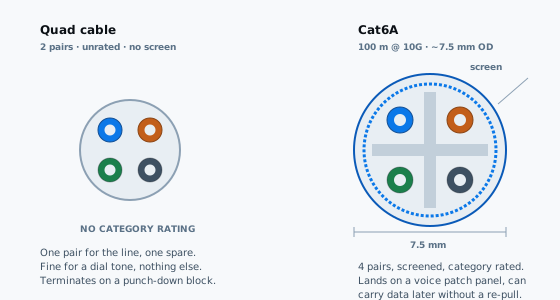
| Quad cable | Cat6 / Cat6A | |
|---|---|---|
| Conductors | 2 pairs, unrated | 4 pairs, category rated |
| Screening | None | None (Cat6) or screened (Cat6A) |
| Termination | Punch-down block | Voice or data patch panel |
| Carries | Analogue voice only | Voice, or data, or both over time |
| Testing | Continuity and polarity | Full category channel test available |
| Sensible for | Existing runs still in service | Any new telephone cabling installation |
Quad cable isn't wrong for what it was built for — a dial tone doesn't need bandwidth. The problem is flexibility: it can't be repurposed, it isn't rated to any category standard, and testing it means checking continuity rather than certifying a channel. Running structured cable for a new telephone cabling installation costs a little more in materials, and the point behind that wall plate can become a data point later without anyone touching the wall again.
Testing and compliance for a telephone cabling installation
Testing a phone line and testing a data link aren't the same process, and a telephone cabling installation gets tested against what it's actually meant to do.
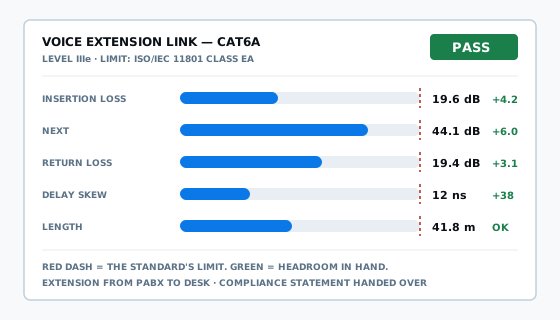
Continuity and polarity
Every conductor checked end to end, pairs confirmed the right way round — get polarity wrong and a phone can ring without the handset working.
Dial tone confirmation
Once terminated, the run is proved against a live port or the PABX itself, not just a tone generator at the far end.
Category test where it applies
Extensions run on Cat6 or Cat6A get the same permanent link test as a data point, because it's the same cable and the same standard applies.
The paperwork is identical to any other customer cabling job. Whether the invoice says "telephone cabling installation" or "data point install," section 25 requires a written compliance statement after the work — regardless of payment — and it's the record an insurer, a landlord, or the next cabler will want to see.
What a telephone cabling installation costs
Pricing a telephone cabling installation follows the same logic as data cabling — largely the same labour with a different device on the end.
Priced per point
New extensions or analogue points are usually quoted per outlet — cable, termination, wall plate, patch panel port and testing, the same components as a data point.
Priced hourly
Fault finding, single additions and re-terminating an old PABX are usually hourly. Published Brisbane rates for comparable cabling work sit around $185 per hour in standard hours.
What moves the number is mostly what moves a data cabling quote: access to run the cable, not the cable itself. A single extension into a room above a roof cavity is straightforward. The same extension run to a fire panel or a lift shaft usually needs more care and more time, regardless of it being "only" a phone line.
One thing worth asking on any telephone cabling installation quote: whether the existing PABX has a free port for the new extension, or whether the job needs a card added to the cabinet. That's a different job again, and belongs in the quote, not discovered on the day.
How a telephone cabling installation job runs
No surprises is the whole point. Every telephone cabling installation follows the same steps, whether it's one new extension or a full PABX re-cable.
Scope
Which devices need a line, where the PABX lives, and whether it's new cable or a re-terminate of something already there.
Fixed quote
Per point or hourly depending on the job, with cable type and testing stated rather than assumed.
Pull and terminate
Cable run and landed at both ends — the extension cabinet or MDF at one end, the wall plate at the other.
Prove the circuit
Continuity, polarity and dial tone confirmed before anything gets handed back or cut over.
Test and hand over
Results and the written compliance statement supplied, same as any other customer cabling job.
It stays supported
Labelling and the compliance record mean the next fault call or extension starts with information instead of a guess.
Where telephone cabling installation fits with data cabling Brisbane wide
Telephone cabling installation work follows the same footprint as the rest of this site — Brisbane metro first, then Ipswich, Logan, Redlands, North Lakes, Springfield, the Gold Coast, the Sunshine Coast and Toowoomba. Older commercial buildings in these areas are the ones most likely to still have a PABX worth keeping alive.
Down the coast it's usually scoped alongside the data cabling work already happening on a fitout — the same crew doing data cabling installation in Burleigh Heads or a job across the southern Gold Coast will pull telephone extensions in the same visit if the building needs them, rather than sending someone back for a second trip.
Telephone cabling installation questions we get asked
Is telephone cabling installation covered by the same registration as data cabling?
Yes. The Telecommunications (Cabling Provider) Rules 2025 regulate customer cabling generally, not data cabling specifically — it covers any line on your side of the network boundary, telephone extensions and analogue phone points included. The same registered cabler who runs your data cabling can lawfully run your telephone cabling, provided they hold the right registration class.
What is a PABX extension, and why would an office still need one added?
A PABX extension is a new line run from the private exchange cabinet out to a handset, fax machine or dial-out device. Plenty of Brisbane offices kept their PABX after moving desk calls to a digital system, because it still feeds devices that system doesn't handle — a lift phone, a fire panel dial-out, an EFTPOS backup line.
Do I need a registered cabler to add a single analogue phone point?
Yes, the same as for a single data point. Whether it's one socket or fifty, section 21 applies equally: a registered cabling provider does the work, or supervises someone doing it directly. Job size doesn't change the registration requirement, only who is qualified to carry it out.
Do EFTPOS terminals still need a dedicated phone line in Brisbane offices?
Less often than they used to — most current terminals run over mobile data or the office network — but older dial-up units still rely on an analogue connection. Where one is in service, it needs the same telephone cabling behind it as any other analogue device, run and tested the same way.
Does a lift emergency phone use the same telephone cabling as office extensions?
It's the same style of cabling — a dedicated analogue pair back to a distribution point — but treated as its own circuit, separate from office extensions, because it has to keep working during a fire or power event when the rest of the building's systems might not. It's usually one of the first things checked on a telephone cabling installation in a building with lifts.
What is the difference between quad cable and structured cabling for phone points?
Quad cable is the old two-pair cable used for analogue extensions before structured cabling became standard — no category rating, no screening, just enough copper for a dial tone. Most telephone cabling installation work now runs the same Cat6 or Cat6A used for data, landing on a voice patch panel instead of a punch-down block.
Do you provide telephone and data cabling services together on the same job?
Yes — most fitouts and office moves get both scoped together rather than as separate call-outs, because the same access and crew are often doing the work regardless of which patch panel the run lands on. Telephone and data cabling services quoted as one job usually cost less than the same work split across two visits.
What certification do I get for a telephone cabling installation?
The same as for any customer cabling job: a written compliance statement supplied after the work under section 25, regardless of whether the invoice has been paid. Where the extension runs on structured cable, the link also gets tested against the category it was installed to, with results handed over.
Can telephone cabling be added to an office without disrupting the phones already in use?
Usually yes. New extensions are pulled and terminated at the PABX end first, tested, and only cut over once proven — existing phones stay live until the new ones are ready. It's the same staged approach used for adding data points to an occupied office.
Get a telephone cabling installation quote
Tell me what's not working or what needs adding — a couple of new extensions, a PABX re-cable, or a telephone cabling installation alongside a data fitout that's already being quoted. Most of these jobs can be scoped from a phone call and a few photos of the exchange cabinet.
Or just call 07 3521 8082. If it goes to voicemail I am up a ceiling somewhere; leave a message and I will call back.
ACMA registered cabler no. 42489 All work to AS/CA S009:2020