Brisbane & South East Queensland
NBN repair — finding the fault, and whose job it is to fix
Most nbn repair calls start the same way: something worked, then it stopped. A socket that went dead, a cable a renovation caught, a service dropping out for no obvious reason. Before any of it gets fixed the fault has to be traced to one side of the boundary or the other, and only one side is actually an nbn repair job for a cabler.
ACMA registered cabler no. 42489 Installed to AS/CA S009:2020 Compliance statement every job

An nbn repair call nearly always turns out to be one of two things: a fault nbn Co owns, or a fault that sits on your side of the wall. Working out which one it is before anyone drives out is most of the job — the rest is a continuity tester and a patch lead.
This page covers the internal half: the sockets, the runs, the terminations behind the wall plate. For the wider explanation of where nbn Co's network stops and private cabling starts, read the nbn cable installation boundary page first — everything below assumes you already know roughly where that line sits.
The nbn repair symptoms that show up again and again
Four patterns account for most nbn repair callouts that follow an existing install rather than a fresh nbn Co fault. None are exotic: a socket that used to work and now doesn't, cable caught in a renovation, a service that drops out at what feels like random times, and a socket that ended up in the wrong spot once a floor plan changed. Each has a different cause, but the first diagnostic step is the same for all four.
A socket that stopped working
Fine for years, then nothing. Usually a loose or corroded termination inside the plate, occasionally a patch lead that finally gave out. Rarely the cable itself.
Wiring damaged during a renovation
A wall came out, a ceiling went back up, and a cable that used to run between them didn't survive. Sometimes it's obvious on day one. Sometimes it's a dead point nobody notices until a desk moves into that room.
Intermittent dropouts
The link syncs, drops, resyncs. Often a termination making contact most of the time and failing when the roof heats up, the house settles, or someone walks near the cavity it sits in.
A socket in the wrong room
The floor plan changed and the data point didn't move with it. Not a fault at all — a relocation, and one of the more common jobs booked alongside a repair visit.
The line every repair sits on one side of
Whose job an nbn repair actually is
The dividing line is the network boundary point. On full fibre it's the data port on the nbn connection box; on older technologies it can sit as far back as the first telephone socket. Fixed cabling past that point must be worked on by a registered cabling provider, or by someone directly supervised at all times by one — section 21 of the Telecommunications (Cabling Provider) Rules 2025, in force since 31 March 2025. That applies to a repair exactly the same as a first install.
Nothing about that changes because the job is a fix rather than something new. Customer-side cabling still has to meet AS/CA S009:2020, the Wiring Rules, and a written compliance statement under section 25 is still owed to you afterwards — whether it was a new run pulled from scratch or an old one re-terminated.
How an nbn repair fault actually gets found
Every nbn repair starts the same way: check the box first. A steady light on the nbn connection box or modem usually means the carrier side is fine, which pushes the fault onto the customer side and turns it into a job for a cabler rather than a call to your provider. A red or flashing light points the other way, and no amount of testing past the boundary changes that.
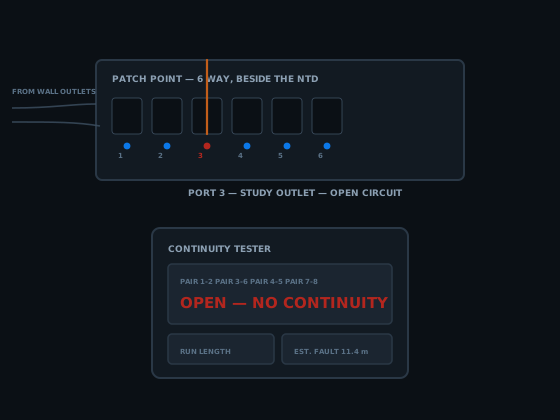
Past the box, the tool that actually finds an internal fault is a continuity tester, not a laptop. It gets connected at the patch point or panel end and walked out to the outlet, checking each pair for an open circuit, a short, or a connection that only makes contact under pressure — the classic cause of a socket that tests fine sitting still and drops the moment someone leans on the wall near it. On copper-fed premises the old telephone wiring is part of the path, and a decades-old joint in a roof space is often where the fault actually sits.
Intermittent faults are the harder half of any nbn repair, because a reading taken at rest can pass on a termination that fails under heat or vibration. Finding those means physically flexing the cable at each termination while watching the reading, not plugging in once and moving on. If the cable's path isn't obvious, a tone generator traces the run through the wall first.
When it's an nbn Co fault, not an nbn repair
Some calls that sound like a repair never get past the front step, because the fault turns out to sit on nbn Co's side of the boundary. That's not a bad outcome — it just means the wrong trade got booked, and the fix is a call to your retail provider instead.
The fault light is on the box itself
A red or flashing indicator on the nbn connection box or utility box, rather than the router, usually means carrier infrastructure. That's outside what any private cabler can touch.
The whole street lost service
Neighbours reporting the same outage at the same time points at the lead-in or a street asset, not something internal cabling work will fix.
An outage is already logged
nbn Co's network status checker shows planned and unplanned outages by address, worth ten seconds before booking anyone.
An honest drawback: if the fault genuinely sits on the carrier side, no amount of internal cabling work fixes it. Paying a cabler to attend and confirm that in writing is sometimes worth it to break a deadlock with a provider, but know that's what's being bought. Where the fault traces to the box on the outside wall rather than anything inside, the premises connection device guide covers what that unit is and what a registered cabler may lawfully do to it.
A socket that has stopped working
This is the single most common nbn repair call. The socket carried a link for months or years, then one day it didn't, and nothing in the house changed that anyone noticed. Nine times out of ten the cause is inside the wall plate itself: a punch-down termination that has slowly oxidised, or a conductor that was never fully seated and finally let go.
The fix is usually a re-termination rather than a re-run — strip back, re-punch to the standard, retest. If the cable checks out clean on continuity but the socket still won't link, the fault can sit further back at the patch point or the NTD end, which is why a dead socket gets tested at both ends before anything gets pulled apart.
Where the plate itself is physically damaged — cracked, or a keystone jack that has been forced one too many times — it gets replaced as part of the same visit rather than treated as a second job.
The most physical kind of repair
Wiring damaged during a renovation
A wall comes out, a new one goes up in a slightly different spot, and a cable that used to run through the old cavity is now either cut, crushed under a stud, or gone under new plaster. It's the messiest category of nbn repair because the fault isn't always electrical — sometimes the cable is physically fine but its path no longer exists.
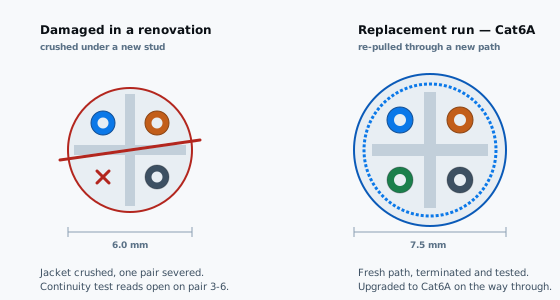
Continuity testing finds the break, but locating it inside a closed wall needs a tone generator or, for a longer run, a time-domain reflectometer to estimate the distance to the fault from the patch point. That tells the cabler roughly where to open the wall rather than guessing along its length.
Once confirmed, the honest options are a re-pull through whatever path is still open, or a fresh run through a different cavity if the original is now blocked. Cable is cheap next to the labour of opening and re-sheeting a wall, so it's worth upgrading to Cat6A on the re-run if the original was older Cat5e — same effort, more headroom for whatever gets plugged in next.
Intermittent dropouts traced to a bad termination
This is the nbn repair category people put off the longest, because the service works most of the time and a working connection is easy to talk yourself out of investigating. The pattern is usually temperature or vibration related: a link that drops in the heat of the afternoon, or whenever someone walks past a particular section of ceiling.
A tester reading taken with the house sitting still will often show a clean pass, which is why an intermittent fault gets tested under load — flexing the cable gently at each termination while watching the numbers, rather than plugging in once and calling it fine. The usual culprit is a conductor that seats under pressure and lifts free again once the cable cools or settles, most often at a termination rushed the first time around.
Once found, the fix is a straightforward re-termination. The harder part is almost always access — a termination behind a fixed ceiling takes longer to reach than one in an open roof cavity, and that access time is what actually drives the cost of this kind of repair.
A socket in the wrong room after a reno
Not every nbn repair call is a fault. A good number are a floor plan that changed after the original cabling went in — a study became a nursery, a wall moved, and the one socket in the house that matters is now on the wrong side of it. Nothing is broken; the cable is just serving the wrong room.
New run from the patch point
The cleanest fix is a fresh run from the patch point near the NTD to the outlet's correct location, tested and labelled like any other point rather than daisy-chained off the old one.
The old socket, capped or left
The redundant point gets capped off cleanly or left inactive. Reusing an old run by re-routing it through a new wall is sometimes possible, but only once its physical path has been confirmed intact.
Bigger than one socket — a full office rewire after a fitout, for instance — moves past repair territory into a proper redesign, which is structured cabling work rather than a repair visit.
How an nbn repair job runs on site
Same four steps whether the fault is a dead socket or a run cut in half by a renovation. No surprises is the point of writing it down.
Confirm the boundary
Check the nbn box, check the network status checker, rule out the carrier side before anything else happens. If it's not on your side, the visit stops here and costs nothing extra.
Trace and test
Continuity tester at the patch point, walked to the socket. Tone generator if the physical path through the wall or ceiling isn't obvious.
Repair or re-run
Re-terminate where the cable is sound, re-pull where it isn't. Cable category gets upgraded on the way through if the old run was undersized for what's plugged into it now.
Test and hand over
Retested against the standard, labelled to match, and closed out with the written compliance statement the rules require.
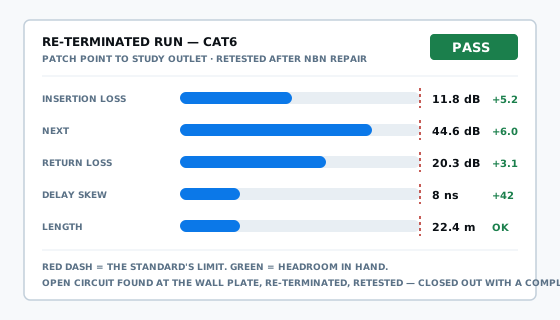
Work carried out under this process is performed by an ACMA registered cabler — the registration framework behind that is issued to individuals, not companies, so registration no. 42489 is the thing worth checking on any quote, not a business name on an invoice. A single socket follows exactly this process; a whole tenancy or a multi-site rollout scales into nbn installation contractors territory instead of a one-off repair visit.
What nbn repair work costs
Nobody in this trade publishes a rate card, so here's how the pricing actually works rather than a number that means nothing without the context behind it.
Priced hourly
Fault finding and repairs are almost always hourly rather than a fixed per-point price, because the time to find the fault is the unknown. Published Brisbane rates for comparable work sit around $185 an hour standard time, with after-hours attracting a premium.
What moves the number
Access, not cable. A re-termination behind an open roof cavity is a short visit. The same fault behind a sheeted ceiling or a rendered wall is a longer one, and that's most of the variance between one quote and the next.
Worth asking before booking any nbn repair: whether the callout is chargeable if the fault turns out to be nbn Co's, whether testing is included, and whether a compliance statement comes with it. Those three sort a proper quote from a guess.
Two extra outlets while the wall is already open cost a fraction of a standalone visit later — worth raising at the same time rather than as an afterthought once the ceiling is closed again. For a full breakdown of how cabling work is priced generally, see what data cabling costs in Brisbane.
NBN repair questions I get asked
How do you work out whether an nbn repair is needed or nbn Co owns the fault?
Start at the box. A steady light on the nbn connection box or modem usually means the carrier side is fine, which points to an nbn repair job on your side of the boundary. A red or flashing fault light points the other way, and nbn Co's network status checker will confirm whether an outage is already logged at your address before anyone drives out.
What does an nbn repair actually cost in Brisbane?
Fault finding and small repairs are priced hourly, at rates comparable to the rest of the trade — published Brisbane rates for this kind of work sit around $185 an hour standard time. A straightforward dead socket might be one visit. A renovation-damaged run that needs re-pulling costs more once access and cable length are known.
Is a dead data socket after a renovation an nbn repair or a new job?
It is an nbn repair in the sense that it is customer-side cabling work, but whether it is a repair or a re-run depends on what the tester finds. If the original cable survived and only the termination failed, it gets re-terminated. If the cable itself was cut or crushed behind a new wall, it gets replaced.
How long does an nbn repair take once the fault is found?
A re-terminated socket is usually finished the same visit once the fault is confirmed. A renovation-damaged run needing a full re-pull takes longer and depends entirely on access — a roof cavity above the run is a different job to a slab home with the cavity closed up behind new plaster.
What tool finds an nbn repair fault inside the walls?
A continuity tester connected at the patch point or panel end and walked out to the outlet, checking each pair for an open circuit, a short, or a connection that only makes contact under pressure. For a run that has to be traced through a ceiling or wall with no visible path, a tone generator locates the physical cable first.
Why does my nbn service drop out intermittently after a renovation?
Usually a termination that survived the renovation physically but not electrically — making contact most of the time and failing when the house heats up, cools down, or someone walks near the cavity it sits in. It reads fine on a tester taken at rest, which is why intermittent nbn repair faults take longer to pin down than dead ones.
Can a socket be moved to the right room as part of an nbn repair?
Yes, and it is one of the more common jobs booked alongside an nbn repair rather than as one. A new run gets pulled from the patch point near the NTD to the outlet's correct location, tested and labelled, and the old redundant socket is either capped off or left inactive.
Do I get a compliance statement after an nbn repair?
Yes. Section 25 of the Cabling Provider Rules requires a written statement of compliance after any customer cabling work, and an nbn repair is no exception. You get the statement plus the test results for whatever was re-terminated or re-run, regardless of whether the invoice has been paid yet.
Get an nbn repair quote
Tell me what the socket or service is doing, and whether anything got renovated near it recently. If you know what the light on the nbn box is doing, mention that too — it usually sorts an nbn repair job from an nbn Co fault before anyone drives out.
Or just call 07 3521 8082. If it goes to voicemail I am up a ceiling somewhere; leave a message and I will call back.
ACMA registered cabler no. 42489 All work to AS/CA S009:2020