Fitouts, tenancies & towers — Brisbane
Commercial data cabling Brisbane fitouts can actually be built around
Commercial data cabling for offices, tenancies and industrial sites — scoped against your program, pulled around the people still using the floor, cut over after hours in stages, and handed to you with a test result for every link.
ACMA registered cabler no. 42489 Installed to AS/CA S009:2020 Compliance statement every job
A fitout has a date on it. The tenant has signed, the builder has a program, and there is one weekend where the desks move. Commercial data cabling either lands inside that program or it becomes the reason everything else slips — and most of that is decided weeks before anyone pulls a cable.
Written for the facilities manager and the fitout PM, not the homeowner. This is how commercial data cabling gets sequenced on a live site. The network cabling Brisbane homepage covers the trade in general, and data cabling in Brisbane sits above both residential and commercial work.
What a commercial data cabling scope actually covers
On a residential job the scope is a list of rooms. On a commercial job it is a sequence, and half the line items are coordination rather than cable.
Floor horizontal
Cat6A from the floor comms room to every workstation, meeting room plate, ceiling access point, camera and door reader — inside the 90 m fixed plus 10 m patch channel.
Riser and backbone
Fibre from the base building MDF up the shaft to each level. The part of a commercial data cabling job most often delayed by somebody other than the cabler.
Containment
Tray, catenary, conduit and the route through the ceiling void. Builder supplied on some jobs and not on others — that question moves a price more than cable category does.
Comms room build
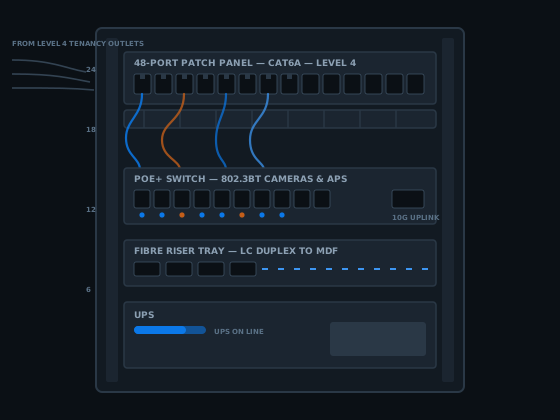
Rack, panels, management, labelling, earthing. The comms room and rack build is what the job gets judged on six months later.
Cutover and strip-out
Moving live services off the old cabling in stages, then pulling the abandoned cable three tenancies left in the ceiling. Real hours — name them on the quote.
One boundary is legal, not preference. Fixed cabling that connects to a telecommunications network can only be installed by a registered cabling provider, or someone directly supervised at all times by one — section 21 of the Telecommunications (Cabling Provider) Rules 2025, in force since 31 March 2025. Registration is issued to individuals, so on a commercial data cabling contract, ask which named person on site holds it — the registered cabler explainer covers the rest.
The one you can plan properly
Office fitouts — commercial data cabling around a builder's program
A fitout is the good version of this work: the ceiling is open and nobody is on a call underneath you. It is also the version where two days late is visible to everyone. Cabling sits between the ceiling grid and the joinery, and finishes before the tiles close.

Scope off the desk layout
Two outlets per desk, plus a dedicated run per access point, printer, camera, reader and AV plate. Count meeting rooms twice — video kit multiplies faster than desks.
Rough-in before the tiles
Cable pulled and left long while the ceiling is open. Miss that window and every run afterwards costs several times what it should have.
Coordinate tray, not cable
Data tray competes with duct, sprinkler mains and lighting for one void. Agree the route at services coordination and the ceiling comes down once.
Commercial data cabling carries a dependency the other trades do not: base building access. Sparkies and ceiling fixers work inside the tenancy. The cabler needs the riser, the ground floor MDF and often a lift booking, all owned by somebody else. That request belongs with the building works application, not the week before rough-in.
Occupied premises — cabling a floor that is still trading
A lot of commercial data cabling in Brisbane happens in tenancies that never stop. A team is coming off ageing Cat5e, adding forty desks into space they already lease, or moving to a fibre service and finding the internal cabling will not carry it.
The method is unglamorous. New goes in alongside old: pulled, terminated, labelled and tested while the existing system keeps working. Only the patch lead moves at cutover, and only in groups. If a group does not come up, the old patching is still there, labelled.
Never unplug to test
The new link is certified on its own, off the live network. Nothing is proven by disconnecting a working desk and hoping.
Tiles back the same shift
An open ceiling over an occupied floor is a hazard and a bad look. Bays get opened, worked and closed before anyone arrives.
Dust and noise get booked
Core drilling and anything above a desk goes out of hours by default, not after a complaint.
Occupied-site commercial data cabling costs more per point than an empty shell, and a quote pricing them the same has not thought about it. You pay for access windows, working around furniture, protection and clean-up.
After-hours commercial data cabling and building access
After-hours is the default mode for anything touching live services, not a premium extra. The constraint is rarely the cabler's diary. It is the building.
Brisbane towers run inductions, permits and access registers: a site induction before anyone lifts a tool, a works permit naming dates and trades, a separate permit for hot work or any fire-rated penetration, an after-hours booking with security, and a goods lift reservation if a rack or a drum of cable is going up. Each has its own lead time.
The practical bit: name the building and the tenancy at quote stage, not at start-on-site. Half the commercial data cabling projects that run late do so because the access paperwork was an afterthought. Dates, names and insurance details go to you in writing so building management gets a complete request first time.
Honest trade-off: nights are slower. Sign-in, set-up and pack-down eat into each shift, and lone-worker rules put two people on tasks that would take one in daylight. Four days in an empty shell becomes seven across evenings. It still beats losing the floor.
High-rise risers, fire stopping and commercial data cabling penetrations
Getting between floors is where a tower differs most from a warehouse. The riser is a fire-rated shaft, and every cable through a slab makes a hole in a fire compartment boundary — a compliance obligation the moment it exists.
Clause 16.2.1 of AS/CA S009:2020 puts it on the cabling provider: where cabling goes through an opening in a building element likely to be a fire compartment boundary, the cabler must ensure the opening is fire stopped to perform at no less than the fire resistance level that element was intended to perform at.
The exception is narrow — a person authorised by the building owner stating in writing that someone else is doing it. Under the National Construction Code the fire stopping system must be one demonstrated by test to AS 1530.4 not to impair that performance, so on commercial data cabling "a bit of foam" is not an answer.
Use the sleeves that exist
Most towers already have fire-rated riser sleeves or a transit block. Faster and far less contentious than coring a new hole in someone else's slab.
Fire stopping in writing
Either it is on my scope, or the head contractor's fire specialist has it in writing before the penetration is made. What fails is both parties assuming the other has it.
Keep 50 mm off the power
Clause 16.3.1 wants customer cable with conductive elements permanently separated from LV power by 50 mm, a barrier, or a stud or joist. Risers are crowded.
Lift wells are separate
Cable fixed in a lift or hoist shaft carries extra requirements under clause 16.6, and lift cabling is one of the three registration classes in its own right.
Long riser, go fibre
Any commercial data cabling design with copper creeping toward 90 metres of fixed cable needs a second comms room, or a backbone in fibre optic cabling.
Body corporate, base building and who owns the shaft
In a strata-titled building the riser is not yours, and neither is the ground floor comms room. Section 20 of the Body Corporate and Community Management Act 1997 (Qld) makes utility infrastructure in a community titles scheme common property, with limited exceptions. That is the legal reason a tenant cannot just decide to run a fibre up the shaft.
In practice: a written request describing the route, the cable, the fire stopping method and who is doing the work. Committees meet on their own schedule — a managed scheme might take a fortnight, a self-managed one longer, and no amount of chasing speeds it up. Build that wait into the commercial data cabling program from day one.
What unblocks it: a one-page route description, the cabler's registration number, a certificate of currency, and a commitment that penetrations are fire stopped to the element's rating. Committees knock back vague requests, not specific ones.
Owner-occupied and single-tenant buildings are simpler, and plenty of Brisbane commercial data cabling happens there — a two-level office in Milton, a warehouse and office at Eagle Farm, a medical suite. One decision maker, no committee.
What to specify on a commercial data cabling job
Specifications get copied between projects and quietly go stale. Here is what actually changes the outcome on a commercial floor.
| Decision | Cheap option | What the better option gets you |
|---|---|---|
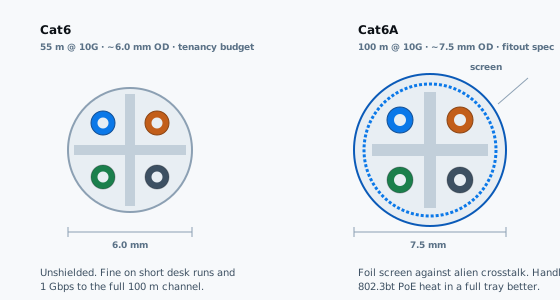
| Cable category | Cat6 | Cat6A — 10 Gbps to the full 100 m, screened against alien crosstalk, ~7.5 mm OD |
| Outlets per desk | 1 | 2 — a fraction on the day, a fortune later |
| Ceiling points | Added later | Cabled at rough-in for access points, cameras and readers |
| Containment | Cable on ceiling grid | Dedicated tray — survives the next fitout and the one after |
| Comms room count | One, central-ish | Enough that no fixed run exceeds 90 m |
| Labelling | Marker pen | Printed, matched at both ends, on a schedule |
| Testing | Link light | Certified permanent link results for every run |
Cat6A earns its place on commercial data cabling for a reason unrelated to anyone needing 10 gigabit at a desk today. It is the PoE. Cameras, access points and readers draw real power, and power in a cable becomes heat in a bundle. Residential maths differs, which is why home network cabling lands on Cat6 more often than not.
Specify the comms room too. A commercial data cabling install can be perfect and still be miserable to live with if the rack has no spare RU or no ventilation. The structured cabling design principles behind that are worth ten minutes before anyone signs a floor plan.
Testing, certification and the commercial data cabling handover pack
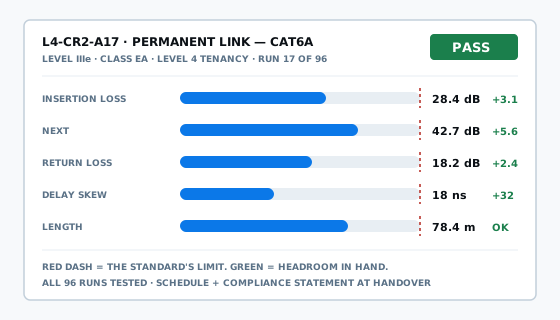
A link light proves a cable is connected. It proves nothing about whether the link holds up in three years, in a warm ceiling, next to a bundle carrying 60 watts of PoE. On commercial data cabling the test result is the deliverable.
Every link, not a sample
Insertion loss, near-end crosstalk, return loss, delay skew and length, on all four pairs, against the category limit.
Headroom is the real number
A link that scrapes a pass by 0.2 dB will fail once a termination ages. Read the margin column, not the word PASS.
The compliance statement
Required by section 25(3) of the Cabling Provider Rules and owed to you after the work regardless of whether the invoice is paid.
The rest of the pack matters more than people expect, because whoever inherits it is rarely whoever commissioned it. A floor plan with outlet numbers, a schedule tying each outlet to a panel port, and labels matching both, turn a future fault from a half-day hunt into a ten-minute check. Proving an existing system rather than installing one is cable testing and certification as a standalone job.
Queensland adds no electrical licence on top of commercial data cabling. The Electrical Safety Act 2002 (Qld) says at section 55(3) that an electrical work licence is not required for installing or repairing telecommunications cabling — so "licensed electrician" on a tender response tells you nothing. The standard behind it, AS/CA S009:2020, is a free download if you want to check a claim yourself.
Reading a commercial data cabling quote without getting caught
Two quotes for the same eighty-point office can differ by a factor that looks impossible until you read what each excluded. Commercial data cabling is priced per point on volume work and hourly on everything else, and the gap is almost always inclusions rather than rates.
Per point
Cable, both terminations, plate, panel port, test and label. The rate drops as the count rises. Ask what count it assumes — it moves if the job shrinks.
Hourly
Fault finding, moves and adds, strip-out, anything unpredictable. Published rates for comparable work in Brisbane sit around the $185 per hour mark for standard hours, with after-hours carrying a premium.
Six checks on any commercial data cabling quote: who supplies containment; whether after-hours labour is in the rate or a variation; whether certification is included; whether strip-out is priced; who is responsible for fire stopping; and whether the cable is named by category and brand or just called "data cable".
The honest drawback of proper commercial data cabling is that it is not the cheapest number in the pile. Certified testing takes time per link, fire stopping costs money, nights are slower. If the budget will not carry it, fewer points done properly beats a floor nobody will certify. There is a fuller breakdown of what data cabling costs in Brisbane for budgeting.
Where commercial data cabling work happens around Brisbane
Building type changes the job more than the suburb does. Brisbane's commercial stock splits into a few recognisable groups.
CBD towers
Fire-rated risers, permits, goods lift bookings and after-hours rules. Nearly every commercial data cabling job here is a recable between leases, not a virgin floor.
Fortitude Valley and Newstead
A decade of warehouse-to-office conversion has left converted brick alongside purpose-built stock. Exposed structure, no ceiling void to hide in, and containment that has to look deliberate.
Milton, Toowong and the western fringe
Mid-rise with more turnover — in the December 2025 fringe numbers Milton carried the highest vacancy at 14.1% and Toowong the tightest at 6.4%. Part-floor tenancies, so shared risers and shared comms rooms.
Eagle Farm, Murarrie, Rocklea
Warehouse and office combinations where distance bites immediately. High ceilings and long spans, usually a fibre run to a satellite cabinet rather than heroic copper.
One local wrinkle: fringe office stock is shrinking. Net additions ran negative through FY2025 with no new buildings under construction, the largest recent withdrawal being 30 Little Cribb Street in Milton — 8,700 sqm of A-grade office pulled out for conversion. Tenants concentrate into what is left, so more commercial data cabling lands in older mid-rise stock whose risers were sized for a phone system, not for four tenants each wanting their own fibre.
Commercial data cabling runs across Brisbane metro plus Ipswich, Logan, Redlands, Springfield, the Gold Coast, the Sunshine Coast and Toowoomba — further than residential work, because a week on site makes the drive irrelevant.
Commercial data cabling questions facilities managers ask
Can commercial data cabling be installed while our tenancy stays occupied?
Yes, and most of it is. New cable is pulled, terminated and tested while the old system keeps working, so the only disruptive moment is the patch-over, measured in minutes per desk group. Ceiling tiles come out a bay at a time and go back the same shift. Nothing dusty or loud happens over people's heads.
Who arranges after-hours building access for a commercial data cabling job in a Brisbane tower?
You do, through building management, and it takes more lead time than people expect. Most Brisbane towers want a site induction, an escort or swipe booking, a permit for hot work or any fire-rated penetration, and the paperwork lodged days ahead. Dates, trade names and insurance details go to you in writing so the request lands complete the first time.
Do we need body corporate approval to run cable through a high-rise riser?
Usually yes. Section 20 of the Body Corporate and Community Management Act 1997 in Queensland makes utility infrastructure in a community titles scheme common property, with limited exceptions, and the riser is base building rather than your leased area. The body corporate or the owner controls what goes in, so the request has to be approved before anyone opens a shaft door.
Who is responsible for fire stopping where commercial data cabling penetrates a fire-rated floor?
The cabler, unless a person authorised by the building owner has taken it on in writing. Clause 16.2.1 of AS/CA S009:2020 puts the duty on the cabling provider to fire stop the opening back to the fire resistance level that element was intended to perform at. If the head contractor's fire specialist is doing it, get that in writing first.
How far ahead of an office fitout should commercial data cabling be scoped?
As soon as there is a workstation layout and a comms room location, normally well before the builder starts. The cable route depends on the tray, the tray depends on services coordination, and the comms room position decides which desks fall inside the 100 metre channel. Scope it after the ceiling grid is drawn and you are designing around other people's decisions.
What happens to the old cabling when a tenancy is recabled?
It gets identified, left live through the cutover, then removed or made safe once the new links are proven. Abandoned cable stacked in a ceiling or a riser is a fire load and it makes the next job harder, so most building managers want it gone. Stripping it out is a priced line item, not a freebie.
Should an office fitout be cabled in Cat6 or Cat6A?
Cat6A for anything with a lease longer than the equipment in it. Cat6 carries a gigabit to 100 metres and 10 gigabit only to about 55, while Cat6A holds 10 gigabit across the full channel because it is screened against alien crosstalk. The labour to pull either is identical, and the cable is the part you cannot swap later.
How is a staged commercial data cabling cutover run so nobody loses their desk on Monday?
In groups, not all at once. A group of desks is patched, the switch ports are confirmed up, someone walks the floor and checks real devices, and only then does the next group start. The old patching stays in place and labelled until the whole floor is proven, so backing out takes seconds instead of a rebuild.
What documents should a facilities manager get at commercial data cabling handover?
A test result for every permanent link, a labelling schedule matching what is physically on the panel and the outlet, a floor plan marked with outlet numbers, and the written statement of compliance. Section 25(3) of the Cabling Provider Rules requires that statement to be given to the customer after the work regardless of whether payment has been made.
Does a commercial data cabling quote include cable tray and containment?
Sometimes, and it is the single biggest reason two quotes for the same office differ. On a new fitout the builder often supplies tray and the cabler pulls into it. On a recable of an existing tenancy there may be no tray at all. Ask which arrangement the price assumes.
Get a commercial data cabling quote
Tell me the building, the level, roughly how many points, and when the floor has to be working. If it is a tower, name it — that tells me what the access process looks like.
Or just call 07 3521 8082. If it goes to voicemail I am up a ceiling somewhere; leave a message and I will call back.
ACMA registered cabler no. 42489 All work to AS/CA S009:2020