Brisbane & South East Queensland
NBN cable installation Brisbane — where nbn Co stops and I start
NBN cable installation splits into two halves that almost nobody explains properly. nbn Co owns the network up to and including the box on your wall. Every metre past that box is private cabling work, and it can only be done by a registered cabler.
ACMA registered cabler no. 42489 Installed to AS/CA S009:2020 Compliance statement every job

Two trades meet at one small plastic box, and every argument about nbn cable installation happens right there. On one side, a national carrier with a call centre. On the other, whoever you hire. Get the line between them wrong and you lose a fortnight on hold over a fault that was never nbn Co's to fix.
This page is the map of that line, and the hub for everything else here about nbn cable installation: the technologies, the box, the sockets, the repairs, and who may lawfully do which. For the wider trade rather than the carrier boundary, the network cabling Brisbane homepage covers that ground.
The nbn cable installation boundary, in one paragraph
There is a formal name for it: the network boundary point. nbn Co defines it as the point that decides whether cabling and equipment count as customer cabling for technical regulation under Part 21 of the Telecommunications Act 1997. In plain English, where the carrier's network ends and your property begins.
Where that line sits depends on the technology at your address. On full fibre it is the data port on the nbn connection box. On coax it is the service output port on the nbn modem. Where no nbn box is installed, it falls at the first socket after the building entry point.
The one sentence worth remembering: if the fault is on the carrier side you ring your retail provider, who escalates to nbn Co. If it is on your side it is an nbn cable installation job for a cabler. Nobody at either end of that phone tree will tell you which side you are on.
A first nbn cable installation at a premises is carrier work. A second data point in the back bedroom is not. Those two jobs are quoted, regulated and repaired by different people, and the confusion between them is why most nbn cable installation calls I take start with someone sounding annoyed.
Three parties, one wall
Who actually does what in an nbn cable installation
Three organisations touch an nbn cable installation and they do not overlap. Knowing which one owns your problem saves more time than any amount of troubleshooting.
nbn Co
Owns the network to the boundary — street infrastructure, lead-in, utility box, connection box. Their contractors do the initial nbn cable installation. They do not take calls from you.
Your retail provider
Sells the service, supplies the router, and is your only door into nbn Co. Every carrier-side fault or dead service goes through them. They cannot touch the cabling in your walls.
A registered cabler
Everything past the boundary: sockets, runs to other rooms, patch points, ceiling points, fault finding, and relocating fixed nbn equipment inside the premises under the Authority to Alter process.
An nbn cable installation booked through a provider gets you a service at one point in the building. That is the whole deal as written, and it is why nbn cable installers working privately are a separate trade from the technicians in the branded vans.
Not sure which you need? The breakdown of what an nbn installer does versus a private cabler goes through it job by job, and there is a walkthrough of how the installation of nbn service at a premises runs from order to working socket.
FTTP, FTTN, FTTC and HFC — what each does to your internal cabling
The technology at your address is not trivia. It decides where the boundary lands, whether a box gets mounted inside, whether your old phone cabling still matters, and how much private work an nbn cable installation leaves behind.
| Technology | nbn box inside? | Boundary sits at |
|---|---|---|
| FTTP (fibre to the premises) | Yes — connection box / NTD | The data port on the box |
| FTTC (fibre to the curb) | Yes — connection device | The device fed from the wall socket |
| HFC (hybrid fibre coaxial) | Yes — nbn modem | The service output port on the modem |
| FTTN (fibre to the node) | No | The first telephone socket |
| FTTB (fibre to the building) | No | The socket, or the building MDF |
Full fibre, the cleanest case
Fibre runs from the street to a utility box outside, then to a connection box inside. Both that box and your router need power. The one-port box is about 200 mm high, the four-port about 250 mm.
Fibre to the node, the messy one
Fibre reaches a street cabinet and the copper pair carries the last leg. nbn Co installs nothing unless a socket is needed. Your provider posts a VDSL2 modem, so your ancient phone cabling is now load-bearing.
Fibre to the curb
Fibre goes to a distribution point unit in a street pit and copper covers the last few metres. The connection device inside plugs into the telephone socket and has to sit near power.
Hybrid fibre coaxial
The old pay TV coax does the final leg. A utility box goes outside, a coaxial wall outlet feeds the nbn modem, and the boundary is the port on that modem. Old roof splitters cause most of the grief.
On copper technologies the state of your internal telephone cabling is part of the service. On fibre it is not. That is why an nbn cable installation on FTTN and an nbn cable installation on FTTP feel like different products despite the same speed tiers.
What nbn Co will not do — and where an nbn cable installation quote starts
None of this is nbn Co being difficult. Their contract ends at the boundary and their technicians work to a scope. That scope is just much narrower than most people expect when they book an nbn cable installation.
Cable to another room
The box goes where the technician can make the service work. If that is the garage and you wanted the study, nothing in the booking covers the gap between them.
Install data points
Wall plates, ceiling points, floor boxes, patch panels — none of it. The connection box has a small number of data ports and that is the lot.
Fix your internal cabling
A dead socket, a run cut during a renovation, a splitter left in the roof — all customer side. Raising it as an nbn fault only delays the fix.
Tidy, label or certify anything
No labelling, no test results, no rack. An nbn cable installation that leaves a documented, testable network behind it is private work by definition.
Treat the carrier connection and the internal cabling as two separate jobs with two quotes. The step-by-step nbn installation guide covers the carrier half, and the nbn equipment installation rundown covers what physically gets mounted where. Neither runs a cable to your study.
The part that surprises tradespeople
The law on your side of the nbn cable installation boundary
Past the boundary you are working on customer cabling, and customer cabling is federally regulated. Cabling that connects to a telecommunications network must be performed by a registered cabling provider, or by someone directly supervised at all times by one. That is section 21 of the Telecommunications (Cabling Provider) Rules 2025, which commenced on 31 March 2025.
Registration comes in exactly three classes — open, restricted and lift — and is issued to individuals, never companies. A business cannot hold it, which is why the honest phrasing is that work is carried out by an ACMA registered cabler, registration no. 42489. The framework sits on the ACMA's cabler registration page.
Restricted does not cover much
A restricted registration specifically does not authorise work terminating at a main distribution frame or a patch panel — which rules it out for most commercial nbn cable installation work.
An electrical licence is not the answer
Section 55(3) of the Electrical Safety Act 2002 (Qld) says an electrical work licence is not required for installing or repairing telecommunications cabling. Useful trade, wrong ticket for this job.
The standard is AS/CA S009:2020, the Wiring Rules, free to download from the Australian Telecommunications Alliance. Section 23 makes compliance mandatory, and section 25 requires a written compliance statement be given to you after the work, whether or not you have paid.
Breach carries a penalty of up to 100 penalty units. That is the blunt reason an nbn cable installation inside your walls should never go to a handyman with a drill, however good the price sounds. The full argument is in whether you need an electrician or a cabler for nbn work.
Cabling off the NTD — how a proper nbn cable installation is finished
Here is what good looks like. The connection box stays where nbn Co put it. Beside it goes a small cabinet or backboard holding a patch panel, a switch and the router, with one lead from the box's data port into the router. Everything else lands on that panel.
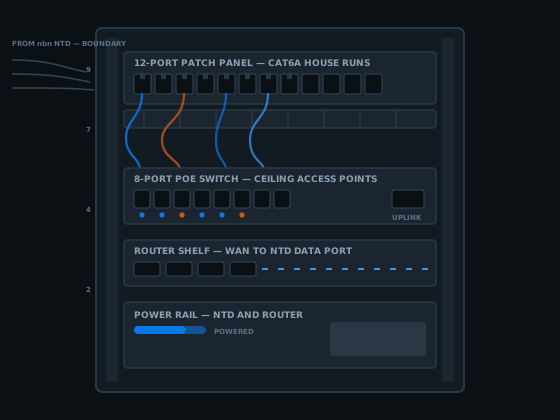
That does three useful things. It leaves the carrier equipment untouched. It puts every internal run on one labelled point. And it makes swapping providers or routers a five-minute job rather than a rewire.
One lead across the line
A single patch lead from the nbn data port to the router WAN port. That lead is the only thing crossing the boundary, and the only thing that should.
Star topology, no daisy chains
Every outlet runs back to the patch panel independently. The 100 metre channel limit still applies to nbn cable installation work: 90 metres fixed plus 10 metres of patch.
Tested and labelled
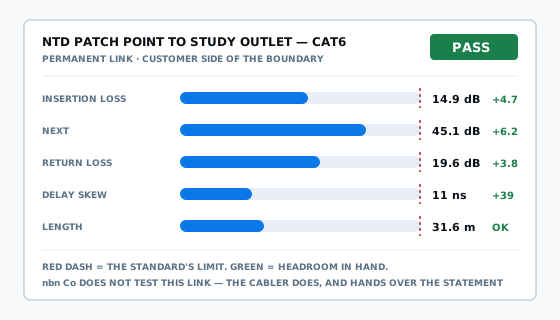
Each permanent link tested against the standard it was built to, both ends labelled to match, results handed over with the compliance statement.
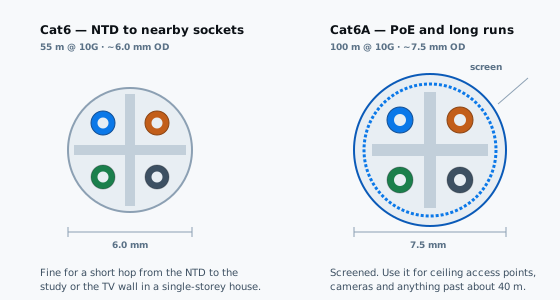
Cable choice off the box is simple. Cat6 carries a gigabit to the full 100 metres and 10 gigabit to about 55, at roughly 6.0 mm outside diameter. Cat6A holds 10 gigabit the whole 100 metres because it is screened against alien crosstalk, at about 7.5 mm. For ceiling access points and cameras, use Cat6A.
Bigger than a house — offices, a warehouse, a fitout — and the same boundary logic applies with more design work, covered under structured cabling in Brisbane. For a couple of extra outlets after an nbn cable installation, data point installation is the page you want.
The nbn cable installation jobs people actually ring about
Almost every call about nbn work at a house is one of four things. None are network faults. All sit on the customer side, which is why the provider could not help.
The box is in the wrong spot
Garage, laundry, behind a door. nbn Co's own guidance is not to remove or relocate it yourself: changes need to be made by nbn Co or a registered cabler, who may do it under the Authority to Alter guidelines.
Only one room has a socket
The classic result of an nbn cable installation done to scope. A working service at one point and nothing anywhere else, solved with runs from a patch point beside the box.
The old phone cabling is failing
On FTTN and FTTC the internal copper is part of the path. Corroded sockets, a decades-old spur off a roof junction box, a second socket wired in parallel — all drag the sync rate down.
Renovation cut the run
A wall came out, a ceiling went in, a cable went with it. Customer side every time, and usually a straightforward re-run once the break is located.
The relocation question is worth being precise about. Fixed nbn supplied equipment inside a premises can be moved by a registered cabler working to nbn Co's standards under the Authority to Alter process, and it may attract a charge. Equipment outside the building goes through nbn Co's relocation works application — a form and a wait, not a trade booking.
Detail sits in who can legally move an nbn box, and for a fault rather than a wish list, start with nbn repair work on the customer side. For the box on the outside wall, the premises connection device guide covers what it is and what may be done to it.
When the boundary moves — fibre upgrades and nbn cable installation afterwards
Plenty of Brisbane addresses connected on copper are being upgraded to full fibre. Good for the service, awkward for the cabling, because the boundary physically relocates and the original nbn cable installation no longer lands where it used to.
On the old FTTN service the boundary was your telephone socket and any internal cabling ran from there. After the upgrade it is a data port on a new connection box, mounted wherever the technician found a wall and a power point. That is frequently not where the old socket was, so everything you had wired now terminates in the wrong place.
Worth doing before the upgrade, not after: decide where you want the connection box, make sure there is a power point there, and clear access to it. You cannot direct the technician's design, but an obvious location beats a spot behind a full linen cupboard.
The cleanest fix afterwards is a patch point beside the new box and short re-runs into the existing cabling — a half-day of nbn cable installation work in a house with roof access, and a bigger job in a slab-on-ground place. The NTD installation guide covers the box itself, and the nbn install process end to end covers what happens on the day.
Commercial sites hit the same problem at scale, with the boundary at a building MDF rather than inside a tenancy. For nbn cable installation across a tenancy or a strata building, nbn installation contractors covers how it gets scoped and staged.
What nbn cable installation work costs on the customer side
The carrier connection is arranged through your provider and priced by them. Everything here is the private half, quoted like any other cabling job.
Priced per point
Runs from a patch point out to outlets are quoted per outlet — cable, both terminations, wall plate, panel port, test and label. The rate falls as the count rises because access and setup cost is shared.
Priced hourly
Relocations, fault finding and small additions are hourly. Published Brisbane rates for comparable work sit around the $185 per hour mark for standard hours, with after-hours carrying a premium.
What moves the number is access, not cable. A 1970s brick veneer with a roof cavity over the whole floorplan is straightforward; a rendered two-storey with no cavity access is not. Which is why nobody serious quotes nbn cable installation work over the phone without a lot of questions first.
Three things to check on any nbn cable installation quote: is testing included or extra; is the cable specified by category rather than called data cable; and does the quote say who wears it if the fault turns out to be on the carrier side. That last one separates people who understand the boundary from people who do not.
An honest drawback: if your problem genuinely sits on the nbn side of the boundary, no amount of nbn cable installation work fixes it. The only path is your retail provider. Paying a cabler to attend and prove it is sometimes worth it to break a stalemate, but know that is what you are buying.
nbn cable installation questions I get asked
Does nbn Co run cable from the nbn connection box to the rest of my house?
No. The nbn technician brings the service in, mounts the utility box outside, mounts the connection box inside and proves the service works at that box. The cable from there out to a study, a lounge room or a ceiling access point is customer cabling, and nobody from nbn Co is coming back to run it for you.
Where exactly is the network boundary point on FTTP, FTTN, FTTC and HFC?
On FTTP it is the data port on the nbn connection box. On HFC it is the service output port on the nbn modem. On FTTN and FTTB there is usually no nbn box at all, so the boundary falls at the first telephone socket after the building entry point, or at the MDF in a strata building. FTTC lands at the connection device fed from the wall socket.
Who do I call when the nbn cable installation fault is inside my walls rather than in the street?
Your retail provider, every time, for anything on the nbn side of the boundary — they raise it with nbn Co. For anything past the boundary you call a registered cabler directly. Ringing the provider about a dead socket in the back bedroom just burns two weeks before somebody tells you it was never their cable.
Can a private cabler legally touch the nbn NTD, the utility box or the wall socket?
A registered cabler can work up to and connect at those points, and nbn Co publishes an Authority to Alter process covering relocation of fixed nbn equipment inside a premises. What a cabler cannot do is quietly rehome nbn plant outside the building or alter the lead-in — that goes through nbn Co's relocation works application instead.
Does an FTTN nbn cable installation come with an nbn connection box?
No. On Fibre to the Node the existing copper pair runs from a street node straight to your existing telephone socket, and nbn Co installs no equipment at the premises unless a socket has to be added. Your retail provider posts you a VDSL2 modem and you plug it into the socket yourself. That socket is the boundary.
Do I need an electrician or a registered cabler for cabling work off the nbn box in Queensland?
A registered cabler. Queensland does not require an electrical licence for telecommunications cabling at all — section 55(3) of the Electrical Safety Act 2002 says so plainly. The requirement that does bite is federal: registration under the Telecommunications (Cabling Provider) Rules 2025. An electrical licence on its own authorises none of this work.
What happens to my internal cabling when the premises is upgraded from FTTN to full fibre?
The boundary moves. FTTN terminated at your phone socket; full fibre terminates at a new connection box, often mounted wherever the technician found power and a wall. Every cable that used to feed off the old socket is suddenly on the wrong side of the house, which is why upgrades generate so much private cabling work afterwards.
Can I move the nbn utility box on the outside wall myself before a renovation?
No. Anything fixed and nbn supplied stays put unless nbn Co or a registered cabler moves it, and equipment on the outside of the building goes through nbn Co's relocation works application rather than a trade visit. Start that paperwork early — a render job or a new carport is not a reason nbn Co will rush.
Does the nbn connection box give me data points around the house?
It does not. The connection box has one or a small number of data ports and that is the whole of it. Every wall plate, ceiling point and patch panel port beyond it has to be cabled by somebody, tested, and labelled. That work is the reason this trade exists and it is not part of what nbn Co supplies.
What paperwork should I get after private cabling work around the nbn connection box?
A written statement of compliance, plus the test results for every link that was installed. Section 25 of the Cabling Provider Rules requires that statement to be given to you regardless of whether you have paid the invoice yet. If a cabler treats it as optional paperwork, that tells you something about the rest of the job.
Get an nbn cable installation quote
Tell me the technology at your address if you know it, where the box is now, and where you want the network to reach. That is enough to scope most nbn cable installation work. If it is a fault, say what the lights on the box are doing — that usually sorts the carrier side from your side before anyone drives out.
Or just call 07 3521 8082. If it goes to voicemail I am up a ceiling somewhere; leave a message and I will call back.
ACMA registered cabler no. 42489 All work to AS/CA S009:2020