Brisbane & South East Queensland
Structured cabling installation, Brisbane — the system, not just the cable
A structured cabling installation is six subsystems that happen to be made of cable: entrance facility, MDF, backbone, floor distributor, horizontal, work area. Get the boundaries between them right and the building stays cheap to change for twenty years. Get them wrong and every future move costs money.
ACMA registered cabler no. 42489 Installed to AS/CA S009:2020 Channel held under 100 m

The reason the trade uses the word "structured" is that the alternative is unstructured, and everyone has seen unstructured. Forty cables in a ceiling, no two labelled, three of them going somewhere nobody can identify. Structured cabling brisbane buyers are quoted every week is really a promise about organisation, not about copper.
This page is the system view of a structured cabling installation. It walks the subsystems in the order the signal travels, says what each one is bound by, and explains the single measurement — 100 metres — that quietly dictates the floor plan of every comms room in the building. The broader picture sits on the network cabling Brisbane homepage.
What a structured cabling installation actually is
Strip the marketing off it and a structured cabling installation is a set of rules about where cables are allowed to start and stop. Nothing runs device to device. Everything lands on hardware — a patch panel, a frame, an outlet — and the flexible bits are short leads at the ends that anyone can change without touching the fixed cable.
That single constraint is what produces every benefit people claim for a structured cabling installation. A desk moves and only a patch lead moves with it. A switch is replaced and the horizontal cable never knows. Ten years later the building goes from 1 Gbps to 10 Gbps and, if the horizontal was specified properly, the copper stays where it is.
Entrance facility
Where the carrier's service physically enters the building — the conduit, the pit, the lead-in, and the point at which the network stops being anyone else's problem.
Main distribution frame
The building's single reference point. Everything terminates back here or back to a distributor that terminates here. If you can only label one thing properly, label this.
Backbone and risers
The vertical or inter-building spine between distributors. Almost always fibre, because this is the leg where copper distance limits stop being negotiable.
Floor distributor
The comms room or cabinet serving one level or one zone. Its position is set by geometry, not by which cupboard happened to be free.
Horizontal cabling
Fixed copper from the floor distributor out to every outlet. This is the expensive, permanent, hard-to-change layer — and the one bound by 90 metres.
Work area
Outlet to device. A patch lead, a wall plate, a floor box, a ceiling point for an access point. The only part of the system a user ever touches.
Every decision on a structured cabling installation belongs to exactly one of those six. When a quote is hard to compare, it is usually because it has silently merged two of them — pricing the horizontal but not the distributor it lands in, or the outlets but not the backbone that feeds them.
Subsystem one and two
The entrance facility and the MDF: where the building's network begins
The main distribution frame is the most misunderstood object in the building. People treat it as a cupboard. On a structured cabling installation it is a legal and technical boundary: on one side is the carrier's network, on the other side is customer cabling, and the rules about who may work where change at that line.
That matters more than it sounds. The three registration classes are open, restricted and lift, and restricted registration specifically does not authorise cabling that terminates at an MDF or at a patch panel. Since a structured cabling installation is defined by terminating at exactly those two things, restricted registration cannot lawfully cover it. Ask which class before anyone opens a frame — the classes are set out in the Telecommunications (Cabling Provider) Rules 2025, which commenced on 31 March 2025, and registration is issued to individuals, never to companies.
What the entrance facility has to do
Start the structured cabling installation somewhere dry, accessible and identifiable, with enough room to terminate and enough spare pathway that the next service does not need a new trench. On older Brisbane commercial stock this is often the part that has been quietly filled up by three previous tenancies.
What the MDF has to do
Present every incoming service and every backbone departure on labelled hardware, with the earth done properly and the record kept current. A frame nobody has documented is just a wall of jumpers that costs an hour to read before any work can start.
The question worth asking on any structured cabling installation quote: does the price include re-terminating and re-labelling the MDF, or does it stop at the cabinet door? Frames are where scope quietly disappears, because the client never looks inside one and the difference is a day of labour.
Backbone, risers and the distributor hierarchy
Backbone cabling is the leg between distributors on a structured cabling installation: MDF up to each floor, or across a campus between buildings. It carries aggregated traffic, so it is sized for the future rather than for today, and it is almost always fibre because copper cannot make the distances without another room in the middle.
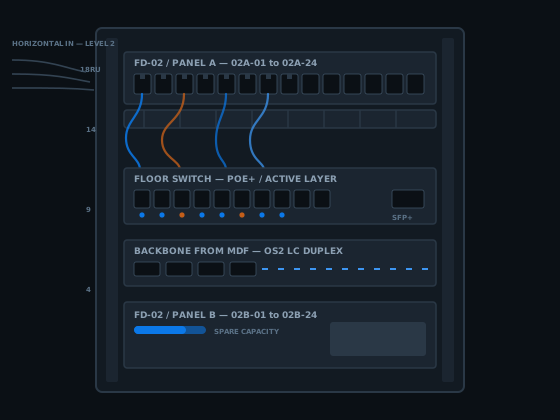
The old Australian designation for the generic cabling standard, AS/NZS 3080, described that hierarchy as a campus distributor feeding building distributors, feeding floor distributors, feeding telecommunications outlets. The current AS/NZS ISO/IEC 11801 series renumbers the same idea as distributors one to four with subsystem cables between them. The words changed; the shape did not.
What is worth taking from that is the principle underneath. Each tier exists so the tier below it can be worked on independently. Re-lamp the backbone to higher-speed optics and the horizontal is untouched. Add a floor distributor and only the runs on that floor change. A structured cabling installation that respects the hierarchy stays cheap to modify; one that short-cuts it — a run straight from the MDF to a desk two floors up — is the thing that makes the next job expensive.
In Brisbane towers the riser itself is usually the constraint. Shared, full, and governed by a building manager with rules about fire-stopping and after-hours access — a scheduling problem as much as a technical one, and it belongs in the quote rather than in a variation later. Across a yard between sheds, copper is out on distance and often on earthing grounds too, so fibre to a satellite cabinet turns one impossible horizontal run into a normal short one.
The 100 metre channel — the number that draws the floor plan
Here is the rule that shapes every structured cabling installation. The copper channel is 100 metres total: up to 90 metres of fixed horizontal cable between the floor distributor and the outlet, plus a maximum of 10 metres of patch leads across both ends combined.
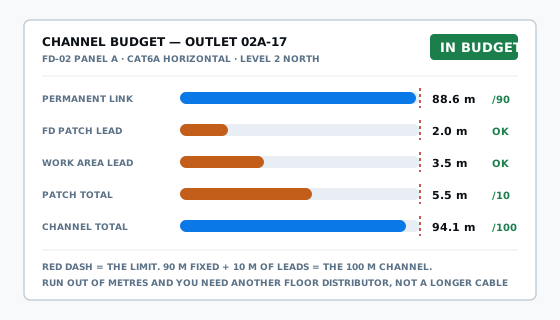
Read that as a design constraint rather than a spec sheet line and it starts drawing rooms for you. Every outlet on a floor has to sit within 90 metres of its distributor measured along the cable path — up the wall, through the ceiling, around the lift core, down again. The straight-line distance on the plan is always shorter than the real one, often by twenty per cent or more.
Which is why comms rooms end up near the middle of a floor plate. Push the room to a corner and the far corner of the building is suddenly out of reach. On a long, narrow tenancy the geometry can force two distributors on one level, each fed by its own backbone. That decision belongs at the start of a structured cabling installation, before anyone orders cable.
The trap every rushed structured cabling installation falls into: a run measured at 96 metres will often work on day one. It will pass link lights, it may even pass at gigabit, and it will fail certification and then fail properly the first time the building gets busy or the tenant moves to 10 Gbps. Out-of-spec length is the defect that hides longest.
When a floor genuinely cannot be served inside the limit, the answer is never a longer copper run. It is another distributor and another fibre leg back to the MDF. Extending copper past the channel is the one shortcut on a structured cabling installation that guarantees a rebuild later, and the certification results handed over at the end of the job are exactly where it gets exposed.
Horizontal cabling and the work area
The horizontal is where most of the money and nearly all of the labour on a structured cabling installation goes. One fixed cable per outlet, home run to the distributor, terminated on a keystone at the outlet end and a patch panel port at the other. No joins, no daisy chains, no shared runs.
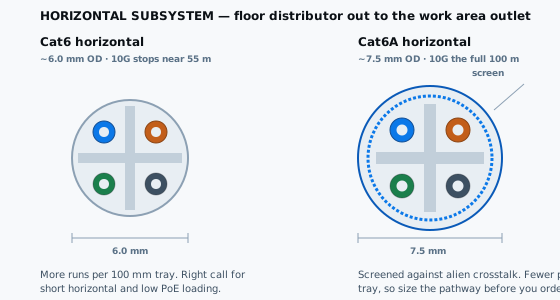
| Cat6 | Cat6A | |
|---|---|---|
| 1 Gbps | 100 m | 100 m |
| 10 Gbps | ~55 m | 100 m |
| Alien crosstalk | Unscreened | Screened |
| Outside diameter | ~6.0 mm | ~7.5 mm |
| Effect on pathway | More runs per tray | Size the tray for it up front |
| Best fit | Short runs, residential | Commercial floors, PoE devices |
The cable itself is a small share of a structured cabling installation. Pulling it is the same labour either way, so on a commercial floor the honest recommendation is usually Cat6A — not because Cat6 is bad, but because the horizontal is the layer you cannot revisit without opening the ceiling again. In a three bedroom house with a longest run of thirty metres, Cat6 is the right cable and paying for Cat6A buys nothing.
The work area is the last subsystem of a structured cabling installation and the only one anybody sees: the outlet, the plate, the lead to the device. Keep the leads short, keep them inside the 10 metre allowance, and resist the urge to solve a layout problem with a twenty metre patch cord across a room.
Two outlets per desk is the minimum worth planning for, and ceiling points for access points, cameras and door controllers are horizontal runs like any other — they belong on the plan at design time, not as a variation after the grid goes back up. Twenty per cent spare capacity costs cable and a little labour on the day. The same runs added in two years cost access, ceiling work and a return visit.
Which standard governs a structured cabling installation in Australia
This is where a lot of marketing copy about structured cabling installation work gets it wrong, including copy written by people who should know better. There are two families of document and only one of them is law.
The mandatory one
AS/CA S009:2020, Installation Requirements for Customer Cabling — the Wiring Rules. Compliance is mandatory under section 23 of the Cabling Provider Rules. It is a free download from the Australian Telecommunications Alliance, and it is the document that decides whether the work was lawful.
The performance ones
The AS/NZS ISO/IEC 11801 series — general requirements, office premises, industrial premises, homes, data centres, distributed building services. These describe how cabling should perform and what a channel must measure. They are not the legal instrument, which is why "compliant to AS/NZS 3080" is a claim worth questioning.
Getting that distinction right is not pedantry. A structured cabling installation is designed against the performance standards and made lawful by S009, and the paperwork you receive at the end reflects both: test results proving the channels perform, and a written statement of compliance proving the work met the mandatory requirements. Under section 25(3) that statement has to be supplied after the work regardless of whether the invoice has been paid.
Queensland adds no electrical licence on top. The Electrical Safety Act 2002 (Qld) says at section 55(3) that an electrical work licence is not required to install or repair telecommunications cabling — so "licensed electrician" tells you nothing about whether someone may lawfully run your data. The cabler registration is the thing to ask for, and the registration behind this site is no. 42489, open class.
Labelling and administration — the subsystem made of paper
Administration is the seventh subsystem, and the one that gets deleted first when a quote is being sharpened. It is also the only part of a structured cabling installation that pays for itself in cash rather than in principle.
AS/CA S009:2020 requires a cabling provider to keep records that are legible and able to be updated, and to identify terminations and cross-connections clearly. On a structured cabling installation that means a scheme applied at both ends of every run, the same scheme on the panel and on the plate, and a record that survives the person who installed it.
What a workable scheme looks like
Encode position, not purpose. 02A-17 — level two, panel A, port seventeen —
stays true forever. ACCOUNTS-PRINTER is wrong the day accounts moves, and
somebody will spend an hour discovering that.
What the record has to contain
A floor plan with outlet numbers, a panel schedule, the backbone routes, and the test result for each link. Four documents. They cost an afternoon to produce and save days across the life of the building.
Fault finding is where the value of a documented structured cabling installation shows up. On a labelled system, "port 14 in accounts is dead" is a five minute job: read the plate, find 02A-14, test it, fix the termination. On an unlabelled one the same fault starts with tracing cables in a ceiling, and that is charged by the hour like every other kind of detective work — which is a large part of what data cabling actually costs in Brisbane once you count the second and third visits.
How a structured cabling installation goes wrong
Cabling rarely fails dramatically. It degrades, and the symptoms get blamed on the switch, the internet or the laptop for months before anyone measures the cable. These are the faults that turn up most often on a structured cabling installation done in a hurry.
Over-length runs
The single most common design defect. Works at first, fails certification, fails properly under load. No fix except pulling a new run or adding a distributor.
Untwisting at the termination
More than about half a twist undone at the punch-down wrecks crosstalk performance. It looks perfect and reads terrible on a tester.
Cable ties pulled tight
Deforming the pair geometry changes impedance. A neat bundle strangled with nylon ties can measure worse than a messy one.
Sharp bends and crushed runs
Dragged over a purlin, kinked into a tray corner, or squashed under something heavy in a ceiling during a later fitout by another trade.
Mixed components
Cat6A cable onto Cat6 keystones. The channel performs to the weakest part, so the upgrade money is spent and not received.
No testing at all
A link light proves continuity, nothing more. Without certification nobody knows whether the channel has headroom or is scraping the limit.
The pattern is that every one of them is cheap to prevent and expensive to find. That is the real argument for treating this as a system: not that the diagram is tidy, but that a structured cabling installation done to the standard removes the whole class of faults that cannot be diagnosed from the switch end.
What a structured cabling installation costs, and what moves the number
Almost nobody publishes rates, which makes comparing two structured cabling installation quotes for the same building genuinely hard. Here is how the pricing is built so you can read one properly.
Per point for the horizontal
Each outlet carries its cable, both terminations, the plate, the panel port, the labelling and the test. The rate per point drops as the count rises, because access and setup are shared across more outlets.
Separately for the infrastructure
Distributor cabinets, backbone runs, fibre termination, cable tray and the MDF work are priced on their own. A quote that folds these into a flat per-point number is either padding the points or leaving something out.
Hourly for the unknowns
Fault finding, alterations and investigation are hourly. Published rates for comparable Brisbane work sit around the $185 per hour mark in standard hours, with after-hours carrying a premium.
Access, not cable
The biggest swing factor by a distance. A suspended ceiling with a walkable void is one job; a rendered two-storey with no cavity access and a heritage overlay is another entirely, for the identical outlet count.
Three things to check on any structured cabling installation quote. Is certification included or an extra line. Is the cable specified by category and brand rather than described as "data cable". Does the number include the distributor hardware, or only the runs that land in it. Cheap quotes are usually cheap in one of those three places.
The honest drawback is worth saying out loud: a proper structured cabling installation costs more up front than pulling cable point to point, and on a small job — four outlets in a house that will never change — the full discipline is overkill. It earns its keep on buildings that will be re-arranged, re-tenanted or upgraded. Most commercial ones qualify; plenty of homes do not.
Structured cabling installation questions I get asked
What makes a structured cabling installation different from just running data cables?
Structure. A pile of cables is a set of point-to-point runs that only the person who pulled them understands. A structured cabling installation is divided into named subsystems — entrance facility, backbone, floor distributor, horizontal, work area — each terminated on hardware, labelled to a scheme, and replaceable on its own without disturbing the others.
What are the subsystems of a structured cabling installation?
Six, working inwards. The entrance facility where carrier services arrive, the main distribution frame, the backbone or riser cabling between distributors, the floor distributor serving each level or zone, the horizontal cabling out to each outlet, and the work area where the patch lead reaches the device. Every part of the design belongs to one of them.
Why is horizontal cabling limited to 100 metres?
Because that is the channel the copper standards were written around: 90 metres of fixed cable between the floor distributor and the outlet, plus up to 10 metres of patch leads at the two ends. Beyond it, insertion loss and delay stop the link performing predictably. It is a hard design boundary, not a target to aim near.
Where should the comms room go on a structured cabling installation?
Wherever it keeps every outlet on the floor inside 90 metres of fixed cable, measured along the real cable path rather than across the floor plan. That usually lands it near the core of the building. If one wing pushes past the limit, the answer is a second floor distributor fed by fibre, not a longer copper run.
Is AS/NZS 3080 still the structured cabling standard in Australia?
No. AS/NZS 3080 was the old local adoption of ISO/IEC 11801 and it has been replaced by the AS/NZS ISO/IEC 11801 series, split into parts for general requirements, office premises, industrial premises, homes, data centres and distributed building services. Those describe performance. The instrument that carries legal force in Australia is AS/CA S009:2020.
Does every structured cabling installation need an MDF?
Every building has a point where the carrier's network stops and yours starts, and that point is the main distribution frame. In a house it might be a small enclosure near the meter box. In an office tower it is a dedicated room. The size changes; the role does not. It is also the boundary that decides which registration class may lawfully work there.
How should the outlets and panels be labelled on a structured cabling job?
To one scheme, applied at both ends, that encodes where the run lands: distributor, panel, port. Something like 02A-17 for level two, panel A, port seventeen. AS/CA S009:2020 requires a cabling provider to keep legible and updatable records and to identify terminations and cross-connections, so labelling is an obligation rather than a courtesy.
Can a restricted cabling registration cover work at an MDF or patch panel?
No. There are three registration classes — open, restricted and lift — and section 9(2) of the Cabling Provider Rules says restricted registration does not authorise cabling that terminates at a main distribution frame or a patch panel. Since both are central to this kind of work, an open registration is what the job requires.
Is Cat6A worth the extra cost on the horizontal subsystem?
On commercial floors, usually yes. Cat6 carries 1 Gbps to 100 metres but only manages 10 Gbps to about 55 metres, while Cat6A holds 10 Gbps across the whole channel because it is screened against alien crosstalk. The labour to pull either is identical, and the horizontal is the one layer you cannot upgrade without opening the ceiling again.
Get a structured cabling installation quote
Tell me what the building is, roughly how many outlets, and where the comms room is now — or where you think it could go. That is usually enough to say whether the 90 metre geometry works or whether the floor needs a second distributor. The more you can tell me about the pathways, the tighter the structured cabling installation quote comes back.
Or just call 07 3521 8082. If it goes to voicemail I am up a ceiling somewhere; leave a message and I will call back.
ACMA registered cabler no. 42489 All work to AS/CA S009:2020