Brisbane & South East Queensland
TV cabling installation for aerial-to-outlet coax and multi-room distribution
TV cabling installation is the coax run from the antenna to the outlet — treated as its own trade, not squeezed in as an afterthought on a data cabling job. Aerial down to a distribution point, then out to however many rooms need a picture, with the splitter or amplifier chosen for the signal you've actually got.
ACMA registered cabler no. 42489 Installed to AS/CA S009:2020 Compliance statement every job
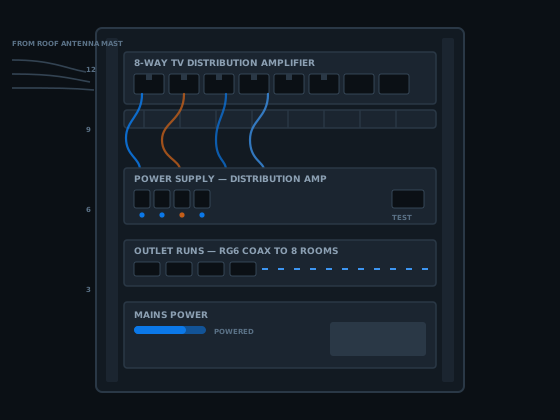
Most network cabling pages treat TV cabling installation as a footnote — a line item next to the data points, covered by whoever happens to be up the ceiling that day. It's a different trade with its own cable, its own signal budget and its own licence category, and treating it as an afterthought is exactly how a house ends up with a snowy picture on the back TV and nobody able to say why.
This page is about TV cabling installation on its own terms: the aerial-to-outlet run, what happens when one signal has to feed six rooms, and whether the person doing it is actually allowed to under the Cabling Provider Rules. If you're also cabling data points in the same job, the detail on data cabling in Brisbane covers the Cat6 and Cat6A side, and the two jobs often go in on the same visit.
What TV cabling installation actually covers
A TV cabling installation starts at the antenna — usually on the roof, sometimes on a mast bracket against the gable — and runs down through the roof cavity to a distribution point. From there it either goes straight to a single outlet or splits to feed however many rooms are getting a TV point. The cable itself is coax, not the twisted-pair Cat6 used for data, and everything about how it behaves — signal level, loss per metre, loss per split — is different.
Four parts make up most jobs:
Aerial-to-outlet run
The single run from the antenna down to one TV point. Straightforward on a roof-cavity home, more involved on a two-storey rendered job with no cavity access.
Distribution point
Where one aerial signal splits to feed multiple rooms — a small enclosure near the roof entry or in a cupboard, holding the splitter or amplifier and every downstream run.
Splitter or amplifier
Passive splitting is fine for two or three short runs. More outlets, or a weak signal to start with, and an active distribution amplifier usually earns its keep.
Outlets and F-connectors
A TV point is a wall plate with an F-connector, terminated properly rather than a compression fitting jammed on with pliers — the usual point a cheap TV cabling installation starts losing signal.
TV and antenna coax as its own trade
Coax and Cat6 look similar enough on a spool that people assume the trade is the same. It isn't. Twisted-pair data cable has a hard distance limit — 100 metres — and either passes a certification test or it doesn't. Coax has no fixed distance limit; instead it has a signal budget, and every metre of cable, every splitter and every connector spends part of it. A TV cabling installation that ignores that budget doesn't fail a test on the day — it fails eighteen months later when a connector corrodes and tips a marginal run over the edge.
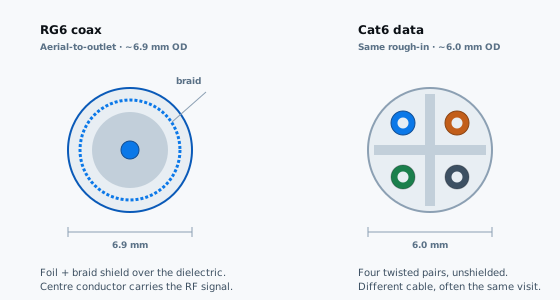
RG6 is the standard coax for a modern install — a thicker centre conductor and dielectric than the RG59 it replaced, which means less loss per metre and a cleaner signal over a longer run. Quad-shield RG6, with two foil layers and two braids instead of one of each, earns its place on long external runs or anywhere near noisy wiring — a switchboard, a fluorescent driver, a solar inverter. None of that matters if the F-connector on the end is a compression fitting done badly, which is still the single most common point of failure in coax work.
The legislation actually treats the mast and the cable as two different things. Aerial cabling — the physical antenna, its mount and the run of cable directly off it — sits in one specialised category. Coaxial cabling, the cable itself wherever it runs, sits in another. A TV cabling installation touches both, which is part of why it isn't something to assume any general cabler is automatically covered for.
The bit most quotes skip past
Is TV cabling installation its own licensed category?
Short answer: yes, and it surprises people who assume "cabling registration" is one single licence. The Telecommunications (Cabling Provider) Rules 2025 set out six specialised categories of cabling work — aerial, broadband, coaxial, optical fibre, structured and underground — and coaxial is the one that covers TV cabling installation. Each of the six needs its own completed units of competency and its own notification to the registrar before someone may lawfully perform that category of work. Holding a cabling registration at all does not automatically mean coax is covered.
That matters more than it sounds. There are three registration classes — open, restricted and lift — and they are not equally entitled to specialised categories. A restricted registration covers only aerial, broadband and underground cabling. Coaxial is not on that list, so a restricted-class cabler is not authorised to carry out TV cabling installation at all, regardless of how many years they've been running cable. An open registration can cover any of the six categories, coaxial included, once the units are completed and the registrar notified — both steps, not just one.
What to ask anyone quoting TV cabling installation: their registration number, whether it's open or restricted, and whether they've actually completed and notified the coaxial endorsement — not just assumed a general registration covers it. The registrar notification is public record, and a legitimate cabler won't mind being asked.
None of this is Queensland licensing — it's federal, under the same Telecommunications (Cabling Provider) Rules 2025 that cover data and fibre cabling, and it sits alongside the general registration requirement in section 21: cabling that connects to a telecommunications network has to be done by a registered provider, or under their direct supervision. ACMA's own guidance on the three registration classes is worth five minutes if you want to check what a class actually authorises before you sign off on a quote.
Multi-room TV cabling installation: splitters or an active amplifier
Feed more than one room off the same aerial and something has to divide the signal, and every way you split costs signal. A two-way splitter typically costs each leg somewhere around 3.5 to 4 dB. Split four ways and each leg is down around 7 dB. Split eight ways for a full house and you're often losing more than 10 dB before the cable run itself has taken anything — which is why a whole-house TV cabling installation on a marginal signal needs more thought than buying the splitter with the most ports.

| Passive splitter | Active distribution amp | |
|---|---|---|
| What it does | Divides the signal that's there | Boosts it, then divides |
| Typical use | 2–3 outlets, strong signal | 4+ outlets, or a weak start |
| Power needed | None | Mains power at the point |
| Cost | Cheap | Higher, plus ongoing power draw |
| Risk if wrong | Far outlets too weak | Overdriven, distorted picture |
An amplifier is not automatically the right call. Overdrive an already-strong signal and you get distortion and intermodulation instead of a clean picture — more gain is not the same as more quality. The only way to size one properly is to measure the signal at the distribution point first, work out how many ways it needs to split, and pick the smallest amplifier that gets every outlet into a usable range. That's the design step most cut-price TV cabling installation quotes skip, because it takes an actual meter rather than a guess.
The standard behind a proper TV cabling installation
Two standards do different jobs here. AS/CA S009:2020 — the Wiring Rules, the same standard that governs every other kind of customer cabling — sets how the coax itself gets run: separation from mains wiring, bend radius, how it's fixed and terminated. It's mandatory under section 23 of the Cabling Provider Rules for any customer cabling, coax included, and it's a free download from the Australian Telecommunications Alliance.
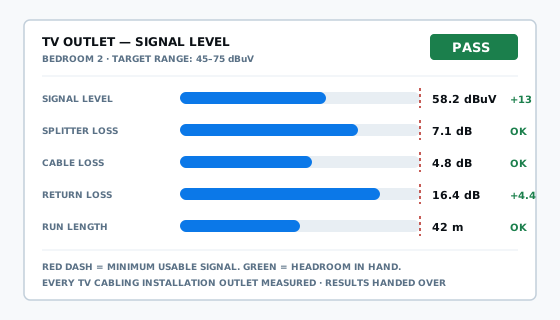
The second standard, AS 1367, covers the RF side rather than the physical install: how a distribution system should be designed so every outlet — not just the one closest to the splitter — gets a signal inside a usable range once all the splitting and cable loss is accounted for. A TV cabling installation that only follows S009 and ignores the signal budget can be perfectly compliant on installation practice and still deliver a picture that breaks up on the far outlet.
Running coax in the same rough-in pass as your data cabling
Most Brisbane roofs only get opened up once if the owner has anything to say about it, which is the practical argument for doing TV cabling installation at the same time as any data cabling job rather than as a separate callout. The access is the same — roof cavity or subfloor — and pulling an extra coax run alongside the Cat6 while the ceiling is already open costs a fraction of coming back for it later.
The two cables don't need to be kept as far apart as coax and mains power, but they're still separate services under the same wiring rules, and a rough-in that just zip-ties everything into one bundle without a second thought is the kind of shortcut that shows up as noise on the TV picture or interference on the data side later. Planned properly, a combined data cabling and TV cabling installation rough-in is one visit, one set of access holes, and one compliance statement covering both.
The same logic holds wherever the job is — a TV point going in alongside a data cabling job in Logan or the south side gets planned the same way: one access, both cables pulled together, both tested and signed off before the ceiling goes back.
What TV cabling installation costs
Priced the same way as a data point, in practice — per outlet, with the number falling as the count goes up because the roof access and travel cost is shared across more points. A single TV cabling installation into a room with roof cavity access above it is a straightforward job. The same outlet in a two-storey rendered home with no cavity access, or a distribution point that needs an active amplifier and a power point run to it, is a different quote entirely.
Three things worth asking on any TV cabling installation quote: is the coax RG6 or something thinner and cheaper; is a signal check at the outlets included or assumed; and does the price include a proper F-connector termination rather than a compression fitting pushed on in five seconds. Those three are where a cheap quote gets cheap.
What goes wrong when TV cabling installation is done cheap
Three shortcuts account for most of the callbacks.
Too many ways, no amplifier
Splitting eight ways off a passive splitter because that's the box in the shed, without checking whether the signal survives it. The far outlets pixelate first, usually the ones that get complained about last.
Reused flylead coax
Whatever cable was already in the wall gets reused for a new point instead of a proper run, often a thinner grade with a foil-only shield that was never rated for the distance.
Compression fittings done badly
The F-connector is the single most common failure point in coax work — a poorly crimped or hand-twisted connection corrodes and drops signal months after the install looked fine.
None of it shows up on the day. A TV cabling installation with a marginal signal budget looks perfect at handover and starts failing once a connector oxidises, a splitter ages, or the weather turns — which is exactly why measuring the signal properly during the install matters more than eyeballing a picture on the day.
TV cabling installation questions I get asked
What does a TV cabling installation in a Brisbane home actually involve?
A TV cabling installation runs coax from the antenna on the roof down to a distribution point, then out to a wall plate in each room that needs a TV point — the lounge, the main bedroom, sometimes a study for a set-top box. Once more than two or three outlets are involved, that distribution point needs either a splitter or a powered distribution amplifier, chosen on signal strength rather than habit.
Does TV cabling installation need its own licence category, separate from data cabling?
Yes. Coaxial cabling is one of six specialised categories under the Cabling Provider Rules, alongside aerial, broadband, optical fibre, structured and underground cabling. Each category needs its own completed units of competency and its own notification to the registrar before someone may lawfully perform that work — holding a registration at all doesn't automatically cover every category.
Can a restricted registration holder do TV cabling installation work?
No. Restricted registration only covers aerial, broadband and underground cabling — coaxial isn't on that list, so a restricted-class cabler isn't authorised to carry out TV cabling installation at all. That work needs an open registration with the coaxial units completed and notified, or direct supervision by someone who holds it.
Should multi-room TV cabling installation use a splitter or a distribution amplifier?
A passive splitter is fine while the signal at the antenna is strong and the split is modest — two or three outlets, short runs. Every extra way costs several decibels, so once you're feeding four or more rooms, or the antenna signal was marginal to start with, an active distribution amplifier usually earns its keep by putting the loss back.
Can coax and Cat6 be pulled in the same rough-in visit?
Usually, yes. If the roof or subfloor is already open for a data cabling job, running the TV coax at the same time saves a second access and a second callout. Both are customer cabling under the same wiring rules, so the same separation-from-power requirements and the same registered-cabler obligation apply to the coax as they do to the Cat6.
What standard governs a TV cabling installation in Australia?
Two standards, doing different jobs. AS/CA S009:2020, the Wiring Rules, is the mandatory installation standard for all customer cabling, coax included — how it's run, terminated and separated from other services. AS 1367 covers the RF side: how a distribution system is designed so every outlet gets a usable signal after splitting or amplification.
How much does TV cabling installation cost for a typical Brisbane house?
It's priced the same way as a data point — per outlet installed, with the rate falling as the count rises because the roof access and setup cost is shared. What moves the number most is access: a straightforward roof-cavity run costs less than a two-storey job with no cavity access, or a distribution amplifier and its power supply added to the design.
What goes wrong when TV cabling installation is done cheaply?
The usual shortcuts are reusing degraded coax instead of a proper run, splitting too many ways off one passive splitter without checking the resulting signal level, and skipping the distribution amplifier a longer run actually needed. All three show up later as pixelation, dropouts on some channels but not others, or a picture that fails only in bad weather.
Can existing TV coax be reused for a new outlet or does it need replacing?
Sometimes, if it's decent quality cable in good condition and the run is short enough that its loss stays inside budget. Older cable is often a thinner, cheaper grade with a foil-only shield rather than the foil-and-braid combination a new install would use, and testing it before relying on it is worth the ten minutes it takes.
Does a TV cabling installation need a compliance statement like data cabling does?
Yes. Section 25 of the Cabling Provider Rules requires a written compliance statement for cabling work carried out by a registered provider, and coaxial cabling is one of the six specialised categories the Rules cover. It has to be supplied after the work regardless of whether the invoice has been paid, and it's the paperwork that shows the job was done lawfully.
Get a TV cabling installation quote
Tell me how many rooms need a TV point and roughly where the antenna feed comes into the house. Most TV cabling installation jobs can be scoped from a few photos of the roof access and a phone call — send them through with the form below.
Or just call 07 3521 8082. If it goes to voicemail I'm up a ceiling somewhere; leave a message and I'll call back.
ACMA registered cabler no. 42489 All work to AS/CA S009:2020