Brisbane & South East Queensland
Data cabling cost Brisbane: what a data points installation cost is really made of
Hardly anyone in this trade explains a data points installation cost in public. So here it is — how per point and hourly pricing work, what moves the number, and what has to appear on a quote before you can honestly compare it with the one next to it.
ACMA registered cabler no. 42489 Installed to AS/CA S009:2020 Compliance statement every job
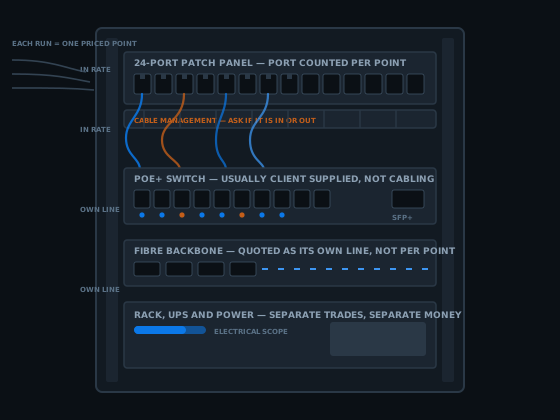
You cannot compare two cabling quotes on the total. Two prices for the same twelve outlets can differ by a third and both be honest, because one tested the links and named the cable and the other did neither. The number at the bottom is an output.
This page is pricing mechanics, not a price list. Nobody can tell you what your job costs from a web page without seeing your ceiling. What it will tell you is how a data points installation cost is built up, which decisions move it, and which five omissions make a cheap quote cheap.
The shorter version is how much professional network cabling costs; the work itself is on the network cabling Brisbane homepage.
What sits inside a data points installation cost
A "point" sounds like a wall plate. It is a whole permanent link, and every part of that link has to be inside the price or the price is wrong.
The cable run
Copper from rack to outlet, supported and separated the whole way. Length matters less than what the cable has to travel through.
Two terminations
A keystone at the outlet, a punch-down at the panel. The two places a rushed install shows up on a test sheet.
Plate, port and label
Wall plate or floor box, a panel port, matching identifiers at both ends. Small money that someone still has to allow for.
The certification test
Every link tested against its category. A certifier is a five figure instrument needing annual calibration, and that sits inside the rate.
Making good
Patching the access hole, clipping the ceiling back, taking offcuts away. Cheap to include, dear to argue about.
The paperwork
Test results and the compliance statement. Not a favour and not an upsell — a legal obligation on whoever did the work.
Six components, one of them cable. That is why a data points installation cost barely moves when copper prices move, and moves a lot when the building fights back. The case for all six rather than a cable to the nearest spot that works is in the benefits of structured cabling.
Two ways this trade prices work
Per point or hourly — and when each one is the honest answer
Almost every data points installation cost in Brisbane is written one of two ways. Neither is a trick. They suit different jobs, and the wrong one for your job tells you how well the scope was understood.
Priced per point
One rate times the outlet count, covering cable, both terminations, plate, panel port, test and label. The cabler carries the risk of a slow day and you get a number you can hold someone to.
Priced hourly
Time plus materials. Right for fault finding, one-off additions, and anything that cannot be scoped until someone is in the roof. Published Brisbane rates for comparable work sit around $185 per hour for standard hours, after-hours at a premium.
Rule of thumb: if you can count the outlets and point at where they go, insist on per point. If you cannot describe the problem in a sentence, expect hourly. A fixed data points installation cost for an unscoped job is optimistic, and an hourly rate for twenty outlets in an empty fitout has moved the risk to your side of the table.
Hybrid quotes are normal. Twenty points at a per point rate, four hours to relocate the existing rack, plus a materials line for the cabinet. That is not padding. It is someone separating what they can price with confidence from what they cannot. Ask for that split if you do not get it.
Why access drives the data points installation cost more than anything else
One thing to take from this page: the building sets the price, not the cable. The same outlet, specified identically, is a fifteen minute job or a two hour job depending on what sits between the rack and the plate. A cabler prices the pathway in their head while you are talking about the outlet.

The easy end
Post-war Brisbane home, tiled roof, walkable cavity, stud walls. The only opening is the one the plate covers.
The dear end
Two storey rendered block with a slab between floors, or a unit with a concrete ceiling. Now it is surface duct, a core hole, or a route three times as long.
The occupied-site premium
Working around staff, after hours, old links left live until the new ones test clean. The right way to run a cutover, and slower by design.
The distance cliff
Ninety metres fixed plus ten of patch leads is the whole channel. Past 100 m you do not buy more cable — you buy a second comms room and a fibre run.
That cliff is the most under-appreciated driver of a data points installation cost on big sites, and it is why a warehouse with an office at the front and a mezzanine at the back quotes differently to a floor plate of the same area. Where the gear lands matters, which is comms room and rack installation.
Power separation is the other quiet cost. Data cannot be strapped to the nearest electrical run for convenience, and the required minimum separation distances between power and data cables sometimes force a longer route. That is a compliance requirement, not a preference, so it belongs in the data points installation cost rather than in a variation.
How the data points installation cost per outlet falls with volume
Four outlets do not cost four times one outlet, because a large slab of every job is fixed effort. Ladders, ceiling access, finding a route, setting up the rack end, calibrating the tester — all of it happens once. One point carries the lot. Forty points each carry a fortieth.
| Job size | What dominates | Effect on the per point rate |
|---|---|---|
| 1 point | Travel, setup, access | Highest — setup is most of the job |
| 2–4 points | Setup, still | Falls sharply after the first |
| 5–12 points | Cable pulling | Settles into a working rate |
| 13–40 points | Pulling and terminating | Lowest practical rate per point |
| 40+ points | Pathways, comms rooms, staging | Flat, but new lines appear |
Two consequences. Having one point installed, spend ten minutes on what you will want in three years, because adding it now beats a second visit. And past roughly forty points the data points installation cost stops falling and grows sideways — extra pathways, another rack, staged cutover.
The corollary nobody likes: one data point in an awkward spot can genuinely cost more than three in easy ones. If a single-outlet data points installation cost looks disproportionate, ask what a second and third would add. The answer is usually a fraction of the first.
The anatomy of a quote you can actually compare
These lines belong on the page in writing. A total and a sentence is not a quote, it is an invitation to a variation. Hold every data points installation cost you get against this list.
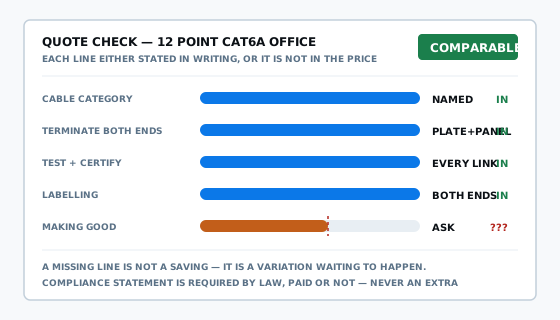
Cable named by category
"Cat6A U/FTP" tells you something. "Data cable" lets the cheapest drum on the shelf turn up.
Point count and locations
How many outlets and roughly where. Vague counts are how a job grows "extra points" at a rate you never agreed to.
Testing stated explicitly
Not "tested" in passing. Certified against the category, results supplied. A real cost, and honest quotes show it.
Making good
Who patches the access hole and who paints it. The most common argument on residential jobs, and entirely avoidable.
A registration number
An actual number you can check. Registration is issued to individuals, not companies — a business name is not an answer.
Exclusions, written down
Switch not supplied, electrical by others, asbestos not handled. Naming exclusions is competence.
The compliance statement is the one line that should never sit outside a data points installation cost as an extra. It must be given to the customer after the work regardless of whether payment has been made — section 25 of the Telecommunications (Cabling Provider) Rules 2025. Charging for it is like charging for a receipt.
Where a cheap data points installation cost gets cheap
A cheap data points installation cost is rarely cheaper labour. It is the same labour with things removed, and the things removed are always invisible. Here is the order they go in.
1. No certification testing
The biggest saving available and the one you cannot see. A link light proves a cable is connected, not that it meets the standard. Marginal links run fine for two years, then start dropping.
2. Unspecified cable
Copper-clad aluminium and out-of-spec drums exist and are much cheaper. They terminate fine, light up fine, and fail a certifier. If the category is not named, nothing stops them.
3. No labelling
An hour on a twenty point job; days over the building's life. An unlabelled panel means every future fault starts with someone toning out ports at an hourly rate you pay.
4. No making good
The cable works and there is a hole in your ceiling. Technically finished. This is the omission that turns a good price into a bad week.
5. No compliance statement
Usually because there is no registration behind the work — where a cheap price stops being a bargain and becomes your insurer's problem.
6. Shortcut pathways
Cable draped over ceiling tiles, tied to a sprinkler pipe, run hard against power. Fast on the day, non-compliant, expensive to unpick.
None of that means the dearest quote is right. It means the comparison has to be like for like. Once the same inclusions sit on both pages, a gap between one data points installation cost and another is usually efficiency and overheads — and picking the cheaper one then is perfectly sensible.
What the cable choice does to the number
People expect this decision to dominate the price. It does not. Cat6 to Cat6A is a material change on a job where labour is most of the cost.
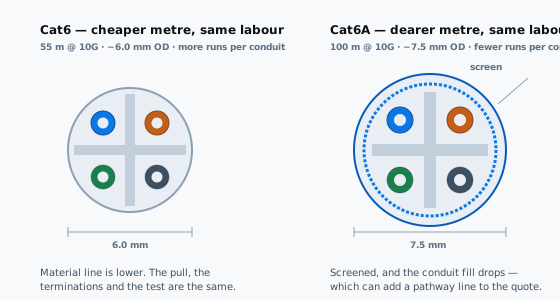
| Cat6 | Cat6A | |
|---|---|---|
| 1 Gbps | 100 m | 100 m |
| 10 Gbps | ~55 m | 100 m |
| Outside diameter | ~6.0 mm | ~7.5 mm |
| Labour to install | Same | Same |
| Conduit fill | More runs fit | Fewer — may force a new pathway |
| Where it pays off | Short residential runs | Commercial, PoE, long life |
The honest position: in a three bedroom house with a longest run of thirty metres, Cat6 is not a compromise, and upgrading barely shifts the data points installation cost. On a commercial floor with PoE cameras and access points, Cat6A is the cable — the cable in the wall is the one component you cannot change later without redoing the job.
Where Cat6A does move money is pathways. At roughly 7.5 mm against 6.0 mm, fewer runs fit an existing conduit, so a refit can pick up a pathway line that has nothing to do with the cable price. That is what a site look catches and a phone estimate does not.
Lines that sit outside the per point rate
Plenty of legitimate work sits beside a cabling job without belonging inside the per point figure. Folded in silently, it makes two quotes impossible to compare — different scopes wearing the same data points installation cost label.
The rack or cabinet
Cabinet, brackets, fan and power outlet are materials plus install time. Different sites need different sizes, so one rate cannot cover it.
Active equipment and fibre
Switches, access points and UPS are usually client supplied. A fibre backbone has its own materials and test regime — never a per point item.
Core holes and fire stopping
Penetrating a fire-rated wall or slab brings sealing requirements and sometimes another trade. Real money, and it should be visible.
Electrical work
New outlets at the rack, or anything on the mains side. Queensland requires no electrical licence for telecommunications cabling, but the reverse is not true.
The last one catches people out. The Electrical Safety Act 2002 (Qld) says at section 55(3) that an electrical work licence is not required for installing or repairing telecommunications cabling. So "we're electricians, we'll do the data too" is not a qualification — the cabling registration is, and it is a real input to any data points installation cost. See what a registered cabler in Brisbane actually is.
Homes versus commercial sites — same outlet, different number
A data point in a house and one in an office are the same six components and price differently. Not because businesses get charged more, but because the two environments load different parts of the job.
What loads a residential job
Small point counts, so setup dominates. Confined roof spaces, insulation, a Brisbane summer ceiling unsafe past mid-morning — and two or three outlets carrying all of it.
What loads a commercial job
Pathways, tray, fire stopping, work at height, inductions, after-hours access, staged cutover. The per point rate is lower and the surrounding lines are longer.
Two Brisbane specifics. Older timber homes on stumps often have a subfloor that beats the roof as a pathway, which pulls a residential data points installation cost down against a slab-on-ground house of the same size. And CBD tenancies carry building management requirements — induction, contractor lists, after-hours riser access — that add hours before a cable moves.
Neither is a reason to be suspicious — they are reasons to check which conditions the quote assumed. A commercial data points installation cost priced for daytime access, on a site that only allows after-hours work, is a variation waiting to happen.
Comparing a data points installation cost across three quotes
This takes twenty minutes and beats ringing around for numbers, because it forces every quote onto the same page before you look at a total.
Fix the scope yourself
Outlet count and locations, the cable category you want, testing and making good required. Send the same document to everyone.
Ask for the split
Per point rate, quantity, and every other line separately. A data points installation cost with no breakdown cannot be compared with anything.
Check the registration
Ask for the number and the class. Open covers work terminating at a patch panel or MDF; restricted specifically does not.
Normalise inclusions
Add missing items back onto the cheap quote at the dear quote's rates. That is the real comparison, and it often flips the ranking.
Ask what would change it
"What would make this go up on the day?" A good answer names risks. A shrug means the number is soft.
Then read the totals
Only now. With like-for-like scope, the cheapest data points installation cost of the three is usually a fine choice.
Check a registration claim yourself — the ACMA explains cabler registration at acma.gov.au, and AS/CA S009:2020, the mandatory installation standard, is a free download from the Australian Telecommunications Alliance. Ten minutes with both makes you a better buyer of a data points installation cost than any price list would.
Work here is carried out by an ACMA registered cabler, registration no. 42489, open class. Every data points installation cost I quote names the cable, includes testing and includes the compliance statement. Leaving any of them out only moves money from the quote to the argument.
Data points installation cost questions I get asked
Why will nobody quote a data points installation cost over the phone?
Because the cable is the cheap part and the pathway is not. Until someone knows whether there is a roof cavity above the outlet, whether the wall is masonry or stud, and how far the run is from the rack, any number is a guess that will grow. Photos of the ceiling access usually get you a real figure without a site visit.
Is per point or hourly better value for a Brisbane office fitout?
For a defined set of outlets, per point is better for you, because the risk of a slow day sits with the cabler instead of your budget. Hourly suits fault finding and anything nobody can scope in advance. An hourly quote for a job with a fixed outlet count usually means the scope was never pinned down properly.
Why does the data points installation cost per outlet drop on bigger jobs?
Setup is shared. Ladders, ceiling access, finding a route, terminating the patch panel and calibrating the tester happen once whether there are four outlets or forty. Spread across forty, that fixed effort is small per point. Spread across four, it is most of the job, which is exactly why small jobs feel dear.
Should a data points installation cost include testing and certification?
Yes, and on a proper quote it is written down. Testing every permanent link against the standard is what turns a cable into a certified link, and the written compliance statement is required under section 25 of the Cabling Provider Rules regardless of whether you have paid. If a quote never mentions testing, assume it is not happening.
How much does choosing Cat6A over Cat6 change a Brisbane cabling quote?
It moves the material line only. The labour to pull, terminate and test either cable is identical, so on a short residential job the difference across the whole quote is minor. Where it bites is pathways: Cat6A is about 7.5 mm against 6.0 mm, so fewer runs fit an existing conduit and a new pathway may be needed.
What hourly rate do Brisbane cablers charge for data fault finding?
Published Brisbane rates for comparable cabling work sit around the 185 dollars per hour mark for standard hours, with after hours and weekend work carrying a premium on top. Fault finding is almost always hourly, because nobody can fix a price to find something they have not seen. Ask for a certifier test in the first hour.
Where does a cheap Brisbane data cabling quote actually get cheap?
Five places, in the order it usually happens: no testing, unnamed cable described only as data cable, no labelling, no making good, and no compliance statement. None of those show on the day the job finishes. All of them show the first time something breaks, or the first time a landlord or insurer asks for paperwork.
Does a data points installation cost cover moving the NBN box or building the rack?
Usually not, and that is fair enough. Relocating a network termination device, building a comms rack or supplying a switch are separate scopes with their own materials and risk, so they belong on their own lines. A quote that folds them silently into a per point rate is hiding something you should be able to compare.
Get a data points installation cost you can compare
Tell me the building, roughly how many outlets, and what is above the ceiling. You get a written breakdown — per point rate, quantity, cable named, testing included, everything else on its own line.
Or just call 07 3521 8082. If it goes to voicemail I am up a ceiling somewhere; leave a message and I will call back.
ACMA registered cabler no. 42489 All work to AS/CA S009:2020