Brisbane & South East Queensland
Data cabling services, listed properly — what each one is and when you need it
Everyone who searches for data cabling services in Brisbane gets the same vague page: a logo, a slogan, a phone number. This one lists the actual trade — structured cabling, data points, comms rooms, fibre, testing, Wi-Fi, phone and TV cabling, NBN-side work and fault finding — with what each piece does and where it stops.
ACMA registered cabler no. 42489 Installed to AS/CA S009:2020 Compliance statement every job
"Data cabling services" gets used for everything from a single Wi-Fi cable drop to a forty-point office fitout, and that vagueness is what makes quotes hard to compare. This page breaks the trade into the pieces it is actually built from, so you know which data cabling services a job needs before ringing around for prices.
Every category below is one a registered cabler can lawfully perform under the Cabling Provider Rules, and most jobs mix two or three of them rather than needing just one. Search "network cabling service" instead and you land on the same trade — the terms get used interchangeably online, and this list answers both.
The full list of data cabling services
Six specialised categories are defined in the cabling rules — aerial, broadband, coaxial, optical fibre, structured and underground — but that legal list is not how anyone actually orders the work. In practice, data cabling services in Brisbane break down into six jobs on site, and a single fitout might touch every one of them in the same visit.
Structured cabling and data points
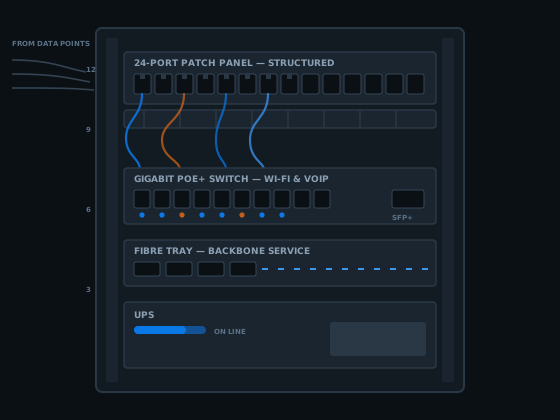
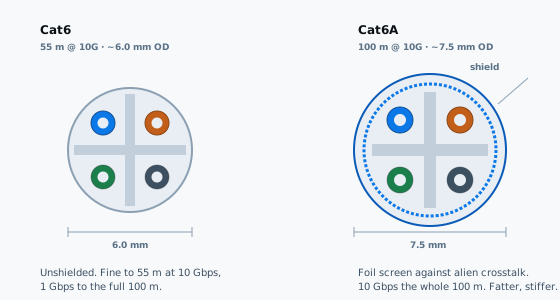
The base layer: a star network of Cat6 or Cat6A run from a central point to every outlet, with nothing daisy-chained — structured cabling, in the trade's own word for it. Data point installation is the pointy end of it: a wall plate, a floor box or a ceiling point for wireless gear, landed and labelled to match the panel it came from. Most data cabling services quotes start here, because everything else plugs into it.
Comms rooms and rack builds
Patch panels, switches, cable management and an earth, built into a comms room or rack that is not a cupboard full of cleaning supplies. A rack labelled properly turns a fault find into a ten minute job instead of an afternoon. This is where most data cabling services actually terminate, and where a badly finished job costs the most to fix later.
Fibre optic backbone cabling
Copper stops working past 100 metres. Fibre optic cabling does not, which is why backbone runs between comms rooms or between floors are fibre almost without exception on anything bigger than a house. Fusion splicing and a proper loss budget separate a link that still works in ten years from one that limps along from day one.
Testing and certification
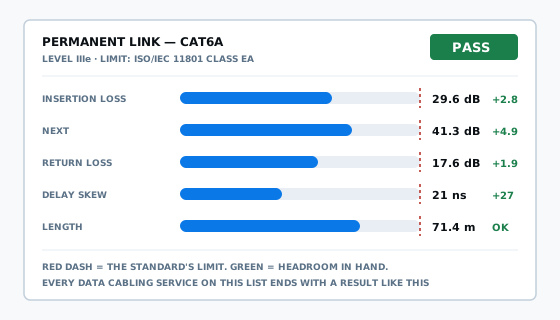
A link light is not proof of anything. Every permanent link gets tested and certified against the standard it was built to — insertion loss, crosstalk, return loss, length — and the results get handed over with the written compliance statement the rules require. Skip this step and you have cable pulling, not a finished data cabling service.
Wi-Fi access points, phone and TV cabling
Powered ceiling runs for Wi-Fi access points, legacy phone extensions for fax lines and lift phones, and coax for TV points and multi-room distribution — three different jobs that often get pulled in the same rough-in pass as the data cabling. Each has its own termination and its own standard, even sharing a wall cavity with everything else.
Fault finding and repairs
Ports that negotiate at 100 megabit instead of a gigabit, a run someone nicked during a fitout, a socket gone dead since a renovation. Usually a termination has failed or a cable was damaged; occasionally it is something stranger. Fault finding ends with the same test results and paperwork a new install gets.

The boundary that decides who you call
Where NBN-side private cabling fits the list
NBN Co's responsibility stops at the network termination device — the box fitted to a wall inside the house. Everything from there into the building is customer cabling, and customer cabling is exactly what the Telecommunications (Cabling Provider) Rules 2025 govern. That single boundary decides who you call.
NBN Co and its contractors handle the connection up to and including the NTD. A registered cabler handles everything on the customer's side of it: running a new data point off the NTD, extending Wi-Fi coverage, moving where a socket lands, or chasing a fault that turns out to be internal wiring rather than the network itself. Private cablers cannot lawfully touch the NTD or the street-side equipment, and an NBN Co technician is not who runs your internal data cabling services — the two jobs sit either side of one small box.
This split catches people out during renovations more than anywhere else: a builder assumes NBN Co will sort the internal wiring, or a homeowner assumes a registered cabler can shift the NTD itself. Neither is right, and knowing the boundary before the tradespeople turn up saves a wasted callout. The NBN-side cabling page goes through the technologies — FTTP, FTTN, HFC, FTTC — and what changes for each one.
Commercial and home data cabling services
The list above does not change between a house and an office tower — what changes is the scale and the sequencing. Commercial data cabling is usually staged around other trades and other tenants: cable gets pulled in stages, cutover happens outside trading hours, and the old links stay live until the new ones are tested and proven. A fitout might run every service on this list in a single job — structured cabling, a comms room build, fibre between floors, testing on every link, and Wi-Fi access points before the desks even arrive.
Home network cabling is the same trade at a smaller scale. Most houses need two or three data points, an access point run for Wi-Fi, and occasionally a TV or phone point moved — rarely a comms room, rarely fibre, but the same testing and the same compliance statement at the end regardless of size. The data cabling services a two-bedroom unit needs and the data cabling services a forty-desk office needs are drawn from the identical list; only the count changes.
Small offices sit in the middle. A five-person studio might need a small rack instead of a full comms room, PoE for a couple of cameras, and enough spare data points to grow into next year without reopening a wall. Scoping that correctly before the quote is worth more than comparing two numbers on a page.
Who may lawfully provide data cabling services in Brisbane
Not everyone who turns up with a cable puller is entitled to provide data cabling services. Fixed cabling that connects to a telecommunications network must be installed by a registered cabling provider, or by someone directly supervised at all times by one who takes full responsibility for the work — section 21 of the Telecommunications (Cabling Provider) Rules 2025, which commenced 31 March 2025. It applies to a two-point house job the same as it applies to a forty-desk fitout.
Registration is issued to a named individual, never to a company, and it comes in three classes: open, restricted and lift. Restricted specifically does not authorise work terminating at a main distribution frame or a patch panel — which rules it out for most commercial structured cabling and comms room work. On top of the class sit the six specialised categories: aerial, broadband, coaxial, optical fibre, structured and underground. Holding one needs both the completed training units and notification to the registrar; an open registration covers all six automatically, restricted covers only aerial, broadband and underground.
Queensland adds nothing on top of this. Section 55(3) of the Electrical Safety Act 2002 (Qld) says an electrical work licence is not required to install or repair telecommunications cabling, so "fully licensed electrician" says nothing about whether someone may lawfully run your data cabling services. The registration and the class are what to ask for, and every job on this page finishes with the written compliance statement section 25 requires — supplied whether or not the invoice has been paid yet.
Full detail on the classes, the endorsements and how to verify one before you hire sits on the registered cabler page.
What data cabling services cost
Nobody in this trade publishes a rate card, which is exactly why data cabling services are hard to compare on paper. Two structures cover almost every quote: priced per point for new installation work, where cable, termination, testing and a wall plate are bundled into one number per outlet, and priced hourly for fault finding, small additions and callouts.
Published Brisbane rates for comparable work sit around $185 per hour for standard hours, with after-hours and emergency callouts carrying a premium — that is the benchmark to measure an hourly quote against, not a fixed number every job hits. Per-point pricing falls as the count rises, because the setup and access cost gets shared across more outlets rather than repeated on every one.
What moves the number most is access, not cable category. A data point going into a room with a roof cavity above it is a different job to the same point in a two storey rendered wall with no cavity access at all — and a quote that does not ask about access before naming a number is guessing. The full breakdown, including what separates a cheap quote from a complete one, is on the data cabling cost page.
Choosing the right data cabling services for the job
What actually separates two quotes for the same job is not the label on the invoice. It is whether the person quoting has named the class of cabler doing the work, whether testing is included rather than an optional extra, and whether the compliance statement is part of the price rather than something you have to chase afterwards.
A job that mixes several services — say, structured cabling plus a fibre backbone plus a rack build — is worth putting to one data cabling installer rather than three separate trades, because the handover between services is where mistakes creep in: a comms room built before the fibre run was scoped, or data points landed before the rack position was fixed. One provider carrying the whole list also means one compliance statement instead of three.
Smaller jobs do not need that coordination. A single fault, one extra data point, or a Wi-Fi access point added to an existing network is a straightforward callout, and there is no reason to over-engineer the choice. The standard behind all of it — AS/CA S009:2020, the Wiring Rules — does not change whether the job is one point or fifty, which is worth remembering when a quote seems to skip steps a bigger job would never skip.
Data cabling services questions people actually ask
What's included in the full list of data cabling services for a Brisbane job?
Structured cabling and data point installation, comms room and rack builds, fibre optic backbone runs, testing and certification, Wi-Fi access point cabling, telephone and TV or coax cabling, NBN-side private cabling, and fault finding. Most jobs use two or three of these together rather than one in isolation, and every one of them ends with a tested link and a written compliance statement.
Do data cabling services include NBN-side wiring, or is that a separate job?
It is part of the list, with a boundary. NBN Co's responsibility stops at the network termination device fitted to the wall. Everything past that — a new data point off it, extended Wi-Fi coverage, or a fault inside the house — is customer cabling, and that is exactly what a registered cabler's data cabling services cover.
Is testing and certification a separate charge or part of every data cabling services quote?
It should be named in the quote either way, not buried. A properly written data cabling services quote states whether testing is included, because a link that carries a signal on the day is not the same as one certified against the standard. If a quote does not mention testing at all, ask before assuming it is covered.
Can one provider deliver every data cabling service on this list, or do I need several trades?
An open class registered cabler can lawfully perform structured cabling, data points, comms rooms, fibre, testing, Wi-Fi cabling and fault finding under one registration, and telephone and TV or coax work is usually the same trade too. The exception is anything on the NBN Co side of the network termination device, which no private cabler is permitted to touch.
Which data cabling services need a specialised category under the six-category system?
Optical fibre and structured cabling are two of the six specialised categories in the cabling rules, alongside aerial, broadband, coaxial and underground. A cabler needs both the completed training units and notification to the registrar for each one they hold. An open registration covers all six by default; a restricted one covers only aerial, broadband and underground.
Is Wi-Fi access point cabling its own service or part of structured cabling?
It sits inside structured cabling in practice — a ceiling point cabled back to the comms room like any other outlet — but it gets planned separately because access point placement depends on coverage, not desk layout. Most quotes list it as its own line so the count and the position get agreed before the ceiling closes up.
What's the difference between data cabling services and general IT support?
Data cabling services install and certify the fixed physical layer — cable, outlets, patch panels, the rack — under the Cabling Provider Rules, and that work has to be done by a registered cabler. IT support configures the equipment plugged into that cabling, such as switches, servers and Wi-Fi controllers. One is a regulated trade; the other usually is not.
Which data cabling service should a home office in Brisbane start with?
Two data points at the desk and one ceiling run for a Wi-Fi access point covers most home offices, run back to a small patch panel or even a single outlet if the setup stays modest. Testing still applies at that scale — a certified two-point job costs little extra and proves the cable was actually done properly.
Is fault finding classed as a data cabling service or a separate call-out fee?
It is one of the data cabling services on this list, priced hourly rather than per point because the cause is not known until someone is on site. If the fix involves re-terminating a link, that re-termination triggers the same compliance statement obligation as a brand new install — fault finding is not exempt from the paperwork.
Get a quote for any data cabling service on this list
Tell me what the building is and which of the services above the job needs — even a rough guess is enough to start. If it is a fault rather than a new install, say what it is doing; that usually narrows things down before anyone turns up.
Or just call 07 3521 8082. If it goes to voicemail I am up a ceiling somewhere; leave a message and I will call back.
ACMA registered cabler no. 42489 All work to AS/CA S009:2020