Brisbane & South East Queensland — AS/CA S009:2020
Minimum separation distances between power and data cables Australia — the numbers, and why they exist
The minimum separation distances between power and data cables Australia sets are not one number. Cable running beside cable pulls a different figure to cable at a termination, low voltage pulls a different figure again to high voltage, and a barrier changes some of them and none of the others. This page has the actual clause numbers behind the 50 mm and 150 mm figures our other guides mention in passing.
ACMA registered cabler no. 42489 Sourced from AS/CA S009:2020 Figures checked clause by clause
Two of our own guides already touch this. The data point installation guide gives the 50 mm and 150 mm figures for a single outlet, and the comms rack installation guide adds the earthing angle. Neither had room to go past low voltage power. This page goes further into the minimum separation distances between power and data cables Australia sets for high voltage circuits, cable sharing a duct, and a run that has to cross power rather than sit beside it — and it feeds directly into what a cabling job costs, because a route planned around these figures the first time is cheaper than one redone after an inspection fails it.
The minimum separation distances between power and data cables Australia jobs need, in one table
Every figure here comes from AS/CA S009:2020, the Wiring Rules that section 23 of the Telecommunications (Cabling Provider) Rules 2025 makes mandatory for anyone terminating customer cabling. The short version: 50 mm clear of low voltage power along a general run, 150 mm at terminations, and considerably more once high voltage cable is involved. A barrier changes some of the numbers and does nothing at all for others — which is the part that catches people out. The free copy of AS/CA S009:2020 from the Australian Telecommunications Alliance has the full text if you want to check any of these figures against the source rather than take our word for it.
| Situation | Distance | Barrier option |
|---|---|---|
| Data cable running beside LV power | 50 mm | Barrier, or a stud/joist between them |
| Data cable terminations near LV power terminations | 150 mm | Permanent, rigidly-fixed barrier |
| Data cable beside multi-core HV cable | 300 mm | 150 mm with a compliant barrier |
| Data cable beside single-core HV cable | 450 mm | No barrier reduces this figure |
| Data cable and HV terminations, separate enclosures | 450 mm | Physical barrier required regardless |
Why the distances exist — induction, not just safety
AS/CA S009:2020's Appendix H splits the risk into two kinds. Earth potential rise and low frequency induction are the hazardous ones — they only appear under an HV fault condition, but a fault can push a dangerous voltage into cabling and equipment for the roughly two seconds it takes a breaker to trip. The second kind is non-hazardous and is running all the time: low-level 50 Hz AC voltage, higher frequency currents, and capacitive coupling between a power conductor and a data conductor running close to it. That is the induction risk the minimum separation distances between power and data cables Australia figures are built to manage.
That second kind is the one a cabling job actually feels day to day. The standard says outright that it can cause unwanted signal-swamping noise in a data service, on top of audible noise on a voice line. Effective separation and continuous, earthed cable screening both reduce it — the same physical principle behind a Cat6A cable's foil screen, even though that screen is there primarily to stop crosstalk from an adjacent data cable, not induction from mains power. Keep the minimum separation distances between power and data cables Australia sets, and most of that induction risk never becomes a fault-finding job.
Running parallel to LV power — the 50 mm rule
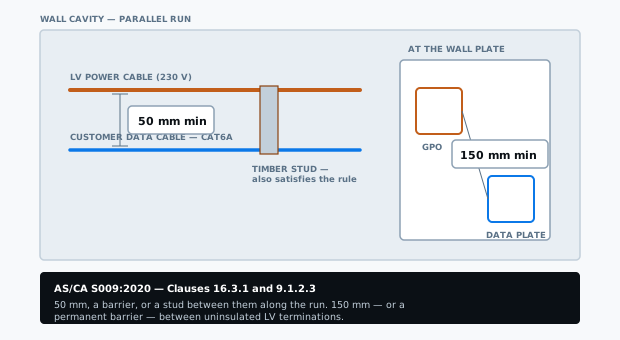
For an ordinary run alongside general power wiring, Clause 16.3.1 gives three ways to comply, and only one has to apply: a minimum 50 mm gap the whole way, a barrier of durable insulating material or metal, or — the one people forget — a timber or metal stud, nogging, joist, bearer or rafter of any thickness between the two cables. A stud already inside the wall satisfies it for free, and it is the baseline the minimum separation distances between power and data cables Australia rules start from before anything else changes it.
There is one hard stop regardless of any barrier: a data cable can't share a drilled hole with an LV power cable if that hole sits within 50 mm of a stud, joist, nogging, plate or batten's securing face, because a screw or nail driven later could hit both. Our data point installation guide covers the outlet-level version of this for a single point; the framing rule reads the same whether it is one outlet or eighty. It is the one part of the minimum separation distances between power and data cables Australia rules a barrier cannot get you out of.
At the wall plate and switchboard — why terminations need more
Terminations pull a bigger number because exposed conductors are what a hand or a tool actually touches. Clause 9.1.2.3 sets 150 mm between a data cable's terminations and any uninsulated or single-insulated LV power terminations, unless a permanent, rigidly-fixed barrier of durable insulating material or earthed metal sits between them. It is why a data plate lands on its own mounting block beside a power point rather than sharing its wall box — the two termination points need that clearance or that barrier, not a shared cavity. That 150 mm figure is the strictest of the minimum separation distances between power and data cables Australia sets for ordinary LV power.
There is a narrow exception for building control or monitoring panels wired by someone qualified on both LV power and customer cabling, with the two circuits kept on separate cables. Outside that specific case, the 150 mm figure — or the barrier — is what a compliant termination looks like, and it is one of the details a data cabling cost quote should already have allowed for, because the minimum separation distances between power and data cables Australia rules don't bend for a tight cavity.
Minimum separation distances between power and data cables Australia sets near high voltage
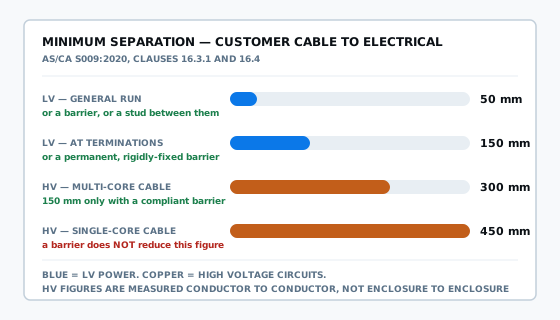
High voltage changes the numbers by a full order of magnitude, and it applies whether the data cable runs alongside the HV cable or crosses it — Clause 16.4 makes no distinction between the two. A multi-core HV cable needs 300 mm clear, reducible to 150 mm only where an interposing barrier gives at least 175 mm of clearance measured around it. A single-core HV cable needs 450 mm, and unlike every other figure on this page, no barrier reduces it. Nothing else in the minimum separation distances between power and data cables Australia table moves that far from the LV figures.
At terminations the rule tightens further: a data cable's conductors can never share an enclosure or building cavity with HV conductors at all, and where each sits in its own enclosure, 450 mm has to separate the two sets of terminations regardless of any barrier. Our comms rack installation guide covers the earthing side of a comms room; this is the separation side of the same room, and most Brisbane fitouts never see it because HV rarely reaches past the switchboard — it's the part of the minimum separation distances between power and data cables Australia rules most homes and small offices never encounter.
Conduit and trays change the minimum separation distances between power and data cables Australia sets
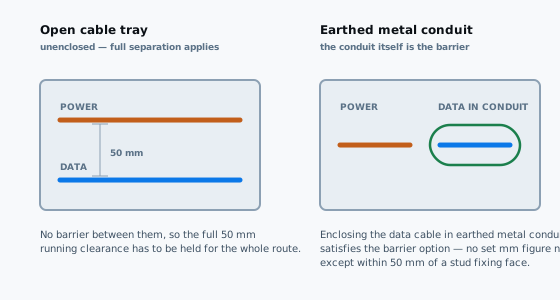
Enclosing either cable in conduit satisfies the barrier option outright — the note under Clause 16.3.1 says so directly. What doesn't count is worth knowing too: neither the metallic shield of a screened cable nor the sheath of a double-insulated cable qualifies as a barrier on its own. The conduit or duct wall has to be the thing doing the separating, not the cable's own construction. Meeting the minimum separation distances between power and data cables Australia figures with containment instead of open air is often the tidier fix on an existing building.
Sharing a duct, skirting trunking or floor duct with LV power is allowed, but the data cable needs its own channel or compartment, split off by a fixed, continuous barrier of the same durable insulating material or metal the general rule calls for. Breaks are permitted where modular office furniture abuts a service column, provided cables don't cross between channels and stay fixed at direction changes — a common Brisbane fitout scenario, with partition walls sharing a power-and-data skirting duct the length of a floor, and the same minimum separation distances between power and data cables Australia principle applying inside that single duct.
Crossing power cable instead of running beside it
Indoors, S009 doesn't hand out relief just because a run crosses rather than parallels — the same 50 mm, barrier or stud rule for LV, and the same 300 mm and 450 mm figures for HV, apply either way. The one documented exception is undercarpet cabling: where the usual 50 mm can't be held at a crossing, the data cable has to cross above the power cable at a right angle, behind a rigid earthed metal barrier that reaches at least 25 mm past both cable sheaths. Crossing does not relax the minimum separation distances between power and data cables Australia rules the way people expect it to.
Underground work runs on a separate table entirely — a trench crossing above LV power needs 100 mm to 300 mm depending on how the power cable is protected, and crossing above HV needs 450 mm. That's outdoor reticulation, not the wall and ceiling cavities most Brisbane fitouts deal with, so it's flagged here as background rather than folded into the minimum separation distances between power and data cables Australia table above.
Fluorescent fittings, ballasts and other noise sources
AS/CA S009:2020 doesn't set out a distinct distance for fluorescent or other discharge lighting. A fluorescent fitting's wiring is still just LV power, so the same 50 mm running clearance and 150 mm termination clearance apply — there's no separate clause with a bigger number attached to a light fitting specifically, and we haven't been able to find one to cite here — so nobody should quote a millimetre figure for it as if it belonged in the minimum separation distances between power and data cables Australia table above.
What is true, and worth flagging honestly, is that ballasts and transformers are a well-known source of electrical noise in the wider cabling industry, and plenty of installers keep extra clearance near them as a habit rather than a rule. Treat that as sensible practice, not as something AS/CA S009:2020 mandates. If a job genuinely needs a guaranteed figure near switching or dimming gear, that's a question for a design engineer, not an assumption made on site. It sits outside the minimum separation distances between power and data cables Australia figures this page can actually verify.
Planning the cable route on a real fitout

On site, this is a five minute conversation during rough-in, not a measurement taken after the fact. Before cable goes in, walk the route: where does it cross the switchboard's feed, does it share a stud bay with a power circuit, and does any section run through a shared duct that needs a barrier fitted. Sorting that on paper, or standing in the roof space before the first cable is pulled, costs nothing. Sorting it after the ceiling is closed and gyprocked is a return visit — walking the route first is the cheapest way to satisfy the minimum separation distances between power and data cables Australia rules on the day.
It's also one of the reasons structured cabling done properly costs more upfront than an extension lead run by whoever's free that day — a designed route accounts for these clearances before the first cable is cut to length, rather than working around whatever's already in the wall. For the fuller picture of what moves a quote up or down, how much professional network cabling actually costs covers the rest of it — and it's usually the reason a quote respecting the minimum separation distances between power and data cables Australia rules costs more than one that doesn't.
Where minimum separation distances between power and data cables Australia rules get broken
The extension lead run
A data cable cable-tied to a mains extension lead because they happen to run the same way. No distance, no barrier, no stud — it fails the 50 mm rule the moment someone checks, and it's the most common defect we see on a retrofit.
The shared wall box
A data plate crammed into the same box as a power point because the hole was already there. Termination separation needs 150 mm or a barrier — a shared box gives neither.
The forgotten HV riser
Cable run past a rooftop plant room or a building's main switchboard without checking what's behind the wall. HV separation is 300 mm to 450 mm, and the minimum separation distances between power and data cables Australia rules don't relax for a quick pass-through.
None of these are exotic. They are the three ways an otherwise straightforward job quietly stops complying, and every one of them is avoidable at the planning stage covered above. Get any one of the minimum separation distances between power and data cables Australia figures wrong and it's the kind of defect an inspection catches immediately.
Minimum separation distances between power and data cables Australia — questions we get asked
What is the minimum separation distance between power and data cables in Australia along a parallel run?
Under Clause 16.3.1 of AS/CA S009:2020, 50 mm clear of any LV power cable the whole way, or a barrier of durable insulating material or metal, or simply a timber or metal stud, nogging, joist, bearer or rafter of any thickness between the two runs. Only one of the three has to apply — a stud already in the wall satisfies it without adding anything, and it is the first of the minimum separation distances between power and data cables Australia figures worth memorising.
How close can a data outlet be installed next to a power point in Australia?
Clause 9.1.2.3 sets 150 mm between a data cable's terminations and any uninsulated or single-insulated LV power terminations, unless a permanent, rigidly-fixed barrier of durable insulating material or earthed metal sits between them. It is why a data plate normally lands on its own mounting block beside a power point, not inside the same wall box.
Do the minimum separation distances between power and data cables Australia rules change near high voltage circuits?
Significantly. A multi-core HV cable needs 300 mm clear, reducible to 150 mm only with a barrier giving at least 175 mm of clearance around it. A single-core HV cable needs 450 mm, and no barrier reduces that figure. At terminations, 450 mm separates the two sets of enclosures and a data cable can never share an HV cavity.
Does running data cable inside metal conduit satisfy the separation rule?
Generally yes — the note under Clause 16.3.1 says enclosing either cable in conduit satisfies the barrier option. The exception is fixing holes: a data cable still can't share a drilled hole with LV power within 50 mm of a stud, joist or nogging's securing face, conduit or not, because a nail or screw could later strike both.
What happens where data cable has to cross a power cable instead of running alongside it?
Indoors, S009 gives no relief just for crossing rather than running parallel — the same LV and HV distances apply either way. The one documented exception is undercarpet cabling: where 50 mm can't be held at a crossing, the data cable must cross above the power cable at a right angle, behind an earthed rigid metal barrier extending at least 25 mm past both cable sheaths.
What separation is required between data cable and a fluorescent light fitting?
AS/CA S009:2020 doesn't set a distinct distance for fluorescent or other discharge lighting — the fitting's wiring is still just LV power, so the usual 50 mm and 150 mm figures apply. Ballasts and transformers are a recognised source of electrical noise in the wider industry, and many installers keep extra clearance near them as good practice, but that is not a figure this standard mandates.
Can a data cable and a power cable share the same duct or trunking?
Yes, provided the data cable sits in its own channel or compartment, divided off by a fixed, continuous barrier of durable insulating material or metal. Common floor ducts, skirting trunking and service columns are all covered by this rule, and breaks in the barrier are only permitted at specific furniture abutment points, which keeps the same minimum separation distances between power and data cables Australia principle intact even inside a single duct.
Do the minimum separation distances between power and data cables Australia figures apply underground too?
No — underground work runs on a separate table. A trench crossing above LV power needs 100 mm to 300 mm depending on how the power cable is protected, and crossing above HV needs 450 mm. That is outdoor reticulation, a different regime to the in-building figures this page focuses on.
Who is responsible for getting cable separation right on an Australian job site?
The registered cabling provider terminating the customer cabling. Compliance with AS/CA S009:2020 is mandatory under section 23 of the Telecommunications (Cabling Provider) Rules 2025, and the minimum separation distances between power and data cables Australia rules are assessed on the data cabling side of the job — the electrician isn't the one signing off on it.
Get a quote that gets separation right from the rough-in
Tell me what the fitout is, roughly how many points, and whether there's a switchboard or plant room the route has to work around. The minimum separation distances between power and data cables Australia rules need planning at rough-in, not discovering at the end — a couple of photos of the site usually tells me most of what I need.
Or just call 07 3521 8082. If it goes to voicemail I am mid-job somewhere; leave a message and I will call back.
ACMA registered cabler no. 42489 All work to AS/CA S009:2020